The Pirelli Cyber Tyre is like magic, and we tried it for ourselves
Pirelli’s sensor-equipped Cyber Tyre gives a car’s safety systems unprecedented insight into available grip. We try it

How do you improve the performance of a tyre without physically altering it? By fitting a sensor inside that can send information about the tyre’s temperature, pressure and wear to the car’s ABS and ESP systems to optimise their responses. Pirelli has been working on what it calls the Cyber Tyre for two decades, and recently, at its Vizzola test track on the outskirts of Milan, it arranged a series of tests to demonstrate how it can improve safety and performance.
Each battery-powered sensor is about the size of a stack of three 10p pieces and is embedded in a starfish-shaped base pad that sticks to the inside of the tyre. It weighs about 12 grams, has to withstand 3000 g, and can transmit data via Bluetooth for around five years. One sensor is placed in each tyre, and a receiver or anchor for each axle receives their raw data. This is then run through algorithms that turn it into useful data, and it’s here that the expertise of Bosch, Pirelli’s partner on the project, comes in.
> I put budget tyres to the test in the wet, and the results were terrifying
In current cars, the responses of safety systems such as anti-lock braking and stability control are impressive, but they’re a compromise, their responses set for an average of the tyres that can be fitted, from winter to summer to high performance. With Cyber Tyre, not only does the car know what tyre is fitted, it also knows its condition and current state. This means that when anti-lock or stability control is activated, they know much more accurately how much grip they have to work with, and once they start operating, they receive further feedback of much higher fidelity to optimise their interventions.
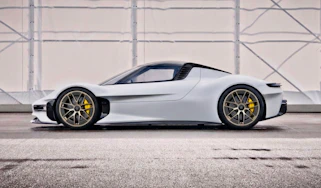
For Pagani, another of Pirelli’s partners and the first adopter of Cyber Tyre on its 852bhp, twin-turbo V12-engined Utopia, this gives the ability to torque-limit to the level of grip; for example, when the tyres are cold. A couple of laps of the wet handling circuit alongside Pagani test driver Matteo Bolondi showed how the Utopia can be kept on a short leash, and the staggering amount of traction and braking performance the car could find on its P Zero Corsas. However, even more impressive were the demonstrations on less exotic cars of the uplift in performance in wet braking and aquaplaning.
The benchmark for tyre performance is wet braking. It appears on every EU tyre label and is a key part of the evo tyre test, usually measured from 80kph (50mph) to zero. The Pirelli demonstration used a higher start speed of 110kph (68mph) and the test car was on winter tyres, but the difference with and without Cyber Tyre active was significant. With the system on, the car pulled up 5.7m sooner. This is because the real-time data from the tyre about its type, temperature, pressure and tread depth allowed the system to go straight to its level of grip and keep it there, rather than feeling its way in.
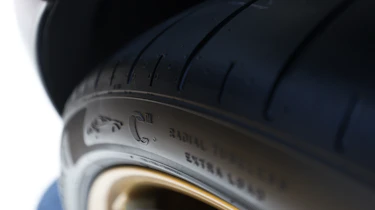
Equally impressive was the aquaplaning demonstration. Aquaplaning is when the tyre tread can no longer clear the water and the tyre loses contact with the road surface, meaning you can no longer brake or steer. The test speed was relatively low and the water about 7mm deep, and with the Cyber Tyre system off, the car carried on straight when you steered. However, with the system on, the car could steer. How so? Although the fronts were riding on water (the system knows from the deformation of the tread pattern), the rears had some contact through the fronts having partially cleared a path. The car then recognises the driver’s steering input and manipulates the rear brakes to help slow the car and also to steer it in the desired direction, as it does when stability control keeps a car on the steered line in normal conditions. It feels like a kind of magic.
Cyber Tyre is already being used by Pagani and has been picked up by a number of other car makers, including Aston Martin and McLaren. Pirelli has invested in its development but Bosch will be the agent for it, because for it to become popular and filter down to regular cars it needs to be fitted to any make of tyre, and integrated into the car’s systems, and this is Bosch’s expertise. If Cyber Tyre can successfully make the leap from hypercars to hatchbacks, it could prove to be one of the most significant safety advances since ABS.
This story was first featured in evo issue 349.