Buying a used supercar? Read this guide first
Thinking of buying a used supercar? Some have hidden histories. Our guide helps you identify any damage before it's too late.

Buying a supercar, especially one that appears to be a bargain, can be a dream come true – or a costly headache. Let’s face it, even the savviest buyers can be caught if their heart starts to rule their head.
Behind the polished paintwork and thoroughbred engine, it's easy for crash-damage, while others hide rolled-back odometers and other dark secrets that can quickly turn your dream purchase into a financial nightmare. Our guide will show you how to avoid accident damaged cars, identify red flags, and make sure your supercar is as perfect as it looks.
The used supercar "bargain": A high-risk gamble?
No matter if it’s a £7,000 Ford Focus or a six-figure supercar, the principles of buying used remain the same. Buyers expect honesty, a clear history (or at least being aware of the car’s past issues), and value for the money they pay. In short, no unpleasant surprises when the paperwork changes hands.
However, while the principles are the same, the risks aren’t. When buying a supercar, the price of getting it wrong can accelerate faster than the car itself.
Why supercars are a write-off minefield
Supercars aren’t written off simply because they’re fragile – the reasons go beyond just the damage itself. In fact, the value of supercars often makes repairing them viable, but some people aren’t prepared to pay what it costs to repair them properly.
For example, replacing a broken headlight on a damaged Ferrari can cost several thousand pounds (and that’s before labour). And what if the damage isn’t limited to the headlight… Ceramic brakes, for instance, can be damaged even in minor accidents. That alone can heavily contribute to a total-loss decision, since repairing them may cost more than buying a regular used car.
Moreover, the materials and technology supercars are built with often require specialist knowledge and experience. A crash-damaged McLaren or BMW i8 with a cracked carbon tub cannot be repaired at just any body shop – and when you add complex suspension systems, infotainment setups, or malfunctioning electronic controls into the mix, costs rise fast.
That’s how even cars that can be repaired end up being written off.
Risk 1: The "Clean history" trap and unrecorded damage
One of the biggest dangers in the used supercar market is the illusion of a “clean history.” A seller may claim that the vehicle is accident-free, but in reality, it could have been heavily damaged and repaired (poorly). Sellers (or previous owners) sometimes hide the car’s accident history to “preserve” the car’s value, and minor incidents may never be officially recorded.
Let’s see what numbers tell us. Among all major supercar brands checked on carVertical, the automotive data provider, every brand had accident records. Bentley leads the pack, with 16.55% of all checked cars showing recorded damage, while Lamborghini (16.42%), Maserati (16.36%), and Lotus (16.3%) are close behind. It means that roughly every 6th used supercar on the market may have been involved in an accident – and that figure only includes damage that was officially reported or for which data is available.
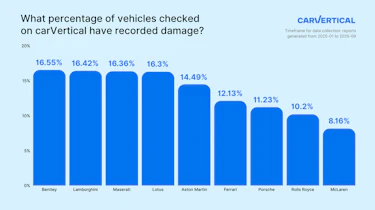
This creates a significant risk for buyers: a car that looks perfect may carry hidden structural damage, replaced parts, or compromised safety systems. A crash-damaged Lamborghini or Ferrari could be restored cosmetically to look flawless, yet underneath, the chassis, suspension, or carbon components may have been weakened.
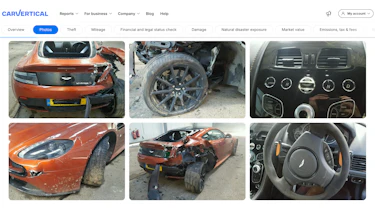
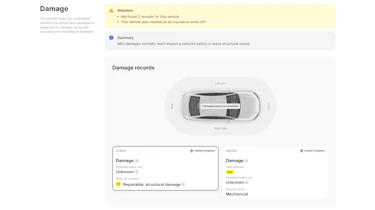
Without doing your due diligence, you might not even know about these issues before buying. And while owning an Aston Martin is a lifelong dream, you probably never imagined it could have looked like the one in this carVertical report (generated in September 2025):
The salvage auction-to-showroom pipeline
In the UK, many supercars end up at salvage auctions after being written off, often under Cat N or Cat S categories. Salvage car auctions from the US are also popular for imported vehicles. While Cat N and Cat S cars are technically repairable, scammers sometimes buy them at a fraction of their original value, perform cheap or purely cosmetic repairs, and then list them on the private market as if they were accident-free.
The motive is clear: profit. A crash-damaged Ferrari, Lamborghini, or McLaren that might sell for £200,000 in perfect condition can be sold for a significant gain with minimal investment. Meanwhile, the new buyer inherits hidden risks that aren’t obvious without thorough inspections.
Understanding Cat S/N and repaired write-offs
Insurers typically declare a car a write-off when damage exceeds its current market value. However, some damage can be safely fixed, and this is especially true in the supercar world, where repair costs can be sky-high even when the damage is minor.
Such written-off cars are categorized as Cat S/N write-offs (as opposed to Cat A and Cat B, which mean the end of the road for the vehicle):
- Cat S (Structural) – The car has sustained structural damage, but it can be repaired, although the process is complex. You can use the vehicle again if it’s restored to a roadworthy condition.
- Cat N (Non-Structural) – The car has suffered non-structural damage (e.g., limited to body panels, cosmetic parts, or minor components). Repairs are generally simpler, but the cost for supercars can still be significant.
For supercars, even Cat N repairs can cost tens of thousands, while Cat S work may require niche expertise to restore safety. Therefore, “minimal investment” and salvage supercar repairs don’t really go hand-in-hand – unless there’s a clever scammer at work.
Risk 2: "Invisible" scams (theft, outstanding finance, and clocking)
Not all risks are physical or detectable by a professional. You might have done your due diligence with regards to its physical condition, but your dream motor could hide serious legal or financial issues. This is where a thorough vehicle history check takes the lead in the “holy trinity” we’re about to discuss, alongside specialist inspections and test drives.
Mileage fraud (“clocking")
Clocking is still one of the most common scams in the used car market, and supercars are no exception. In fact, they are highly targeted by dishonest sellers, and here’s why.
Rolling back just 10,000 miles on a high-performance vehicle can easily add more than £20,000 to its resale value – all while concealing the real wear and tear of critical components like brakes, suspension, or engine.
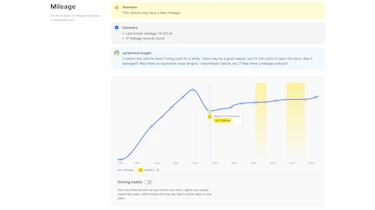
For buyers, this means that the car they’re interested in and consider a bargain may actually have endured far more stress and wear than its odometer suggests. Buying it can make your money vanish just as mysteriously as nearly 5,000 miles vanished from this 2004 Ferrari 456’s history (generated in October 2025):
Vehicle authenticity, theft, and outstanding finance
Some cars may currently be listed as stolen or recovered without the buyers knowing. In some cases, they can even be “cloned” (e.g., usually by faking or replacing VINs), meaning they were given the identity of another vehicle to disguise their past.
Needless to say, purchasing such a car, or in this case, a supercar, can lead to serious legal trouble, including seizure of the vehicle and loss of your money.
Another hidden pitfall is outstanding finance. If a car still has unpaid loans or leases attached to it, the finance company may have the right to repossess the vehicle, even after you’ve bought it. For high-value cars, this can turn a dream purchase into a costly nightmare, leaving the buyer both without the car and out of pocket.
Your pre-purchase protection plan
Buying a supercar – or any car you want to trust – comes down to three key steps: a thorough history check, a specialist inspection, and a performance verification (a.k.a. test drive).
Step 1: Go beyond a standard HPI check
Most buyers already run an HPI or basic vehicle-history check – and rightly so. HPI-style checks are excellent for catching UK-registered write-offs, outstanding finance, and some theft records, yet they can miss unrecorded damage or – very important – international history.
Because of those potential gaps, it’s always recommended to take an extra step and do a wider search. When your purchase involves supercars and all the risks that surround them, no precaution can ever be too much.
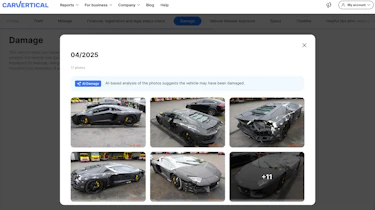
For example, pair your usual research with the carVertical report. This tool has access to more than 900 official databases worldwide (including the UK) that can help you uncover red flags both locally and from abroad (crucial if you’re importing). Moreover, AI-based functionalities, such as AI damage detection, can identify accidents from the car’s photos, even if there’s no official record.
To obtain a report, you can use the carVertical VIN decoder – it first gives you a free VIN check with the car’s key specs, you can then upgrade to a complete history report for deeper insights (including damages, mileage, theft records, financial restrictions, car ownership history, historical photos, and more). Alternatively, you can simply enter the VIN or registration number directly on the carVertical website.
If you ask us, spending £32 is a small price to pay for real peace of mind.
Step 2: Get a specialist marque inspection (PPI)
Once you verify your options with the history report, the next step is to bring your potential new motor for a pre-purchase inspection (PPI). For supercars, it is non-negotiable. Even more, a standard garage check won’t do here – you need an expert familiar with the specific brand. They can spot issues a regular mechanic might miss, from carbonfibre tub repairs to frame alignment and other brand-specific issues.
Given that even minor issues can cost a fortune on a supercar, this step is absolutely crucial for making a safe and successful purchase.
Step 3: The test drive and physical checks
Congratulations, you’re just one step away from getting behind the wheel of the beast you’ve chosen. However, there are still many things left to check, as a proper test drive is your first opportunity to understand your potential new purchase.
During the test drive, keep your eyes and ears open for these red flags:
- Panel gaps – uneven lines or misaligned panels can hint at past repairs.
- Paint thickness – inconsistent paint meter readings can reveal hidden bodywork repairs.
- Warning lights – always check the dashboard carefully and for more than just a few moments, as some warning lights can signal serious issues but won't appear until after a few miles of driving once the car has warmed up.
- Strange noises – pay attention to any odd sounds like knocks, rattles, or whining from suspension and drivetrain.
- Mismatched tyres – different brands or wear levels can suggest someone who has cut corners on running costs.
Combine this with a history check and specialist inspection, and you’ll have a much clearer picture of what you’re actually buying.
Conclusion: Is a used supercar worth the gamble?
So, to roll the dice or not? Sure, buying a supercar is a high-stakes game – the potential rewards are huge, but so are the risks. The key is never to skip a step and verify everything that you can think of, starting with a thorough used supercar history check, followed by a professional inspection and a thorough test drive.
Yes, these steps also cost money – but if you’re already considering a supercar, this is a small price to pay compared to the potential consequences. In other words, these checks can uncover priceless information and, in the end, may turn out to be the smartest investment you make in your dream car.