Driving a Ford Cortina reminded me that normal cars used to be joyful
During our 1970s evo Eras supercars test, we brought in a Ford Cortina to bring things back down to Earth
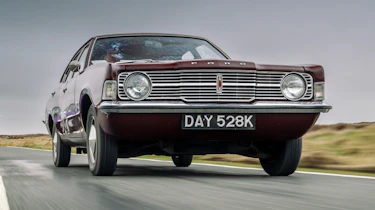
You may be wondering what a Ford Cortina is doing here. Well, for every instalment in this new Supercar Eras series, we’re bringing along a representative of that decade’s best-selling family car, as a barometer for just how far supercar designers and engineers pushed the envelope in each era, and to see how everyday cars have evolved in turn.
Perhaps no decade has seen a greater gulf between the ordinary and extraordinary of the car species than the 1970s. The UK’s best-selling car was the Cortina, leading the sales charts for most of the decade in Mk3 and Mk4 guises. Ford churned 1.1 million Mk3s out of Dagenham during its six-year production run from 1970 to ’76, and sold more than 126,000 in ’76 alone. Compare that with the UK’s best-selling car in 2025 – also a Ford, the Puma – which recorded around 55,000 registrations in a new car market that’s estimated to be 57 per cent larger than it was back then.
It’s a Mk3 we have here: a 1972 1.3 L, to be precise. It was around this time that Ford’s marketeers’ canny one-upmanship trim level system meant consumers aspired to have a particular letter, or combination of letters, on their car’s bootlid. The high-roller Cortina trim level was the GXL (Grand Extra Luxury) with vinyl roof, wooden trim and more besides. This L (for Luxury) was one level up from the base model, with niceties such as reclining seats, a cigar lighter and a wiper-washer footswitch.
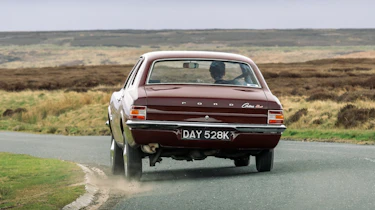
A base-spec Cortina was priced at roughly £930 in 1972, equivalent to approximately £16,000 today; when the Lamborghini Countach went on sale two years later, it was priced at around £18,000 (or £175,000 today). There’s a bit of a rakish fastback angle to the Cortina’s C-pillar and a hint of Coke-bottle curve to its hips, but overall it’s very much a traditional, upright three-box saloon. The wedgy Italian supercars look even more dramatic and alien by comparison.
Countach designer Marcello Gandini later commented how, in modern times, supercar design cues had become part of the standard design language for ordinary cars: muscular surfacing was now de rigueur for the humblest of cars. The Cortina, by contrast, is very much Clark Kent to the Countach’s Superman.
This car belongs to the Great British Car Journey museum, which celebrates the nostalgia of Britain’s most popular everyday cars from the 1920s to today – and also gives visitors the option to drive many of the cars, on a private road route. The museum’s Cortina L is in that most staple of ’70s paint colours: brown.
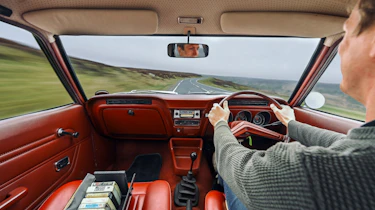
Tastes have changed – figures from the Society of Motor Manufacturers and Traders suggest brown cars account for less than one per cent of the UK’s new car market today. The interior, too, is in a uniform shade of reddish brown across nearly every surface.
This car has, at some point in its life, had an 8-track player fitted and Elton John’s greatest hits are crackling from the speakers as I get comfy – something it’s easy to do in the Cortina, since it’s so roomy inside. There’s a fantastic view not only ahead but all around, with slim pillars and no headrests for the fancy reclining seats (which offer rather limited support). It’s not a car you’d want to be inside in an accident.
But it is an enjoyable car to drive. Great British Car Journey founder Richard Usher advises me to plan ahead for climbing steep hills and use plenty of revs. ‘Gravity will be your friend,’ agrees John Barker, who’d taken the Ford for a drive earlier. Performance is indeed somewhat… limited.
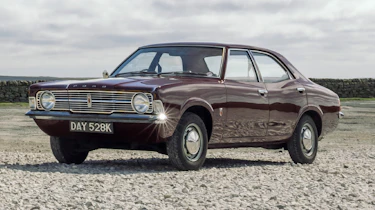
The supercars are spaceships by comparison, in terms of performance as well as styling. Yet such is progress that the UK’s best-selling saloon cars today, the BMW 3-series and Tesla Model 3, could easily outpace these supercars in most scenarios. Body roll in the Cortina is dramatic, the 13-inch steel wheels adopting some fairly jaunty angles in corners. Ride quality is lovely, however, and although the steering is tremendously heavy at parking speeds, it gets much lighter as you go quicker.
Usher points out that for a car which was once so ubiquitous, finding a Mk3 Cortina today is a tricky task. In fact, you might stand a better chance of stumbling upon a purple Lamborghini Countach than a brown Cortina L.
Perhaps it’s just the novelty factor, but there is a real simple, elemental happiness to driving the Cortina. It’s a very likeable car. But it demonstrates that the gap between the ordinary and extraordinary was bigger back then than it is now. Supercars of the ’70s really were super cars, in the fullest sense of the term.