Ferrari Testarossa (1984-1991) review – the Lamborghini Countach’s less striking, more usable nemesis
The Testarossa is a pinup icon and surprisingly usable for its age. If you want a show stopping 1980s supercar for grand touring, this is it
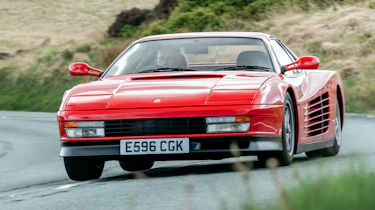
Nothing summed up the hedonistic more-is-more spirit of the ’80s better than the Ferrari Testarossa. Making its debut at the 1984 Paris show, it got its name (which translates to ‘redhead’) from the crimson cam covers of its flat-12 engine, and was tipped ‘the world’s most powerful and most luxurious Gran Turismo car’ by Ferrari.
It was an instant icon, a poster car that went up against Lamborghini’s show-stopping Countach with a more refined, considered approach. This wasn’t an uncompromising ‘race car for the road’ but a usable tourer, with practicality and comfort that would be unrecognisable to a Countach owner.
In 1991 Testraossa became 512 TR, then in 1994 512 TR became 512M, before the all-new 550 Maranello took over in 1996 to begin a long-serving dynasty of front-mid-engined V12 Ferrari grand tourers. That dynasty continues today with the 12 Cilindri, but the Testarossa still stands as one of the most revered. Read on to find out why.
Engine and performance
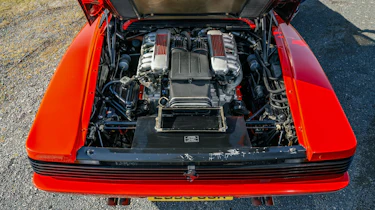
- 512 BB-derived 180-degree V12 with 385bhp
- Engine mounted atop of the transmission, raising the centre of gravity
- Five-speed open-gate manual gearbox
Peak power was 385bhp courtesy of a 4.9-litre 180-degree V12 engine putting power to the rear wheels via a five-speed transmission. It's not a boxer as the cylinders don't actually have individual crankpins – it’s actually a 180-degree V. It was also mounted quite high atop the transmission and differential.
More reviews
Performance wasn't much by today’s supercar standards, with 0-62mph coming up in 5.8sec, on the way to a top speed of 181mph. The finned flanks were born of necessity because several markets wouldn’t allow the large apertures needed to feed the rearward radiators, but they became a TR signature and a key component of its exotic other-worldliness.
Driver’s note
‘The star of the show is undoubtedly the engine: it's magnificent. It's so tractable, with a deep well of thrust that builds and builds down a long straight, piling on speed in the most wonderful crescendo to 6500rpm.’ – Henry Catchpole, evo contributor
Driving the Ferrari Testarossa
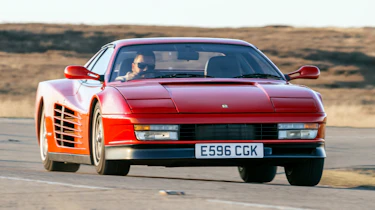
- A tourer first and sports car second
- Engine has wonderful flexibility and a gorgeous soundtrack
- The high-mounted engine can upset the rear end at speed
The Testarossa’s performance stats are some way off the Countach’s claimed numbers, but the manners of the 180-degree 4.9-litre V12 are so much more cultured than contemporary rivals, so it is perhaps inevitable that the Testarossa doesn’t have a punchy demeanour. Regardless, the way it covers ground is deeply impressive.
The car we’re driving, lent to us by evo founder Harry Metcalfe, is an early non-cat model with centre-lock magnesium non-TRX wheels, Harry deliberately swerving the later versions because this looks and sounds better and is rarer. The engine is a big but understated character, the delicious turbine-like delivery projecting a sense of boundless elastic urge. Coupled to a simmering soundtrack that builds with load and throttle opening, but never intrudes, it makes for majestic progress.
The engine is also what defines the Testarossa in the corners. The little 16-inch wheels with their 50-profile sidewalls play their part, but it's the first time you feel the weight of those 12 cylinders start to swing a little and affect the balance behind you that sticks in the mind.
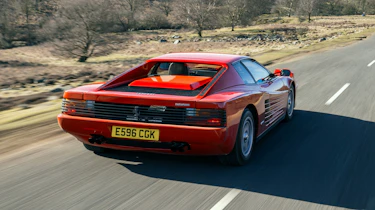
If you carry too much speed into a corner and need to lift then you have to be right on top of the car, because that high, rearward centre of gravity will swing round with an inexorable momentum. There are two things that make it just about manageable, the first being that the engine is naturally aspirated, so the power delivery is beautifully linear and workable. The second is the amount of steering lock available.
It’s important to remember that this was an era before supercars became tuned for trackdays. Yes, this means they don’t have the same robust, indestructible feeling or tireless brakes as modern machinery, but the way the Testarossa finds its groove on a flowing road is an object lesson in fitness for purpose, and makes it far more of a GT than a Countach.
That the Ferrari is every bit as supple as you’d want from a tourer is testament to Maranello’s engineers and their feel for what a production flagship supercar should be when they were also making the wild F40. It feels like a car built by a company close to the top of its game.
Driver’s note
‘It’s one of the easiest and most approachable classic supercars. It really leans into how cars of this era like to be driven. You don’t push it hard, you just use the torque and enjoy the sensations. It’s just perfect for that.’ – Yousuf Ashraf, evo Senior Staff Writer
Design and interior
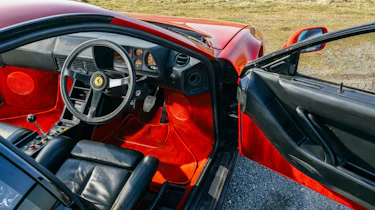
As the years pass, the Testarossa only seems to look more fabulous. Flat as a flounder and impossibly wide, its low-slung profile, square shoulders and trademark linear slats are truly breathtaking. It was a big visual departure from the more classically beautiful 512 BB, but it borrowed heavily from that car’s hardware and sought to improve upon its refined brand of supercar performance.
Swing open the door and you find a cockpit that’s refreshingly airy and easily accessible thanks to the low sills. There’s no tub to speak of, so instead of clambering up, over and then down into the seat, you simply shimmy yourself onto the squab. It’s laughably low, feeling for all the world like you’re sitting on the tarmac, but together with the wide, flat dashboard and huge windscreen, you can’t help but feel slightly awed by your surroundings.
Ferrari Testarossa specs
| Engine | Flat-12, 4943cc |
|---|---|
| Power | 385bhp @ 6300rpm |
| Torque | 361lb ft @ 4500rpm |
| Weight | 1708kg (229bhp/ton) |
| Tyres as tested | Michelin Pilot Sport |
| 0-60mph | 5.8sec |
| Top speed | 181mph |
| Basic price | £62,666 (1984) |
| In today's money | £200,068 |