The Ford Escort RS returns with 10,000rpm, but it'll cost you
Boreham Motorworks’ ‘continumod’ RS is a 1960s Mk1 Escort engineered and manufactured to 21st century standards, and it's made its debut in London

This gleaming green Escort Mk1 RS is a reinterpretation of the 1960s original, engineered and manufactured to 2026 standards. Just don’t call it a restomod. Its creators, Boreham Motorworks, describe it as a ‘continumod’. Officially licensed by the Ford Motor Company, each from-scratch new-build RS will have a continuation Escort chassis number, but only 150 will be sold. The price? £295,000 a piece, and each and every one has already been accounted for.
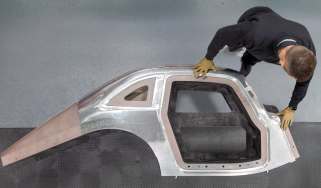
It might be built to the dimensions of a ’60s race-spec Escort RS, but it will possess a far more rigid structure, be produced to the standards and tolerances of a modern-day mainstream manufacturer, and be homologated for small-series production. That differentiates the Boreham Escort from cars such as the (excellent) MST Mk1 driven in evo 319, which is a different take on the concept in that it’s officially not a Ford Escort but a brand-new car built from brand-new parts, with each car individually approved for road legality.
> Ford XR3i restomod: Tolman wants to improve a flawed classic car
What makes this car really special is its engine. Customers will have a choice of two: a 182bhp, 8500rpm fuel-injected 1.8-litre version of the original twin-cam four-cylinder matched to a four-speed straight-cut gearbox, or the extra-cost option of the new 2.1-litre ‘Boreham TEN-K’, a 325bhp four capable of revving to, you guessed it, 10,000rpm…
To achieve such a feat, the bespoke, naturally aspirated twin-cam utilises individual throttle bodies, F1-inspired port geometry and a block that’s almost shrink-wrapped around its lightweight billet internals – the result is a weight figure of just 85kg. Boreham’s even used 3D printing to reduce the thickness of some components while maintaining the required strength, with the latest electronics keeping everything in sync.
The ‘new’ Escort RS will feature a different rear suspension layout from the original RS’s live axle and leaf springs, adopting an ultra-exotic floating aluminium and titanium unit for a 50 per cent reduction in unsprung mass. Ride quality is said to strike a compromise between that of a rose-jointed race car and a modern saloon. Customers should expect a relatively raw driving experience, however: DRVN’s slogan is ‘peak analogue’ and there will be no power steering, ABS or traction control. The target dry weight, with lightweight options such as magnesium wheels fitted, is 895kg.

Sitting inside the Escort, you find yourself behind a deep-dished steering wheel with all the slim-pillared visibility you’d expect of a ’60s car and a neat interior with modern but sympathetically integrated switchgear, plus the option of smartphone connectivity. ‘There’s no existing CAD data for the Mk1 Escort,’ Burgess tells us. ‘We scanned an Escort Mexico and others and found that no two cars are quite the same…’ Given that Boreham’s aim is to create a repeatable OEM-grade car, homologated for European small-series production with mandated pedestrian- and side-impact requirements, that presents a real challenge. ‘We’re packaging things that weren’t on the original, such as air-conditioning,’ he adds. ‘It basically needs to be a TARDIS.’
Boreham’s licensing deal with Ford will extend to further nameplates, but the company says it will concentrate only on European Ford models; it won’t seek to compete with the established scene around modified Mustangs and other Stateside models. DRVN also owns Alan Mann Racing, the historic racing outfit closely linked with Ford in the ’60s. The company says AMR will become Boreham’s ‘in-house’ performance division, so it’s logical to expect track-spec cars to follow the road-legal Escort and RS200. Given AMR’s historic connection to motorsport models such as the Ford GT40 and F3L, it would also seem likely that such cars will be figuring in DRVN’s designers’ thoughts.
Restomod or ‘continumod’, it’s easy to become blasé about yet another re-engineered reimagining of a classic car. However, DRVN’s ability to create a from-scratch new car largely in-house, with Ford’s blessing, gives it something of a USP. How seriously we should be taking this new enterprise will ultimately be confirmed when we drive the Escort RS, but for now there’s plenty of reason to believe that it could be the most exciting Ford-badged car launched this decade.