Honda Integra Type R (DC2, 1996 - 2001) – a front-wheel drive icon for £15k
It’s long been considered an iconic machine, but to discover the real magic of the Integra Type R you have to dig deep into its abilities

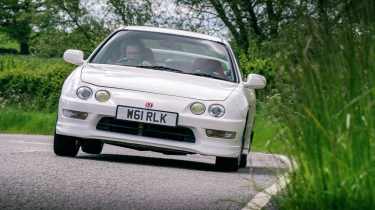
Every so often a car comes along that’s truly groundbreaking. One that years after its debut is still revered as a brilliant piece of engineering, one that has stood the test of time so well that it wins plaudits for the way it drove, even against more modern machinery. One such car is Honda’s Integra Type R (DC2), a car that back in 2006 we proclaimed was the best front-wheel drive performance car ever.
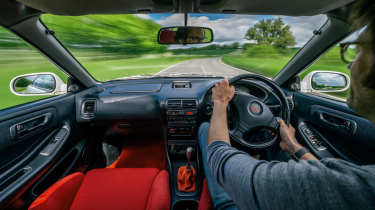
If you ever get the chance to sit in a DC2 Integra Type R then you’ll instantly get a similar sense of reassurance and excitement. You won’t care about the obviously fake, big-weave carbonfibre that waterfalls down the centre console to the gearlever. The acres of shiny, brittle-looking black plastic will matter not a jot. Instead you’ll first be focused on the feel of the Recaro SR2 seat as it applies gentle pressure in all the right places. The red bucket may have strangely little headrest above the harness slots and there might be a bit of flaccid fabric after years of entries and exits, but the way the seat’s shape holds your hips and hugs your torso immediately gives you an encouraging sense of connection to the car. The bolsters bode well.
More reviews
> New Honda Prelude review – the Audi TT alternative you’ve been looking for?
Flip a coin for which touchpoint is next. Or perhaps you reach for them both at the same time. Right hand resting at the three o’clock on the steering wheel while left hand reaches for the gearlever. Leather-covered but worn smooth and shiny like a magnolia leaf, the three-spoke Momo is uncluttered but sweetly sized. And it has more sculpting to it than you first imagine, with your thumbs hooking comfortably into the shapely crooks.
Meanwhile, the small gearknob is about as pure as they come; as simple as a Brâncusi sculpture, it sits into the palm of your hand perfectly. Being titanium imbues it with an inherent coolness – doubly so on a winter’s morning – and its slightly matt grey finish contrasts perfectly with the thin, red arteries of the H-pattern diagram on top. It might look unassuming to most, but along with the Recaro and the Momo, it marks out the Integra Type R as something that has the potential to be special. You sense that a long time ago important decisions were taken with care. You might not know the barista behind the counter or the engineer in the factory, but such physical manifestations of crucial choices speak volumes about the coffee or the driving experience that is about to be served up.
Now, before we go any further, or indeed anywhere at all, I think it’s worth having a brief recap of the Integra Type R’s back story. First appearing in its motherland in 1995, it was the second red badge road car to be launched by Honda, three years after the NSX Type R. A couple of years after that, buyers in the US and the UK got their chance to own one, although the official UK allocation was just 500 units (equal to the first-year allocation for the latest Civic Type R) with a sticker price of £22,500.
Engine, gearbox and technical highlights
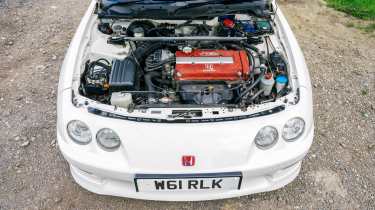
Under the bonnet is a red-topped 1.8-litre four-cylinder with the designation B18C5. It might be based on the lesser Integra GS‑R’s motor, but it has lighter-stemmed valves, molybdenum-coated pistons, angrier camshafts, lighter con rods, a crankshaft with extra counterweights, and better-breathing intake and exhaust manifolds with hand finishing on both the intake and exhaust ports. The result is 187bhp at 8000rpm and 131lb ft at 7300rpm going to the front wheels. With shorter ratios in the five-speed ’box and an LSD helping traction off the line, the DC2 has an official 0-62mph time of 6.7 seconds (we’ve recorded 0-60mph in 6.2) and a top speed of 145mph.
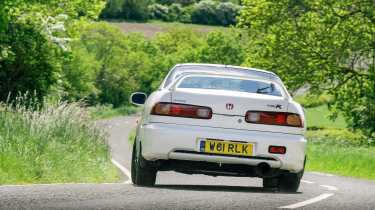
But it wasn’t just the drivetrain that was given attention. If you’ve been poking around under the bonnet then you will have noticed the strut brace just behind the engine. Open the rear hatch and not only will you find a surprisingly cavernous luggage space but more bracing across the back. This particular car, which belongs to former evo staffer Matthew Hayward, also sports an extra bit of metal between the rear struts – a reasonably common official option that just required some neat holes to be cut in the trim. Unseen are the extra spot welds on the bodyshell and the significantly stiffer bushings in the suspension, which also has firmer springs and dampers.
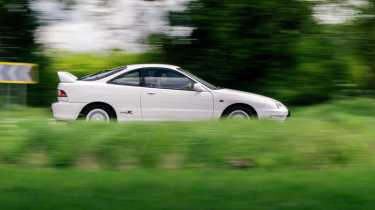
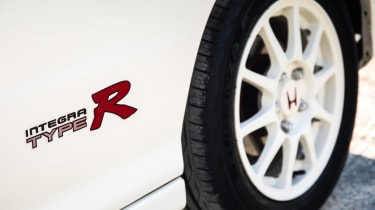
Today, it still looks surprisingly un-old-fashioned. Yes, the five-bolt, 15-inch wheels are about as out of date as a Nokia 5510, but there is a freshness to those small round headlights and the general lack of clutter in the design – epitomised by the simple arch of a rear wing. Championship White was the only colour available in the UK initially, but black and red were subsequently offered and each hue has its merits. Even the typography of the Type R graphics in front of the rear wheels has stood the test of time – a bit Teenage Mutant Ninja Turtles, perhaps, but I like it.
However, I do think that the body shape of the Integra has caused it some issues over the years. Its long, low look makes it seem much bigger than a hot hatch, particularly one from the ’90s. Although it weighs only 1140kg, it doesn’t have that pocket rocket aesthetic. When evo did a Greatest Front-Wheel Drive test back in issue 095, the Integra seemed to stick out like a zero-pod design concept in an F1 pitlane amongst the other five finalists. It won that test, of course, and even though some 17 years have passed since, I’m not sure what would knock it off the top step of the podium today. Maybe Renault Sport’s Mégane R26.R would wrestle the crown away. Conceivably VW’s Golf GTI Clubsport S might seduce the voters. I suppose a case could be constructed for the FK8 CTR. But although they all have more muscle and faster lap times, none of them has the purity of the Integra.
There is certainly nothing muscular about the way the DC2 comes to life in an unassuming lay-by on a sunny spring day in Bedfordshire. Push-twist the key and the noise from the four-cylinder is on a par with the interior plastics for flimsy thinness. Spines will remain untingled on start-up. With a relatively high biting point to the clutch and a throttle pedal that is curiously reluctant in the first bit of travel, there is the feeling that this performance car might take a bit of cajoling. The factory figure of 131lb ft of torque certainly seems bold in these first moments when you feel like you’re having to be a bit assertive to set wheels smoothly in motion.
Once you’re rolling along, however, short-shifting and soaking up all those initial impressions that bubble up during the first few miles in any car, the DC2 starts to come good on some of the initial promise. There is a lightness to the whole experience, both in the way it moves but also in the stripped-out acoustics. The gearshift is tactile but doesn’t have the tight, controlled action of some later Type R shifts, instead swapping between the five ratios with a slightly longer and spindlier feel. Down in the footwell, however, the spacing between throttle and brake feels spot-on for heel and toe, so downshifts can be kept pleasingly smooth. (Contrary to popular myth, white socks and loafers are not essential for fancy footwork in a Honda. Some find such attire helps conjure their inner Ayrton, and I’m not going to belittle them for keeping a pair of both in the boot to be donned in a secluded spot. But don’t feel pressured to sidle into your local cobblers with a screengrab of an NSX footwell if your rev-matching is going through a rough patch.)
Performance, ride and handling
Through the first few turns the chassis might not be what you expect because there is quite pronounced roll. You’d never call it aloof or imprecise, but as you thread the Integra between the hedges you have to adjust to a rhythm that requires a beat or two more in the transitions from left to right and visa versa. There is an easy flow to be found, with the small wheels and modest rubber soaking up any rough edges on the road. It’s involving and enjoyable but also feels a good deal more Type R for Relaxed than Racing.
Then everything erupts when you hit 6000rpm for the first time. Much has been written about the high-rpm personality swap that occurs with a VTEC cam change, but it’s a particularly extraordinary experience in the DC2. There’s a noticeable kick in acceleration but it’s the aural contrast that really sticks in the mind; a sharp increase in intensity from the relatively mundane four-cylinder foothills to the suddenly madly angry motorsport buzzing of the top end. It’s like bursting through clouds in an aeroplane to discover the sun is in fact always shining up top. This is where you want to live, the dazzling world of VTEC.
Once you’ve found this new, energised side to the car, it encourages you to start driving with more purpose and the Integra responds in kind. Gearshifts feel more satisfying and the rev-matching is easier to judge. Corners come alive, that sharper-edged power delivery adjusting the balance beautifully both on and off throttle. And while the small wheels and that initial roll give the impression that limits will be low, as you push harder so you find that the Integra just keeps digging up grip. It feels faintly miraculous when you first experience it.
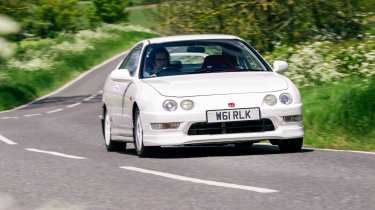
A quicker bend is best if you want to feel the real magic of the chassis though. In that issue 095 finale, Richard Meaden highlighted a particular left-hander in north Wales and marvelled at the magical way that test’s black DC2 dealt with a tricky bump that would have had most cars unsettled and squirming like a toddler sitting on a pine cone.
My own, quickish left-hander in the Midlands is smoother but dips downhill as it opens past the kerbed apex. Turn in a little early and the nose seems to tuck in nicely, sniffing the overgrown verge like it’s testing for signs of hay fever. With the front end faithfully stable, your attention moves to the rear as it starts to swing. There is roll and that initial softness in the suspension, but with speed and commitment you move past this to a harder core that brings with it a surprising level of support as you compress the springs further. The extra bracing and that stiffer shell suddenly step out of the shadows and make themselves known. Now, just when you need it, the Integra provides you with confidence and precision as the tail arcs round.
How much it arcs depends on the momentum you have, but whether it is all nice and neutral or there’s opposite lock required, the Integra never feels unsettled. Even when the inside rear is barely skimming the surface, everything seems graceful and you feel like you have time on your side to adjust and enjoy. That longer, lower look compared with a hot hatch translates into a smoothness at the limit that is utterly beguiling. It’s like the perfect party hostess who can rise above the fire in the kitchen, the argument in the hallway, the late arrival ringing the doorbell and someone else’s Pekingese attached to her ankle in order to gently enquire of an aged aunt if they’d like a little more sherry and another cushion. The Integra is exciting yet easy; involving yet calm.
These layers to its character, this richness to the driving experience, that’s what elevates it to icon status. An ability to entertain in all sorts of situations and offer dynamics that remain interesting and surprisingly individual despite the passing of time – these are the hallmarks of legends like the best Porsche GT cars, BMW M cars and numerous supercars. And as more Type R models have been added to the pantheon over the years, so the status of the DC2 has grown. The fact that the NSX Type R came first lends huge kudos to this Integra in particular; it represents the democratisation of an ethos that was originally applied to something much more expensive.
Even better, it’s not one of those originally affordable cars, those people’s heroes, that have risen out of reach in terms of value. A genuine UK car is a rare thing and yet, for now, DC2s are still a relative bargain in the classifieds, which obviously only makes them even more appealing. Why the lack of wider interest and concomitant inflation of prices? I think it’s down to the fact that the Integra is front-wheel drive. The idea of power going to the steering wheels seems to place a glass ceiling on its status.
With this in mind, it’s worth finishing with the concluding sentences from that FWD group test 17 years ago, because they ring just as true today: ‘Forget the accolade of greatest front-wheel-drive car. The Integra Type R ranks as one of the truly great drivers’ cars of any kind.’
What we said in 2006
'Drive the Integra slowly and it feels a bit flaccid. You could almost wonder what all the fuss is about, but once that firecracker engine ignites, the humble Honda is transformed into a humdinger. It thrives on high revs, that classic VTEC kick hitting home at 6000rpm, from which point the fizzing four-cylinder emits a magical howl as the tacho needles homes in on and then passes 8000. It’s like driving a real exotic: the super-high-revving engine, rifle-bolt gearshift, rigid bodyshell and incredibly controlled suspension melding to deliver sensationally effective performance.
Grip levels are miraculous on such modest rubber, and the limited-slip differential generates tremendous traction. There’s no torque-steer to speak of, but then it’s hardly rippling with lb ft, which probably explains it. Nevertheless, the combination of taut but supple suspensions, a terrifically effective diff, abundant grip and no torque-steer leaves you with one of the purest and least corrupted front-drive helms ever.' – evo 095 - Richard Meaden
Honda Integra Type R (DC2) specs
| Engine | 1797cc, in-line 4cyl |
| Power | 187bhp @ 8000rpm |
| Torque | 131lb ft @ 7300rpm |
| Weight | 1125kg |
| Power-to-weight | 169bhp/ton |
| 0-62mph | 6.2sec (claimed) |
| Top speed | 145mph (claimed) |
| Price new (1997) | £22,500 |
| Price today (2025) | From £14,000 |