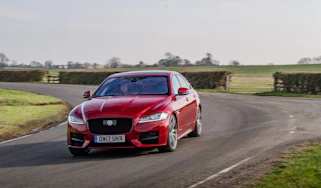
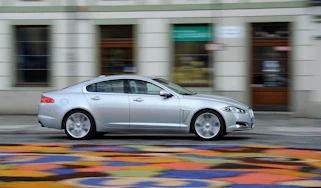
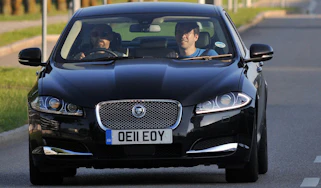
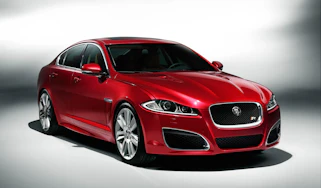
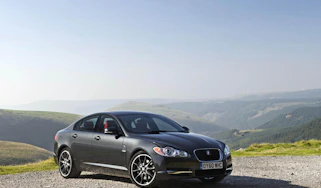
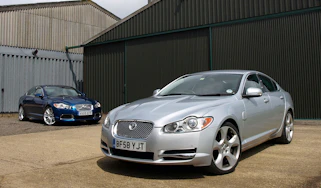
Jaguar XF (X260, 2015 - 2024) review – a British luxury saloon from £4000
The second-generation Jaguar XF became a fine example of a luxury saloon in its final form, and it can now be had for next to nothing
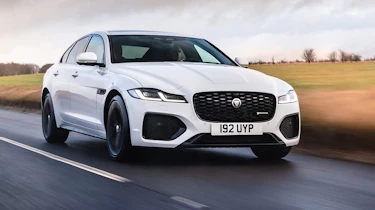
The Jaguar XF was something of a keystone model for the brand when it first appeared in 2007. The executive saloon was not just a replacement for the S-Type, but also a signal that Jaguar was ready to break free of its heritage-led brand positioning and embrace change (sounds familiar, doesn’t it). It was this drive that forgoed the traditional Jaguar burr walnut trim and shameless retro detailing in the XF, creating in its wake, a new image of British luxury.
Fast forward to the early 2020s and the second-generation XF became a rather different proposition. Due to a shrinking market and JLR’s investment in other products, it had fallen to be something of an neglected model in the range, but a mid-cycle update soon rectified most of its downfalls with an interior and exterior design overhaul.
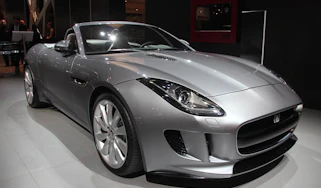
> Jaguar F-type facelift (2020 - 2024) review – the Jag we’ll miss the most
The XF’s limited appeal was partly explained by the lack of variety of its powertrains, as unlike the first-generation X250 model, there never was a high-performance variant. Instead, Jaguar focussed the range to appeal to exactly what it thinks customers in the traditional executive class are after: a plush, refined and sophisticated cruiser. One that over two years after its discontinuation, can now be had for a shockingly low sum…
Engine, gearbox and technical highlights
- Three four-cylinders, plus 3-litre V6 in pre-facelift form
- Smooth automatic gearbox lacks response
- Diesel easily outperforms thirsty petrols for economy
More reviews
Six- and eight-cylinder engines were once commonplace in cars of this size, but now four-cylinders are the norm and anything more a real luxury. Unfortunately, it was a luxury the XF didn’t afford buyers of the facelift model, with only two four-cylinder engine options in a total of three power outputs between them. For anything more, you’ll have to turn to the earlier pre-facelift car which came with a 3-litre supercharged V6 in S-form.
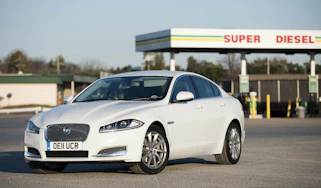
The four-cylinder engine is Jaguar Land Rover's Ingenium unit in both petrol and diesel iterations, starting with a 200bhp 2-litre diesel and climbing up to a 296bhp 2-litre petrol, with a 247bhp petrol variant between. The 2-litre diesel is equipped with a very subtle mild-hybrid system, which helps achieve a peak torque of 317lb ft available between 1750-2500rpm, while petrol models were available in the P250 and P300-forms with 247bhp and 296bhp respectively. Look back to the pre-facelift car and a 375bhp 3-litre supercharged V6 was on the table in the ‘S’.
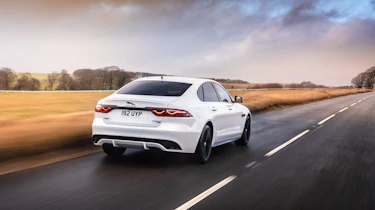
All models are fitted with an 8-speed torque-converter automatic, and while smooth, responsiveness is not very high on the agenda. When fitted to either four-cylinder petrol, the relatively thin torque figures require the transmission to shuffle ratios more often than is ideal, highlighting the muddled nature of the gear changes. Left to its own devices and kept to a gentle pace, the transmission is just about benign enough to slink into the background, but try to make progress and the ‘box quickly reveals its shortcomings.
The diesel’s narrow power band might suggest it suffers the same fate, but the extra torque in the driveline thanks to both the diesel engine and its electric augmentation seems to suit the gearbox better, quietly slipping between ratios and never really dropping out of the torque sweet spot. Up the pace and the same issues as the petrol are there, but they’re less obvious. Diesels are also just as, if not more, refined than the grumbly petrols.
At its most efficient, the facelift mild-hybrid diesel is rated at 57-50mpg on the combined cycle, but is a few MPG above earlier XF diesels. All-wheel drive and Sportbrake models each remove a couple of MPG from the total though, dropping to around 45mpg for an all-wheel drive Sportbrake. In our experience, anything over 35-37mpg feels like a reasonable real-world expectation.
P250 models don’t seem too compromised on paper, rated at 35-31mpg, but the P300, with its bigger outputs and all-wheel drive drops this down to 32-30mpg. In the real world, our experience with the latter powertrain delivered some quite shocking results however, barely troubling the low 20mpg mark on a combination of motorway and fast A-roads. For comparison, the 3-litre supercharged V6 S will achieve similar numbers.
Performance, ride and handling
- Flexible diesels lack speed versus rivals
- Unrefined petrols demand high revs
- Exceptional steering and agile handling
The four-cylinder diesel engine does an admiral job keeping pace with its German rivals of the time. This is not in reference to outputs on paper, but rather that the new mild-hybridised diesel feels just as flexible and responsive. It is slower though, there’s no denying that, reaching 62mph in 7.8sec (the AWD option takes this up to 8sec) which is a solid 0.5sec behind a less powerful BMW 520d. If you do decide to push the engine to the upper part of its rev range, its deterioration in refinement doesn’t equal increased performance. Much better to keep it below 3000rpm and save any disappointment.
The petrol four-cylinders are no more refined or responsive oddly, and when kept within a normal operating window feel less muscular than the diesels. Push them and the performance is improved though, but one must explore the very upper reaches of the rev range, which is not a particularly pleasant experience.
The rear-wheel drive P250’s 6.9sec to 62mph acceleration isn’t particularly impressive, but the P300 all-wheel drive’s 6.1sec time is more admirable, although it doesn’t quite feel that fast in the real world. The engine note is largely muted – as it should be for a car of this type – but there is a grumbly undertone that’s neither premium nor sporty. For the most performance you'll have to go back to the pre-facelift S, and while a 5.3sec 0-62mph time is improved, you don't gain much else. It's an underwhelming engine that doesn't provide as much punch as its 375bhp output suggests.
You expect certain characteristics from a Jaguar when it comes to ride and handling; chiefly a controlled ride, a taught body and a sense of being part of the process. The XF doesn’t disappoint. There are double-wishbones at the front, a multi-link set up at the rear with passive dampers fitted as standard across the saloon range. Six-cylinder engined cars could also be specified with optional configurable active dampers, first seen on the F-type.
Another component taken from the F-type is its EPAS steering, which has been further tuned to the XF’s dynamic make-up and, as in the F-Pace, is a system that Jaguar now claims provides better feedback and precision than the equivalent hydraulic system.
With wheel sizes ranging from 18 through to 20 inches in diameter, the XF’s ride always remains on the calm and sophisticated side. The high profile tyres fitted to the smallest rims produce an unexpected level of ride comfort in today’s world of sharp edged characteristics and that doesn’t deteriorate significantly as the wheel diameter increases and the tyre profile decreases.
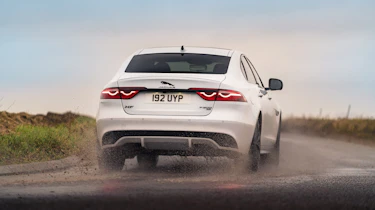
There’s real fluidity to the way the entire XF range dissects a road. On the standard passive dampers the body control never feels out of its depth, the chassis loading up with consistency, riding with a compliance and changing direction with an agility of the very best in the executive car class. On the active dampers it’s a similar story, with improvements in terms of comfort in normal mode, although there’s no real discernable difference in Dynamic mode unless you really begin to push at the XF’s limits where it remains controlled until you breach the tyre’s grip and mild understeer takes over.
Torque vectoring was standard on all XF models, and while it doesn’t offer that on the limit the adjustability of a locking differential it’s not intrusive when it cuts in. The EPAS led the class, with more natural weight than both Audi’s A6 and BMW’s 5-series, and superior feel over Mercedes’ E-class, the XF’s steering was the most natural of all the electronic systems on the market, providing a level of feel, rate of speed and feedback unexpected from an exec saloon.
The all-wheel drive XF uses the same arrangement as the all-wheel drive F-type and F-Pace; its predominantly rear wheel drive and torque is sent to the front axle if the rear loses grip. It works well in those applications, but it isn’t an inconspicuous system, whenever rear-end traction is broken as you can really sense the torque being sent to the front. However, being able to feel this process in action only makes the Jag more interesting and involving to drive.
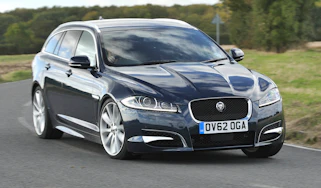
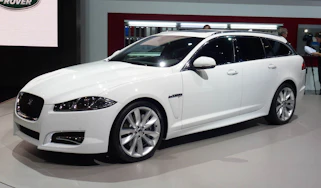
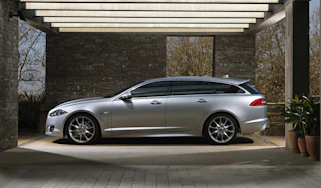
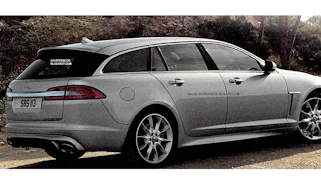
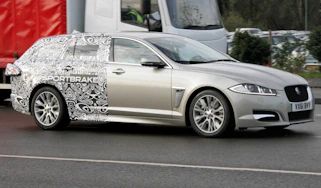
Sportbrake models are identical in setup to the saloon save for a standard-fit self-levelling rear axle that uses air springs rather than coil springs. While the change in hardware is noticeable in the form of slightly woolier feedback, the ride quality is certainly no worse, if not any better. What this does mean is that even with the fattest Saint Bernard in the boot, the XF will stay level and contained.
Interior and tech
- Cabin design lacked the innovation of the first-generation XF
- Interior suffered severe cost-cutting at launch
- Mid-cycle update successfully restored cabin luxury
When the first XF broke cover, it was just as much its interior as the exterior that symbolised Jaguar’s incoming transformation. The cabin of that original wasn’t just a contrast to the linseed leather and walnut cliche Jaguar had fostered for decades, but was theatrical, clever and inspired.
It went on to introduce components like the rising hockey puck gear selector, rotating air vents and layered, almost architectural thought process to materials and layering. You can imagine the disappointment, then, when the second generation XF was revealed with its cost-cutting and entirely outclassed cabin from day one.
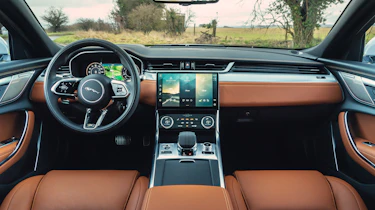
This mid-cycle addressed the cabin’s issues. Like it did with the old S-Type, Jaguar completely redesigned the cabin of the XF, creating a totally new dash and console, fitting new doors, significantly hiking up material quality and introducing JLR’s new Pivi Pro infotainment system accessed via a floating and curved glass touchscreen. The changes were so dramatic, not just compared to the old XF, but to other Jaguar models as well, that it’s hardly believable to come from the same company.
Crucial touchpoints like the steering wheel, standard gearshift paddles and touchscreen don’t just feel plush for an XF, but for the whole exec class, and while the new gear selector does feel a little cheap, it doesn’t compromise the overall aura of quality and opulence the facelift cabin offers.
What to pay
The Jaguar XF was priced from around £35,000 when it initially went on sale in facelift-form to undercut rivals from Germany, making it a very reasonable offering. Jaguar didn’t skimp on standard equipment either, with all models sitting on decently sized wheels and featuring slick LED lighting front and rear. Inside, the impressive Pivi-Pro infotainment centre is standard across the range, so too are electric and heated leather seats, dual-zone climate control and a very good 3D surround-view parking camera.
It was good value in its day, and it’s even better now. If you're willing to take the brave pill and go for an early pre-facelift car with well over 100,000 miles, you can pay as little as £2500 for an un-written-off car. For a clean, early car with under 90,000 miles you'll pay closer to £5000. If a V6 is what you're looking for, you can now find examples for well under £10,000, with the very best examples requiring in the region of £20,000.
Facelift cars fetch considerably higher sums as a result of the improvements Jaguar made, but it still won't break the bank. For a low-owner, well-maintained 2021 car you'll need under £16,000, with the very best near-new sub-10,000 mile cars on the market for under £40,000.
What to look out for
Being a Jaguar, many assume the XF is riddled with endless, expensive problems, but buy the right car with the right service history, and you needn't worry. These are the primary issues to look out for.
Turbocharger failure
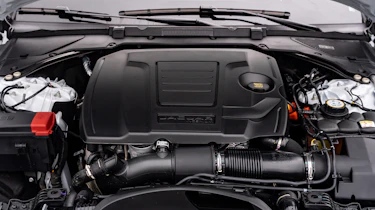
On a test drive, keep an ear out for any unusual droning or whistling under power, as this can be a sign of a failing turbocharger, specifically on 2-litre four-cylinder models.
Timing chain failure
Listen for an unusual clatter on cold start when viewing XFs with the 2-litre diesel, as this is a telltale sign of impending timing chain failure. These are known to stretch over time and should this be left too long, can lead to catastrophic engine failure. The 2-litre petrol can experience the same, but it's much less common – initial petrol reliability concerns were mostly covered by Jaguar under warranty. The 3-litre diesel avoids this issue with the use of a timing belt, but ensure this has been changed in-line with the recommended service intervals of 7 years/112,000 miles.
Miscellaneous
Issues relating to the DPF are common on diesel models, caused by failure of items such as the throttle body or DPF unit itself. These will often result in warning messages on the dashboard, so keep an eye out for these.
While not limited to the XF, the rotary gear selector on earlier X260 models can occasionally get stuck, requiring disassembly of the centre console. Issues relating to an old or poorly maintained battery are also becoming increasingly common as this car ages, so check when it was last changed during a viewing.
As is the case with just about any car you buy, regular maintenance at a trusted service centre is always something to look out for. Frequent oil changes are a must, especially with the more wear-prone diesel units - look for signs of fresh oil every 10,000 miles or sooner.