Lotus Emeya review – Britain’s electric super saloon eyes the Porsche Taycan
It couldn’t be further from a traditional Lotus, but the Emeya addresses the challenges of an EV in a surprisingly Lotus way
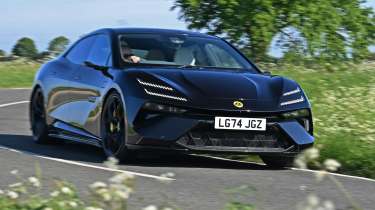
The Porsche Taycan has owned the electric super saloon segment since its launch in 2019, with its Audi relative, the e-Tron GT, picking up the crumbs. Very few other manufacturers ventured away from the draw of the super SUV to create a true competitor, until the Lotus Emeya came along in 2023. It remains one of the only hot electric saloons on sale in the UK, but with underpinnings from China, it’s not a given that it carries the Lotus dynamic edge we’ve come to love.
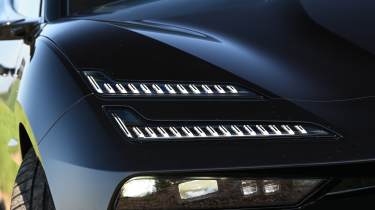
The trim levels are a little bewildering, but simplify it down to the powertrains and there are just two states of tune: 595bhp and 893bhp. It’s a quick car in any of its forms, and hunkered down low on its air suspension, it looks it too. The Emeya’s design is perhaps a little soft and undefined in areas, and its suite of bulky sensors make it look a bit like a Waymo, but aero passthroughs at the rear, a huge active rear spoiler and an imposing stance give it the starpower of a supercar. We find out if it drives like one.
> Porsche Taycan review – it's still one of the most complete electric cars on sale
Powertrain and technical highlights
- Dual-motor, all-wheel drive with up to 893bhp in R-form
- Poor efficiency, often lower than the quoted 2.7mi/kWh
- Rear-wheel steering and electric anti-roll bar
More reviews
Despite a 2590kg weight figure (more than three times an Elise), it won’t surprise you to hear that the range-topper is no slouch. Under the floor is an 800-volt battery powering two permanently excited e-motors, one on each axle and with 726lb ft of torque, it is uncomfortably fast, applying forces upon its occupants that, as with all high-end electric vehicles, cause your cerebral faculties to require some very rapid and immediate reprogramming, and your stomach to be suitably sturdy.
Every Emeya comes with the same 102kWh battery pack, and even the 595bhp ‘entry-level’ car makes use of a dual-motor all-wheel drive setup. The primary difference is that the range-topper gets a two-speed transmission on the rear axle, something the entry-level car (and the vast majority of EVs today) go without. That transmission certainly isn’t for added efficiency though, as Lotus quotes 2.7mi/kWh on the WLTP cycle – we saw not far from 2mi/kWh in our test, resulting in a c250-mile range on mixed drives. Thankfully peak charging speeds are a class-leading 402kw.
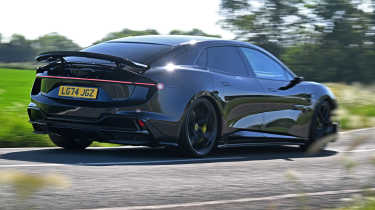
As with its Eletre SUV relative, the Emeya is built on Zeekr Technology’s Electric Premium Architecture, which uses a mixture of aluminium and steel to link the front and rear subframes with the lithium-ion battery positioned in the middle of the car. There’s rear-wheel steering, air suspension and an active anti-roll bar too, with carbon ceramics available at a cost. Its structure is wrapped in aluminium body panels, the design retaining Lotus’s cab-forward ethos with nods to the Evija hypercar with those openings in the rear bumpers just behind the wheels.
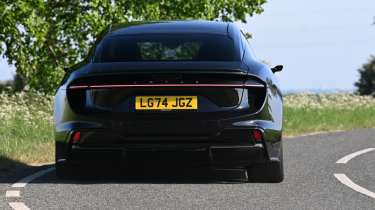
In your mirrors the Emeya does have real presence, from its nose-down stance snorting up the road to the athletic sculpting of the frunk cover, which can be specified with the upper portion finished in exposed carbonfibre, though that’s probably best avoided as it jars with the overall look. The Emeya’s 5m long body is exaggerated by that cab-forward design, and with a thinner battery than that fitted to the Eletre and a lower ride height it’s a far more cohesive design. The rear is a little bland, with the aero elements, including a two-stage active rear wing, being the most distinctive aspects. And there’s no easy way of telling what it is, the rear ‘LOTUS’ lettering being black-on-black on the R, rendering it all but invisible, while the model name isn’t shown at all – which all seems a bit too far down the trendy minimalist route when you’re launching into a whole new sector with a model you have no legacy with. If ever a car needed clear badges to tell other motorists what it is, it’s a 2.5-ton Lotus saloon car. Although if you saw it alongside Audi’s e‑tron GT and Porsche’s Taycan, chances are you’d be drawn to the Brit’s more distinctive style.
Performance, ride and handling
- Endless straight-line performance
- Large dimensions impossible to ignore on tight B-roads
- Well-weighted, direct steering & compliant ride
That forward motion is applied by the 225kW (302bhp) motor on the front axle and the 450kW (604bhp) unit at the rear, with the two-speed gearbox there to optimise the R’s acceleration both off the line and to maintain it up to its 159mph maximum. And it’s uncomfortably effective. From a standing start the instant response to any application of the throttle has the Emeya leaping for the horizon, but it’s the roll-on acceleration when you’re travelling at 50mph and introduce the throttle pedal to its stop that shocks. Another 50mph is added to your speed in what feels like an instant. Another 30mph is added instantly after this and then shortly afterwards the warning light illuminates and the bong sounds. That’s your lot.
If you’d like to tone things down, a click of the left-hand paddle behind the wheel (which rocks up and down for easy access to drive modes) changes everything. ‘Range’ mode helps extract as much mileage as possible from the huge battery pack beneath you, but also softens ride, throttle and even brake response to make calm, everyday driving a breeze. The difference between the modes is very noticeable in the Emeya, and calibration in each is done with finesse.
With this level of performance you need a secure platform beneath you, which the Emeya R has. In addition to the air suspension and dual-valve active dampers fitted to both versions, the R also has active anti-roll control, which added a nervous feel to early cars – model year tweaks have just about eradicated this in the range-topper since, with the R offering a calm, supple ride in even its sharpest mode.
The less powerful S, with a tardy 595bhp and 524lb ft – I know, how will you manage? – with its air springs and active dampers is still an excellent package, fast enough in a straight line if that’s what’s important to you, but a little calmer and smoother to drive. There’s more roll on turn-in and you can feel and hear the 22-inch tyres – Michelin Pilot Sport 4 Ss – being worked, but it’s a more natural and connected drive.
You still have little adjustability via the throttle, but there’s a natural balance to how it behaves, the way it rolls into a corner, transfers and manages its weight and conveys an attitude and character missing in so many electric cars, including Porsche’s generally impressive Taycan. The steering is unusually direct and feelsome for an EV of this kind too, with the thin-rim giving you at least some idea of front end grip before it comes through your seat.
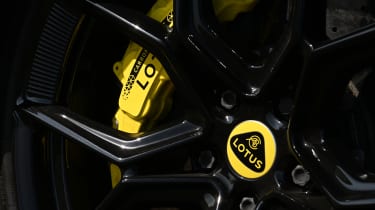
Both Emeya models can be equipped with carbon-ceramic brakes: 412mm discs with six-piston calipers on the front axle. While there’s not much response at the top of the pedal, there’s good modulation that allows you to bleed off speed as required, and the regen is well integrated, although in Sport mode and above it fades into the background.
The frustrating thing about the Emeya is just how convincing it is as a long-distance car. It has true GT credentials in the way it effortlessly rolls down the motorway for miles on end, and the huge cabin makes it genuinely usable too. The issue is, poor efficiency rinses the battery pack in these scenarios and while a 400kw+ charging speed makes that a non-issue should you find a fast charger, it will very likely cost you considerably more than a V8 equivalent on the same journey…
Interior and tech
- Solid build quality & materials
- Tactile, cold-touch physical toggles better than German rivals
- Unfinished software experience
The seat is positioned too high, but Lotus has created an interior that matches its claims for the Emeya being a hyper-GT. A high central tunnel provides a cocooning environment, wrapping you inside the car, and the large central screen is relatively intuitive to use – and quick in its response times – as well as looking as integrated as these things ever can. The occasional software glitch and illogical menu layout does make it feel a little unfinished, but the experience is good overall.
Lotus has also avoided the temptation to position switchgear somewhere different just for the sake of it, which is very welcome, but it has devised a unique solution for the steering wheel controls. Two tactile, cold-touch rotary pods are what you’ll use for media controls and altering the driver’s display, which feel expensive and very satisfying to use. The quality of the build and materials throughout the rest of the cabin matches this, making it a much closer match to the Porsche Taycan inside than you might expect.
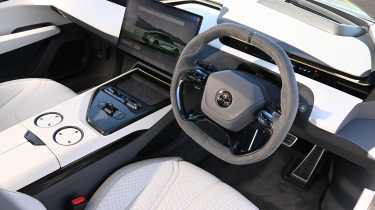
If you decide to option them (we’d suggest you didn’t), the digital-monitor wing mirrors take time to adjust to, your head instinctively looking at the skeletal arm hanging off the bodywork and staring at the camera within it rather than looking at the screen embedded within the door card. Conventional mirrors are also available; unfortunately a conventional instrument binnacle isn’t, the Emeya utilising a thin strip to display just how quickly you’re suddenly going after merely thinking about applying some throttle.
Price, specs and rivals
If it’s pure power you are after, Porsche’s Taycan Turbo S will give you 939bhp in return for £162,200 against the 893bhp and £129,990 Lotus charges for the 900 Sport range-topper – the 872bhp Taycan Turbo is closer to the Lotus on price at £135,200. If you can live with its 595bhp, the less powerful Emeya costs from £84,990, cheaper than even the entry-level 429bhp Porsche Taycan.
Audi’s e-tron GT family begins with the 576bhp entry-level car for £88,605, soon rising from there at £107,875 for the 670bhp S model, £126,475 for the 845bhp RS and £166,475 for the 912bhp RS GT Performance. You won't find it as readily available in the UK, but one of the only other hot electric saloons on the market is the Lucid Air from the US. With 1200bhp in Sapphire form and the best dynamic ability on the market, it pulls ahead of the Lotus, but you'll pay from $250,000 (c£190k) for the privilege.
Lotus Emeya 900 (R) specs
| Engine | Dual-motor, all-wheel drive |
| Power | 893bhp |
| Torque | 726lb ft |
| Weight | 2590kg |
| Power-to-weight | 345bhp/ton |
| 0-62mph | 2.8sec |
| Top speed | 159mph |
| Basic price | £129,990 |