The original McLaren F1 press release in full - Every detail of the incredible V12 supercar - McLaren F1 transmission
As McLaren re-publishes the full, original 1992 press release for its F1 supercar, it's a perfect time to celebrate the F1, we think

GEAR RATIOS OFFER AN ULTRA-CLOSE 5-SPEED CLUSTER FOR 0-160MPH, PLUS A 6TH-SPEED 200MPH-PLUS CAPABILITY
Wheelbase length in most mid-engined sports car designs is increased by conventional clutch and final-drive arrangements forcing the drive-output centre rearwards. Until now, all attempts to minimise wheelbase length – such as sitting gearbox and final-drive beneath the engine – have compromised handling, weight or efficiency.
In conjunction with Traction Products Inc., McLaren Cars has imaginatively solved such problems, with the McLaren F1’s final-drive gear offset alongside its clutch, absolutely minimising engine/drive output centreline separation.
This layout within a transverse-shaft gearbox – already inherently short front-to-rear – provides an exceptionally compact assembly within an extremely rigid cast magnesium casing accepting major rear suspension loadings.
The F1 is also the first production car to adopt current Formula 1 practise by featuring a 200mm diameter aluminium flywheel and carbon clutch assembly. Their extremely low mass and inertia greatly enhance engine response and efficiency, and also save weight.
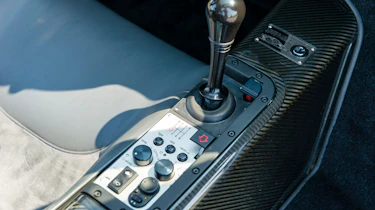
The 6-speed gearbox has a full synchromesh gearchange with helical gears for optimum strength, quiet high-speed running and quick and efficient gear-changing.
Further features include a sophisticated lubrication system, a remote clutch-operating mechanism tailored to provide optimum pedal weight and action, and an integrated purpose-designed starter system.
Gear ratios offer a close 5-speed cluster for 0-160mph (257km/h) plus a 6th-speed presenting a comfortable, peaceful and long-striding 33mph (53km/h) per 1,000rpm cruising gear – plus top speed capability well over 200mph (321km/h).
The final-drive assembly also features a limited-slip differential, while purpose-made constant-velocity jointed high grade alloy-steel drive-shafts are used.
As in all areas of the McLaren F1, exhaustive research and development effort has been applied to no-compromise design and manufacturing quality.