Rare Mercedes-Benz C111 rotary supercar set for first ever auction
Wedge-shaped, Wankel-powered Mercedes prototype will be sold through RM Sotheby’s in February 2027

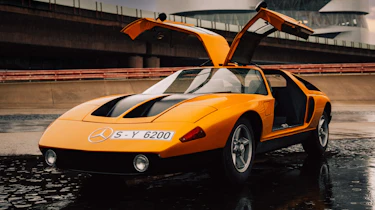
Short of the Le Mans-winning Mazda 787B, the ultimate rotary-engined car has to be the Mercedes-Benz C111-II, a prototype four-rotor sports car created by Mercedes in 1970 as part of a series of vehicles exploring new engine and chassis technology. And for the first time, Mercedes is releasing one of these prototypes into the wild, helping to put money towards development of its spectacular museum in Stuttgart.
The C111 wasn’t just a one-off, but a series of 17 prototypes built between 1969 and 1970, which were then tested well into the 1970s, setting a series of performance, speed, and fuel economy records as late as 1979.
The original C111 made its debut at the IAA Frankfurt Motor Show in 1969, powered by a three-rotor Wankel rotary engine, with Mercedes one of several companies that licensed the technology (others including Rolls-Royce, aerospace firm Curtiss-Wright, and most famously Mazda) in order to experiment with it as a potential replacement for piston engines.
In ‘Weißherbst’ metallic orange paintwork and with gullwing doors inspired by the legendary 300SL, the wedge-like sports car looked as cutting-edge as the technology it housed, but Mercedes quickly developed the concept, unveiling the four-rotor, 2.4-litre C111-II at the 1970 Geneva Motor Show. Now making 345bhp, it could cover 0-62mph in 4.8 seconds and topped out at 186mph. Those are numbers to humble the Lamborghini Miura.
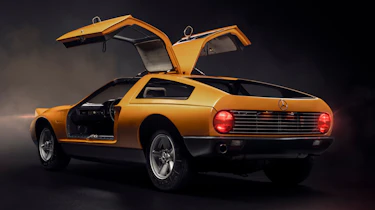
What Mercedes didn’t know was that just around the corner was 1973’s oil crisis. Rotaries are many things, but economical isn’t one of them, and in 1976 the C111-II became the C111-II D, with an intercooled five-cylinder turbodiesel engine in place of the four-rotor Wankel. Thus equipped, it set 16 speed and distance records, including averaging more than 251km/h (156mph) over 10,000 miles at the Nardò Ring in Italy.
C111-II begat C111-III, also diesel-powered but now wearing dramatically different bodywork, with a drag coefficient of only 0.195, which then became the C111-IV, now featuring a massive 4.5-litre twin-turbo V8. This engine in later 5-litre form would power the Sauber C8 Group C car.
It’s an example of the C111-II thought that’ll be auctioned off with RM Sotheby’s at the Palais du Louvre in Paris on 3 February 2027. Confusingly called Car 33 (unrelated to the number of C111s produced) it was the third C111-II produced, and is painted in that iconic Weißherbst hue, with houndstooth interior trim and a Becker Europa stereo.
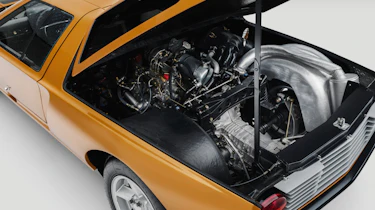
Car 33 has a colourful history, being among other things one of the stars of the first German issue of Playboy in 1972 (though it didn’t make the cover, for some reason…). It was also the car used to test the fuel flow from both side tanks, the prototype used for temperature measurements in the boot (if you’ve ever owned a mid-engined car, you’ll be aware of the importance of this) and for test drives at the Hockenheimring. And you’ll have seen yourself if you’ve visited the Mercedes-Benz Museum since its opening in 2006, where Car 33 has been on display in the Fascination Design section.
Its sale will go towards making the exhibits of that same museum available worldwide, as part of ‘Mercedes Museum 2.0’. One aspect will be a ‘digital twin’ that will let people all around the world learn about the very cars you can see on display when you visit Stuttgart, but the museum itself will be developed too, covering more recent automotive innovations as well as some of the brand’s more recent classic vehicles.
What will it fetch? There’s no real precedent, though partnering with RM Sotheby’s is no surprise. It was after all the auction house that achieved two of the highest values a car has ever attained at auction, with the €135 million SLR Ulenhaut Coupé in 2022, and a W196 R Streamliner for €51,155,000 in 2025. The only real question is whether the C111-II will hit seven figures, or eight…