Lucid Air Sapphire review – showing the Porsche Taycan how to make EVs fun
With three electric motors, an overhauled chassis and calibration and tuning inspired by the BMW M5 CS, the Lucid Air Sapphire gives us hope that big heavy EVs can be fun
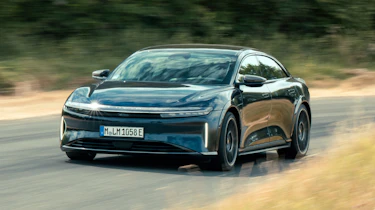
Visually, the Lucid Air Sapphire has changed barely at all since we first drove a prototype at Willow Springs three years ago. It still has the proportions of a long four-door executive saloon (its wheelbase is five centimetres shorter than a current BMW M5’s 3006mm) and looks that are very much of the melted-block-of-butter kind. Flame surfacing and jewellery are conspicuous by their absence.
Crucially, though, since that prototype drive, Lucid has finessed the Air Sapphire to a final production specification that’s been available since the tail end of 2025. The result is one of the most accomplished electric cars of its type we’ve driven, whose talents make an awful lot more sense when you learn that one of the all-time great super saloons, the BMW M5 CS, was the dynamic benchmark. ‘I continue to be amazed at how good it is,’ Lickfold told evo, explaining why it was the benchmark when we first drove the Sapphire. ‘At everything. It’s outrageous.’
Motors, battery and performance
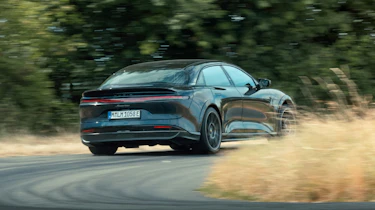
The Air Sapphire retains the 118kW battery, three electric motors – one for the front axle, two for the rear – and 1234bhp and 1430lb ft of torque. Seriously large numbers and there’s another: the 2422kg it recorded on our scales.
More reviews
Unless, of course, you want to see what those three motors can really deliver. They’re housed in Lucid’s integrated drive units, which combine motor, inverter and transmission in either a single-motor unit, as at the front, or a twin-motor assembly that also incorporates a differential, as at the rear. All-in, the weight is around 73kg per motor, with each motor producing 670bhp.
Stepping up to Swift mode still sees the Sapphire pegged at 767bhp, as per the default Smooth mode, but it brings it to a higher state of alert; still measured and calm, but with an undercurrent of intent. Unleashing its full performance, the Air Sapphire feels, well, as you’d expect a car with 1121bhp (Sapphire mode) or 1234bhp (Track) to feel: exhilarating, eye-widening and ever so slightly scary.
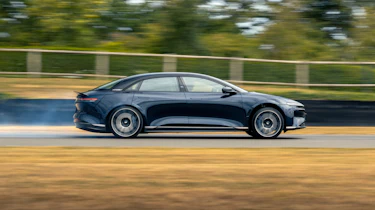
Deploy the full extent of its performance and it’s possible to see 60mph from rest in 1.9 seconds and arrive at 100mph two seconds after that. Astonishing and honestly, one of very few ‘track’ modes where you genuinely agree, it’d be best to avoid its use on the public highway.
> Polestar 5 review – cheaper and faster than a Porsche Taycan but not quite as sharp
The Sapphire doesn’t hit you like a monstrously powerful ICE car. It’s more intense than that. There’s not quite the flick-switch power you expect, but instead it’s like being caught up and then carried relentlessly forward in a stampede. The sheer scale of the forces at work feels oddly elemental. It hardly seems to matter, but for the record Lucid claims 0-60mph in 1.89sec, 0-100mph in sub-4sec and the quarter-mile in less than 10sec at something approaching 160mph. The acceleration alone leaves me feeling queasy for the next 12 hours or so. It obliterates an M5 CS, of course. Or a Ferrari SF90 come to that.
Ride and handing
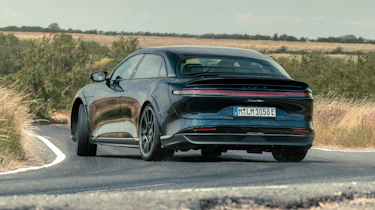
New front and rear wings stretch over wider tracks, the Sapphire rides lower and spring and damper rates for the Bilstein suspension are considerably increased. The changes made by chassis and vehicle dynamics director David Lickfold and his team have created a car of genuine intrigue and interest; one that you learn more about with every journey as you uncover ability and talent you genuinely weren’t expecting. There’s a solid reason for this, too, and it hails from Bavaria. When developing the Air, Lickfold leased a BMW M5 CS, and so impressed was he with the 2021 evo Car of the Year winner that he bought it off the lease company to retain it as a dynamic benchmark.
The result is an electric-powered saloon car that has some very clear Munich DNA flowing through it. If your experience of electric cars has been one of overly light controls, with little variation in weighting regardless of how much force you put in or is fed through the car, that’s not the case here. It fuels your curiosity as to why legacy manufacturers with many decades’ head start on Lucid have struggled to deliver such a resolved electric performance saloon.
Leave the Lucid in its Smooth mode and that’s exactly what it is. Linear, fluid and with a level of response that instantly makes you forget you’re in an electric car. The ride absorbs pretty much everything the UK can throw at it, only jarring on the sharpest of edges, and the body control is, well, like an M5’s: solid but with enough pliancy and movement to allow you to judge the loads you’re putting through it. The Air’s overall proportions are a few millimetres shorter, narrower and lower than a current M5’s and it steers with the detailed precision of that car’s predecessor. There’s a tightness about everything it does, and the throttle forgoes that short-fuse reaction so beloved of many electric cars, instead favouring a measured response that means you’re not bracing yourself every time you want to add some speed.
Push harder and a tension flows through the car, the steering and chassis feeling more connected to your actions, resulting in more direct reactions. The Bilstein DampTronic Sky two-way-adjustable active dampers now trade smoothness for a more secure footing, allowing you to work the standard-fit Michelin Pilot Sport 4 S tyres harder and touch the outer edges of the torque-vectoring system as it distributes the energy front to rear, left to right. Swift mode and above – Sapphire and Track are next – also virtually ‘shorten’ the wheelbase via the torque vectoring (there’s no rear-wheel steering), further enhancing turn-in and giving you more confidence to push.
Surface imperfections are transmitted more forcibly the harder you go in a higher setting, a result of the stiffer bushes (up 25 and 28 per cent front and rear respectively over a regular Air’s), springs (17 and 25 per cent) and anti-roll bars (27 per cent front and rear). The additional firmness is close to that of an M car running in its Sport damper setting. Funny that. But like the best M cars, it doesn’t feel stiff for the sake of stiffness; there remains a level of compliance you can work with, filling the feedback loop back to the driver. Hook up on a favourite road and the rhythm you can build is up there with the best supersaloons.
Driver’s note
‘As standard the big saloon can slip too easily into understeer and the power on offer is just a little too out of kilter with the chassis limits. In Sapphire form it feels much more joined up. You can attack and feel the car accept the lateral loading. The brakes have reassuring power and subconsciously let you know there’s plenty of grip to lean into. It’s a freer experience and presents more options for the driver.’ – Jethro Bovingdon.
Track test
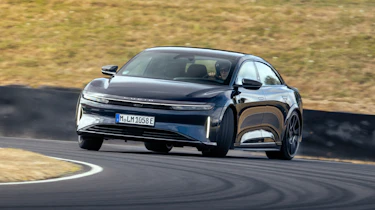
But those fundamental strengths the Sapphire displays on the road are still present on track, it’s simply that everything is coming at you so much quicker that you need to be wide-eyed awake and bring your A-game to managing the mass that’s in motion.
Unleash four figures of instant electric torque in a car weighing nearly 2500kg and your braking points need to be exactly that: on point. Those 420mm Akebono brakes earn their keep when that mass needs hauled back from the track speeds over 1200bhp can slingshot it to. Physics dominate here, the Sapphire diving onto its Michelins as it shreds velocity at an impressive rate, but you need a firm grip, and the feedback on offer through the chassis isn’t replicated by the brakes.
Where you’d like more modulation and feel through the pedal it’s too solid, and it takes quite a few laps to get comfortable with it. On the road the blend of retardation and regen is neat and near seamless, but when your focus is on pure performance it’s a rare weak point in the Lucid, and something that stays in the back of your mind each time you approach a braking point at three-figure speeds.
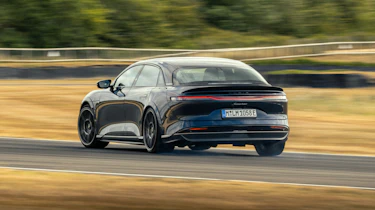
In every other respect, however, the Air Sapphire remains biddable and confidence-inspiring. Big-power electric saloons rely on their headline performance figures to deliver scarcely believable lap times. In the case of Porsche’s Taycan Turbo GT, the Weissach and Manthey packages are also required to provide the higher-fidelity feel and precision needed to extract its full potential on track. The Sapphire isn’t as extreme as Porsche’s electric track special, but you can manipulate it when you want to, induce some angle to your approach to an apex and find a balance on the way out.
> Porsche Taycan Turbo GT Manthey review – by far the most capable Taycan, but at what cost?
Like a big-engined supersaloon you can find a flow on track, stepping up to its limits and working within them rather than merely holding on. Be smooth, calm and accurate and you’ll carve a neat, quick and rewarding tour of any circuit. Let rip and you need to be measured if you don’t want to bleed away momentum. While you can turn the stability control off, it’s never fully off, and the life of the Michelins (the optional Pirelli P Zero Trofeo RS tyres weren’t fitted to our test car) is at the mercy of your right foot.
Design, interior and tech
Its looks might not elicit a jaw-drop moment, but the gurney flap on the bootlid and the 10-piston Akebono carbon-ceramic brakes hiding behind the 22-inch multi-spoke alloys tell those who will notice such details that this is more than just a regular three-box saloon.
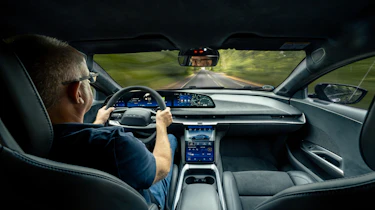
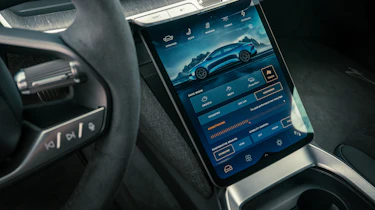
Meanwhile its interior is, well, normal. No flash, no chintz, no trying too hard to shout about its electric DNA. Yes, there are screens, but they don’t dominate. The steering wheel is wrapped in Alcantara, but the seats are more armchair than Sabelt, although they hug, grip and support you while also being immensely comfortable.
You sit a little high in the driver’s seat and you can’t help but feel there’s a lot of cabin around you. It’s beautifully finished, too. Lucid isn’t trying to reinvent the wheel here: everything is simply laid out with nicely weighted controls, good ergonomics and an impressive level of refinement. Should you be so inclined to use every one of the Sapphire’s 427 miles of available range, it’s an interior that would accommodate you and your passengers without complaint for the duration of the trip.
Price and rivals
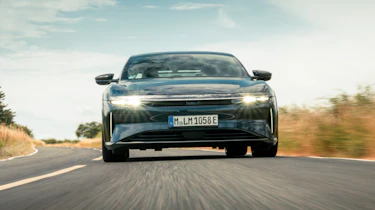
In the Air Sapphire, Lucid has demonstrated that an electric supersaloon doesn’t need to rely purely on its stratospheric power and torque outputs to win you over. It has also shown that the tangible feelings that a genuinely well set up and dynamically sorted car provide do not have to be exclusive to internal-combustion-engined cars. For these reasons, the Lucid Air Sapphire is one of the most impressive electric cars I’ve driven.
Its only problem – and it’s a significant one that can’t be ignored – is its €250,000 price. That’s still less than a Taycan Turbo GT with the Manthey package, admittedly, but it’s difficult to ignore the fact that you could buy a BMW M5 CS for around £100,000 less. You might also consider the aforementioned Porsches, now available with E-shift virtual gears, if such an extreme device is more to your liking. Mercedes-AMG now also offers the astonishing GT 63 4-door electric, though even with over 1150bhp, it’s still down on the Lucid for raw output. Madness.
Specs
| Motors | 500kW front, 2 x 500kW rear |
|---|---|
| Power | 1234bhp |
| Torque | 1430lb ft |
| Weight | 2420kg (518bhp/ton) |
| 0-60mph | 1.9sec |
| Top speed | 205mph |
| Basic price | €250,000 |