Mercedes-Benz S-class updated for 2026 - new V8 for Merc’s iconic limo
140 years after it launched its first car, Mercedes-Benz has given its flagship S-class a thorough update including new engines, advanced suspension and AI assistance

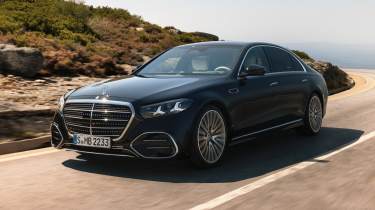
‘The most comprehensive update within one S-class generation’ is how Mercedes-Benz describes this packages of changes to its luxury flagship. While the base car is largely the same as the W223 generation launched in 2020, Mercedes says that more than 50 per cent of the whole is “newly-developed, updated and refined”.
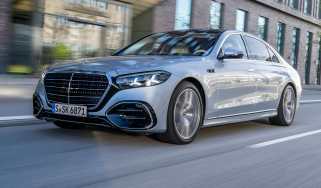
That equates to more than 2700 components newly developed or re-engineered, though some of those components stand out more than others – a few quite literally. For the first time, buyers can opt for an illuminated version of that three-pointed star standing above the grille, “[transforming] every arrival… into a memorable occasion”.
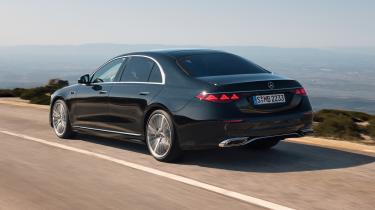
That’s one thing to watch for in your rear-view mirror anyway, though as on several other recent Mercedes, the grille itself – now 20 per cent larger – is also illuminated. The star motif makes its way into the headlights and tail lights – also in common with other Mercedes models – and for more lighting fun, light projectors in the sills beam the Mercedes-Benz lettering onto the ground alongside the car.
Lest you think the new S-class is merely a kind of wheeled Berlin nightclub, most of the rest of those 2700 revised components are more substantive, though some are still related to lighting. Mercedes was among the earlier adopters of complex headlight technology and its new Digital Light tech, using micro LEDs and advanced computer control, is said to improve the “high resolution illumination field” (the area without any light drop-off) by 40 per cent. Ultra Range high beams have a 600-metre range, and a partial high-beam function can dip certain parts of the beam to avoid dazzling other road users.
Another visual update somehow packed with more technology than you’d expect is a new 20-inch cross-spoke wheel option. Not much to report there, you might think, but using high-pressure casting technology Mercedes has been able to realise sharper contours and reduced thickness.
Powertrains and performance
With the EQS still handling electric power for Mercedes’ luxury clients, the S-class remains predominantly combustion-powered. There’s no V12 (unless you opt for the special-protection S680 GUARD), but a range of inline-six and V8 petrols, an inline-six diesel, and an inline-six-cylinder plug-in hybrid reside under that new illuminated badge. S450 and S500 versions use the turbocharged six petrol, each with 443lb ft of torque or 472lb ft for brief periods when accelerating hard. The six-cylinder diesel, meanwhile, has been reworked for cleaner emissions.
The S580’s twin-turbo, 4-litre V8 is an evolution of that in the outgoing car, now making 530bhp and 553lb ft, and notably now using a flat-plane crank, more like the engine in the old AMG GT Black Series, than the crossplane design typical of luxury cars. Mercedes says the benefits include reduced rotating mass, and better response and refinement as a result
Last up is the plug-in hybrid, which pairs the inline six of the regular petrol versions with an electric motor, for a combined 577bhp and 553lb ft – even more power than the V8, but the same torque output. All S-class engines are matched to 4Matic all-wheel drive.
Advanced ‘cloud based’ air suspension
If you never thought you’d hear the phrase ‘cloud-based damper regulation’ then today’s the day, as the new S-class features that too. Part of the Airmatic air suspension system with intelligent damper regulation, it can proactively detect irregularities in the road surface ahead (not a new technology, but still deeply clever), but also store data on speed bumps for 14 days using cloud computing, so other S-Classes (or your own, a few days later) can pre-prepare. Naturally, it can be optionally paired with E-Active Body Control – Merc’s anti roll, pitch, and lift system, which can also pop up one side of the car if it detects imminent impact.
Interior and tech
Finally (or at least, finally in a way that will hopefully retain your attention – Mercedes press kits are legendarily long and detailed) there are the interior changes. Mercedes’ own operating system, MB.OS (running on a water-cooled supercomputer – yes, really), underpins all the interior electronics, handles over-the-air updates, runs the MBUX infotainment system with navigation and an augmented reality head-up display, and the MB.DRIVE functionality that allows for automated parking and driver assistance systems. In China only for the time being, it also governs the semi-autonomous MB.DRIVE Assist Pro technology.
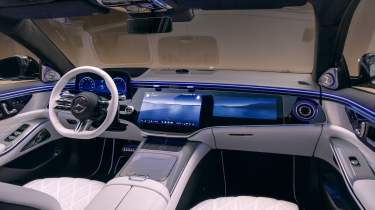
AI tech has inevitably crept its way in too, with Chat GPT, Microsoft Bing and Google Gemini providing extra functionality for the usual voice-activated “Hey Mercedes” commands, and a virtual assistant with two avatar options. MBUX itself runs on a “Superscreen” dash layout, with 12.3-inch displays for driver and passenger incorporated into the same continuous glass panel as the 14.4-inch central touchscreen.
Rear-seat passengers also get 13.1-inch displays (which include HD cameras for business calls), entertainment streaming, the option of two Burmester sound systems, purified climate control, and the interior as a whole has been redesigned with improvements to materials and connectivity.
The new S-class is available to configure and order from January 30. UK pricing hasn’t yet been confirmed, but the range starts in Europe with the diesel, at just over 121,000 euros including VAT – about £105,000.