1750bhp SSC Tuatara achieves 295mph top speed
Still quite some way off 2020’s debunked 331mph claim, a recent 295mph verified pass is impressive nonetheless
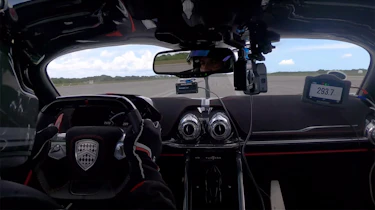
Following intense controversy surrounding the legitimacy of 2020’s claimed 331mph run, and a legitimate 282.9mph two-way average last year that made it officially the world’s fastest production car, the hypercar has now achieved a 295mph top speed.
The attempt took place at the Kennedy Space Center in Florida on a 2.3-mile stretch of tarmac, and unlike the first run, the car was fitted with dual VBOX GNSS data recording systems from Racelogic alongside a Life Racing GPS to ensure accuracy. To verify the legitimacy of the run, SSC also invited one of the biggest critics of the first, Apex Nuerburg's Robert Mitchell, to oversee the attempt – Racelogic technician Mitchell Townsend was also in attendance.
On May 14th 2022, car collector Larry Caplin achieved a 295mph peak speed in his very own SSC Tuatara, exceeding the 286.1mph peak he achieved in January 2021. This (still) comes with a caveat, though. A two-way average is required for top speed records to negate the effects of variables such as wind and surface inconsistencies, so although this speed stands it in good stead, the previous 282.9mph average is still the only official top speed that’s able to be put into the record books.
> Bugatti Chiron Super Sport 300+ marks 304.7mph achievement
Nonetheless, this previous figure does still make the Tuatara world’s fastest production car, eclipsing the 277.9mph average of the previous record holder, Koenigsegg’s Agera RS. The SSC Ultimate Aero was the American hypercar that briefly stole the title of world’s fastest production car from the Bugatti Veyron in 2007, and now its successor holds top spot.
Unlike some recent record breaking hypercars, the Tuatara attempting these speeds is said to be production-spec, and identical to the product delivered to customers. It is also wearing road-legal Michelin Pilot Sport Cup 2 and running on an E85 fuel blend, which is often used by other high-performance hypercar manufacturers, such as Koenigsegg, to increase engine performance.
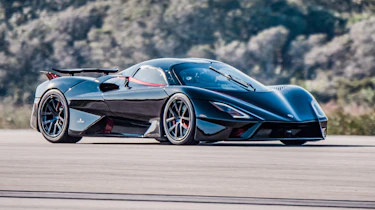
A twin-turbocharged flat-plane crank 5.9-litre V8 co-developed by SSC and Nelson Racing Engines is what powers the Tuatara, sending 1750bhp to the rear wheels through a seven-speed automated manual gearbox. The chassis it’s fitted within is a carbonfibre monocoque, and has a dry weight of 1247kg, the featherweight figure aided by carbonfibre body panels.
In order to reach such high speeds, more than just power is required, with the SSC team streamlining the Tuatara’s body to an impressive drag coefficient of just 0.279. SSC claims that it maintained a 37% front and 63% rear aerodynamic balance from 150mph to its peak speed during the first record attempt.
First customer cars have already been delivered, with a total of 99 to be produced in total, but pricing remains unconfirmed.