The British 'F1 car for the road' that caught fire and promptly vanished
Caparo, Ascari and Strathcarron… just three of the many plucky British sports car firms that burned brightly (and literally), all too briefly
In the aftermath of the Second World War, the British countryside was littered with redundant airfields, surplus to requirements in peacetime but ripe to be used for racing and developing cars. You can see the echoes of it even today. JLR’s R&D base in Warwickshire is built on an old wartime airfield, as is Lotus HQ in Hethel. Every year the British GP takes place on the site of RAF Silverstone. Having dozens of runways and taxiways upon which to hare around in cars helped to cement Britain’s motorsport expertise while giving it bountiful proving grounds on which to nurture a vast number of small sports car makers. The Wells Vertige is born from that tradition. But it’s also a tradition haunted by the ghosts of those who gave it a shot and disappeared just as quickly as they appeared. Or as quickly as their borrowed, mass-produced engines would allow. Remember Parradine or Delfino? No, no one does.
Some defunct British sports cars, however, linger a little longer in the memory. Ascari, for example, was subject to an excellent retrospective on its KZ1 in evo 301. Or how about the Strathcarron SC-5A, announced in 1998 with various promising details including a 1200cc four-cylinder Triumph bike motor, a lightweight structure designed by Reynard and involving aluminium, Kevlar and carbonfibre, a target weight of just 550kg and the involvement of ex-Lotus engineering brain Colin Spooner and Isuzu Vehicross designer Simon Cox? As is often the case with small British sports cars, the SC-5A garnered plenty of attention, but a yawning gap between initial review and start of production saw the spotlight swivel onto something else. It didn’t help that, after driving a production-spec car for evo 033, John Barker confessed to being ‘confused and disappointed’ by the frustratingly uncoordinated dynamics. Just to completely torpedo its chances, SVA regs changed to make it harder for the bike engine to meet road car rules and, despite plans for a cheaper version with glassfibre panels and a Rover K-series, the SC-5A sank after just six had been made. Strathcarron itself, however, was a consultant to the automotive industry long before its own-brand car came along and survives to this day in the same business.
> I called it the world's worst car, then the fans came for me
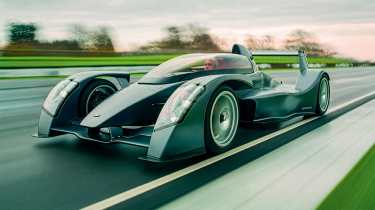
Caparo is another company that existed long before an ill-fated venture into car making, in this case as a multinational conglomerate best known for steel making. In 2006 Caparo bought Freestream, a tiny Surrey-based company founded by two former McLaren Cars engineers and adopted the project it had been working on since 2004, announcing it as the Caparo T1. The on-paper claims sounded nuts, even in an era when everyone was obsessed with the Top Trumps-winning Bugatti Veyron; a 2.4-litre V8 making around 450bhp but pushing less than 500kg for a power-to-weight ratio close to 1000bhp-per-ton and lots of hyperbole about an ‘F1 car for the road’, triggered by the car’s circuit-racer-meets-jet-fighter design. The newly named Caparo Vehicle Technologies claimed it would be making 25 a year for £150,000 a pop…
The next time the T1 was in the headlines was for a less positive reason when a test car caught fire during filming for Fifth Gear, leaving presenter Jason Plato with burns to his hands, face and neck. No wonder Henry Catchpole was required to wear flameproof overalls and a helmet when he drove the T1 on the road for evo 123 in 2008.
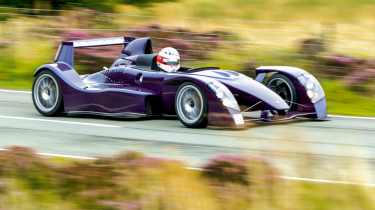
By now the car’s official weight had swollen to 672kg but power had also increased, to 610bhp at a heady 10,500rpm from a 3.5-litre naturally aspirated V8, giving a tidy 921bhp per ton. Unsurprisingly, Catchpole found it ‘bonkers quick’, but unfortunately power and weight were not the only things to have grown; the price had also put on a few pounds and was now well over £200,000 including taxes, which probably contributed to the T1’s lack of success. Officially, Caparo Vehicle Technologies didn’t close down until most of the Caparo group collapsed in 2015, but by 2011 it was already game over when the company admitted it had sold just 11 T1s and production had been halted to allow the car to go through a new ‘development period’, including plans for a more extreme track version, from which it never emerged.
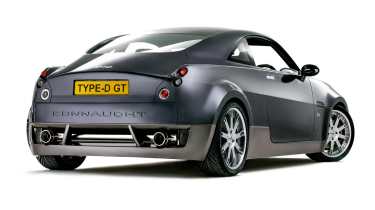
The Connaught Type-D never scorched a touring car champion nor generated any breathless coverage comparing it to an F1 car, but it also failed to reach the point where anybody could buy one. On paper this little coupe, first announced in 2004, seemed intriguing, not least for its 2-litre narrow-angle V10 allied to a far-sighted hybrid system. Reviving the name of a British racing team from the 1950s didn’t hurt when it came to getting some initial attention either. After that, however, the Type-D became one of those British sports cars that was perennially just around the corner and, despite claims of 20-plus deposits from customers drawn in by the talk of 300bhp, and a very pure chassis of double wishbones all round with no PAS or anti-roll bars, customer cars were still nothing more than a collection of bits and a first batch of V10 engine blocks when the money finally ran out.
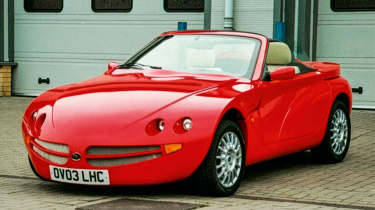
Relative to this, the FBS Census was a glorious success, what with three prototypes and five production cars entering the world before the company collapsed in 2003. The Census was formulated in the late ’90s by two former Rover Group engineers, Robin Hall (now behind the Wells Vertige) and Andrew Barber, initially as the FBS-1. Barber later admitted that FBS stood for something ‘quite rude’, but when it became the name of the company the official story said it was an abbreviation of ‘Future British Sportscar’.
Hall and Barber came up with an appealingly simple and compact two-seater with a 168bhp 2.5-litre Ford V6 driving the rear wheels and held a contest among Coventry University car design students to style its body. Unfortunately, a desire to avoid making something retro and predictable drove the FBS founders to pick a design by Italian student Giovanni Doglioli that certainly couldn’t be called predictable. Unfortunately, what it also couldn’t be called was attractive, and this might explain why sales were not brisk when the car went on sale in late 2001. Its launch price of 26 grand also landed it in the middle of the six-cylinder BMW Z3s, and they looked like oil paintings by comparison.
The Census reportedly drove very well but this wasn’t enough, and within two years FBS was making a last-ditch plea for an investor willing to chuck in half a million quid before officially going pop in September 2003. As a final ignominy, before it went bust FBS had realised it could draw more attention to the car with product placement and made a deal with the producers of an upcoming movie. The lag between shooting and release being as it is, FBS was already a memory when, in October 2004, not one but two Censuses made their big screen debut in a film called Fat Slags.
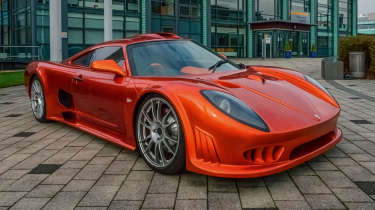
Much funnier than that terrible Viz spin-off movie was the Keating Bolt, revealed in 2013 with a visibly gimcrack show car and a claim that it would crack 340mph and sprint to 60 in two seconds flat thanks to a supercharged GM LS7 V8 producing a claimed 2500bhp. Whether anyone would want to do that sort of speed in this car was one thing. Whether they’d want to pay the asking price of £750,000 was another, especially once they saw the show car’s orange-peel paintwork and what appeared to be generic Ford interior door handles with the bit you pull crudely reworked into the shape of a lightning bolt.
Anthony Keating, company founder and managing director of a diesel generator business, talked a good game at the car’s reveal, proudly telling the Manchester Evening News that he was about to visit locations in the Middle East looking for a place at which his new car could smash the road car speed record. This wasn’t Keating’s first rodeo either, since in 2009 his previous model, the TKR, had hit a claimed 260.1mph at Salt Lake Flats in California, theoretically a record but unverified since the car hadn’t completed a second run in the opposite direction.
Did this really happen? Who knows. Did Keating lend a car to a blind bank manager in 2010 so that he could attempt a new sightless speed record of over 192mph at Pendine Sands only for Tony Keating himself to crash the car on that same beach before the record could be attempted? According to BBC News online, yes, that really happened. Did Keating later come up with a new model called the Berus, which seemed to be little more than a rendering until a prototype was seen losing control and smacking a kerb in the car park of Bolton University? Also yes, according to the Daily Mail, which has some (badly shot) video footage of this incident.
Did Tony Keating tell the Manchester Evening News in 2013 that he’d sold six cars so far, none in the UK, later fetching up in the US in 2018 making bold claims about building a 230mph coupe called the Viperia Berus before doing nothing of the sort and putting Keating Supercars into voluntary liquidation in 2021? Yes to all of those things. Despite the occasional hubris, the truth of the Keating saga seems to have been a simple tale of low sales and financial disaster. In fact, as we’ve seen many times, a classic British sports car story. Now, does anyone know what’s going on with TVR?
This story was first featured in evo issue 345.