Ferrari 456 GT review – an intoxicating yet forgotten modern classic GT car
Today’s Purosangue can trace its roots back through the GTC4 Lusso, FF, 612 Scaglietti and yes, the 456 GT. It’s a beautiful, forgotten Ferrari
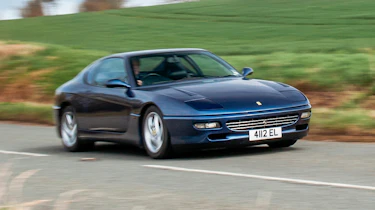
When Ferrari launched the 456 GT, or ‘F116’ if you prefer model type references, in 1992, the motoring press went into retrospective overdrive. Comparisons were invoked with Aston’s V550 Vantage, while others looked back and hailed the return of the front-engine V12 Ferrari by dusting off a Daytona and heading for a rendezvous with the hottest new Italian.
The thing is, Ferrari’s lineage of four-seat front-engined GTs wasn’t exactly fractured. The 365, 400 and 412i continued to carry the front-engined V12 flag for Ferrari, even if few people noticed or cared much for them. Nonetheless, the three years between the 412i’s discontinuation and the introduction of the new 456 don’t do justice to what looks like a three-decade gulf in style and elegance.
Ferrari 456 GT in detail
As the 1980s drew to a close, the world’s economies had cried enough and started a downhill spiral into oblivion. For Ferrari, it was looking bleak. Now under the control of the Fiat Group (Piero Ferrari, Enzo’s second son, still owned ten per cent of the company) its product line was old and weak, the company’s structure equally creaky.
The board was left with little choice but to make some big decisions. The first was to give the go-ahead for a new V12 coupe, the second was to employ one Luca di Montezemolo as chairman. The 456 was already in the development process when the former Ferrari F1 team boss returned to the company in 1991, but there was still time for him to leave his mark on the car before its debut at the 1992 Paris motor show.
The Pininfarina body was produced from aluminium and bonded to a new steel chassis. With a wheelbase 100mm shorter than that of the 412i, it was a compact car, not that it prevented the designers from installing two rear seats.
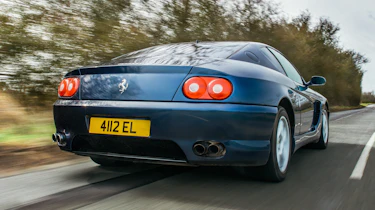
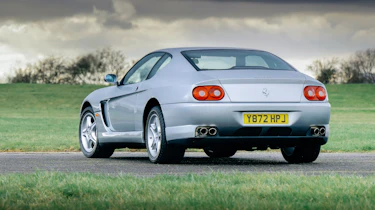
In an instant one could see where the Daytona comparisons came from. The 456’s low, long, sleek nose rose up to a prominent cabin that rolled into a curvaceous behind, with quad tail lights and exhausts the only visual breaks in Lorenzo Ramaciotti’s sweeping design. These and the Cavallino Rampante positioned dead-centre on the tail, of course.
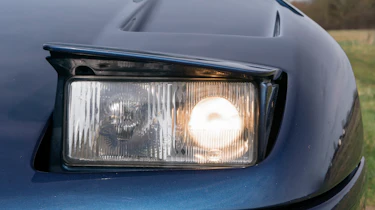
Over three decades later the 456 GT is still an arresting sight, largely because of a design unencumbered by the aerodynamic requirements that afflict today’s supercars. Ramaciotti’s creation is beautifully simple, with clean lines and no fuss, and airflow needs are handled with subtlety and sympathy. In a world of scoops and diffusers, it’s refreshing to be reminded how delicate car design was before ultimate performance headed the agenda.
The 17-inch alloy wheels are one of the few – perhaps the only – visual components that date the 456 to a time when tyre technology restricted a car’s rubber footprint. The ride-height isn’t as hunkered down and muscular as is the norm today, but this Ferrari just looks right, with not a duff angle to spoil your view.
With double wishbones and anti-roll bars front and rear, and adjustable dampers that monitored steering angle, road speed and acceleration to optimise the ride, this was the most technologically advanced chassis on a Ferrari road car yet. There was also a primitive traction control system hooked up to the ABS that worked with the ventilated discs.
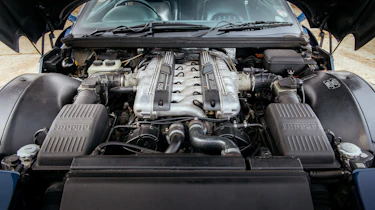
The 456’s blueprint may have been familiar, but beneath the svelte silhouette was an all-new Maranello motor – the 116B. This 436bhp V12 also marked a return to a Ferrari’s model name relating to the swept volume of one of the engine’s cylinders. And whereas previous Maranello V12’s had boasted a 60-degree angle between banks of cylinders, the 456’s was widened by a further five-degrees.
The block, cylinder heads, sump and sundry castings were all constructed from light alloy and the 88mm bore and 75mm stroke gave a suitably supercar-like 5474cc. With the engine’s four valves per cylinder, twin overhead camshafts for each bank and dry-sump lubrication, Ferrari clearly had no intention of watering down its powerplants to suit the economic climate of the day. There was also a six-speed manual gearbox and a limited-slip differential that was laid out in a transaxle. Yes, just like a Daytona…
Ferrari made two variants of the 456, in two generations: the manual GT and torque-converter auto GTA from 1992 to ’97 followed by the 456M (for Modificato) from ’98 to ’03, with traction control, body production moved in-house to Maranello after previously being outsourced to Pininfarina, and a carbonfibre bonnet among other refinements.
Ferrari 456 GT – Performance, ride and handling
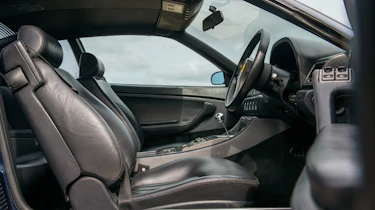
Hook your finger around the small handle in the door and it swings open without drama, reminding you that this is a V12 Ferrari with DNA very much from the era of gentlemen’s grand tourers. The opening is wide and there’s no extreme sill to negotiate on your way to the gentlemen’s club chairs that occupy the front row of the 456’s cabin.
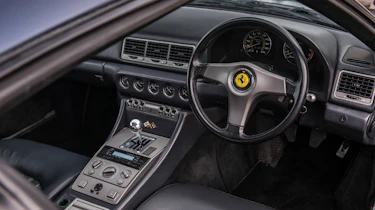
With your posterior positioned on the soft leather there is no car in the world you could possibly be in other than a Ferrari. The three-spoke steering wheel is thrust into your chest and, this being an Italian car, mastering a perfect driving position is not something that’s worth spending too much time on. With a car of this vintage that’s acceptable, a part of its character, and it doesn’t matter one bit. The owner is a little surprised when I mention the offset pedals, however: ‘It’s funny, I’ve never noticed it, but you get used to the quirks of your own car I guess.’
The 456’s interior has aged remarkably well. The grey hue and the size of the graphics on the dials date it, but ergonomically the thought of spending a couple of hours and a few hundred miles casting an occasional eye over those temperature gauges is one of anticipation, not trepidation. And of course, there’s that magical silver wand standing proud from an open gatehouse. If you’re of a certain age, an open-gate gearbox is Ferrari. Preventing today’s customers from experiencing it on the grounds of efficiency is the equivalent of preventing a farmhouse from having an Aga.
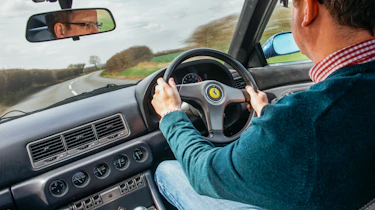
A gentle twist of the key is all it takes to bring the cylinders into life. Controlled by a Bosch ECU, all 12 fire in an instant but you can barely hear them hum. It’s all very serene. There’s no shouty exhaust valves opening on start-up or flaring revs. It’s nicely analogue in a digital world. Engine aside, your first impressions of the 456 are how it shrinks around you – behind the wheel the car feels 25 per cent smaller, a compact two-seater sports car rather than a four-seater GT.
The transmission tunnel is wide, though, and when you stretch for first gear you realise that the 456 can’t hide its girth. Pulling away is no more of a drama than doing the same in the Cayman I arrived in. Tantrum-prone Italian supercars? I don’t know what the fuss is about.
Okay, perhaps now I do. The engine is warming nicely but the gearbox oil is a little late to the party. Adrian recommends bypassing the next four gears and going straight to fifth to enjoy the tremendous reach of that V12. It’s remarkable. From no more than 25mph the engine takes fifth gear at an impossibly low crank speed without the slightest objection. I can’t help but laugh at that.
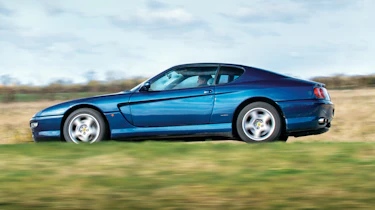
It doesn’t take long for all the fluids to reach operating temperature and then the 456 is ready to demonstrate what it is still capable of. The power steering is direct and quicker than expected, but it guides the front axle to exactly where you want it, the front end then staying resolutely on your chosen line. The rear tyres follow the arc you’ve carved, too, the chassis working as one, the adaptive dampers controlling body weight without sacrificing ride comfort or adjustability. The whole car talks to you, and at no point do feel on your own or that one area shines while the others live in its shadow.
Ask those dozen cylinders to deliver a stronger shove and the 456 responds with immediacy. Some of the 436bhp may have left the stable over the last two decades but I’d be surprised if it’s more than 10 per cent. This is a quick car and one you can work with. Ferrari’s initial claims of it being a ‘GT supercar’ are still well represented.
The 456 hasn’t enjoyed the buoyant rise in values that other models in the Maranello family have in recent years. It doesn’t have a racing pedigree – two-seater Ferraris are still the favoured choice when it comes to V12-engined cars – and there’s no hiding from the running costs. But at the time of writing, £50,000 for a fast and beautiful (not to mention practical) V12 Ferrari finished and launched in the Montezemolo era appears criminally good value to me. It may be more of a grand tourer than a supercar in today’s world, but you’ll struggle to find a better way to tour than in a 456 GT.
Ferrari 456 GT values and buying guide
You might need to swallow a particularly hefty brave pill before buying a used Ferrari 456. Paul Weston and Graeme Lambert both took the plunge and, a little like the red and blue pill options in The Matrix, they’ve had two quite different experiences – but neither regrets taking ownership of Ferrari’s epically elegant 2+2 V12 grand tourer. ‘At the time, in late 2021, I’d bought probably the cheapest manual 456 in the country,’ Lambert says. ‘Which, naturally, is not the way to do it. And I must say, that is how it’s playing out…’
Although the car itself cost a mere £42,500, some unexpected jobs, including rectifying a fuel leak caused by something perishing in the tank, a new radiator and a failed heater matrix (a £5k fix) have resulted in some supercar-worthy bills. Graeme is sanguine about it: ‘It’s a 25-year-old Ferrari; they’re expensive and you do need to go in with your eyes open. It’s one of the most expensive cars the company made; prices were toward £180k towards the end of its production run, and parts costs are still in line with that. Do I regret it? No – so far.’
Key to the purchase was a desire to own a special car with a greater spread of abilities than a two-seater sports car: ‘I need to take two child seats,’ says Graeme. ‘A 911 would have been a sensible buy but the rear seats are a little cramped to accommodate them, and I need to get a pushchair in the boot. I also looked at an Aston Martin DB9 but I wanted a manual.’ (The vast majority of DB9s are autos.)
Like Graeme, Paul Weston owns an early manual car, and regularly uses it to taxi two young children. ‘It was designed for the glory days when you would point it at Nice, cruise at 150mph and arrive some eight hours later, completely unruffled. It’s a completely effortless engine.’ The 5.5-litre V12 generates 436bhp and was good for as much as 190mph when the 456 was new.
Weston echoes Lambert’s sentiments on parts: ‘Ferrari parts are as expensive as you’d expect, but some are at least compatible with Fiat and Alfa parts. I haven’t had any horrific bills; a best friend is a Ferrari mechanic at Prestige Auto Care in East London, which keeps the costs down. ‘I didn’t actually set out to buy one; I was looking to buy a Ferrari 550 Maranello. What swung the 456 was finding out this car had been owned by Nigel Mansell.’ Mansell reputedly ordered two from the stand at the Earls Court motor show; one in left-hand drive to be shipped to Florida, and this right-hand-drive car for use in the UK.
While once upon a recent time, values grounded out at £25k, bottom-dollar (buyer-beware) cars today are high 30s to mid 40s, excellent cars over the £70k mark. You’ll pay around a £20,000 premium for a manual car compared to an automatic with similar miles, spec and condition.
Ferrari 456 GT specs
| Engine | V12, 5474cc |
|---|---|
| Power | 436bhp @ 6250rpm |
| Torque | 406lb ft @ 4500rpm |
| Weight | 1690kg (262bhp/ton) |
| 0-62mph | 5.2sec (claimed) |
| Top speed | 186mph (claimed) |
| Price new | £167,714 |
| Value now | £40,000-90,000 |