Audi Q7 review – the new BMW X5 has its work cut out
Audi has beaten the BMW X5 to the punch with the launch of its full-sized Q7 SUV. It’s a familiar recipe despite a new look, but that’s no bad thing
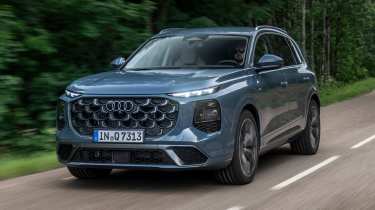
Over two decades since the Audi Q7 made its debut, we find ourselves on the France-Switzerland border behind the wheel of the third-generation of the full-sized SUV. It might be all new on paper, with an entirely fresh, butch aesthetic to go with it, but my time behind the wheel proved the recipe is surprisingly familiar.
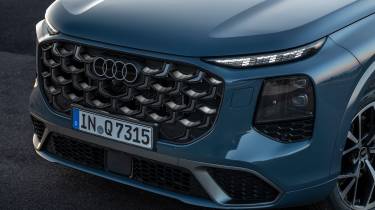
It’s 4cm wider and even taller than the previous car thanks to a new horizontal roofline, and it feels it on first impressions. This is a big car, but it works with these dimensions well, with its deep-dish wheels pushed out to each corner and its upright front end placing its slim daytime running headlights right at the edge of the bonnet. It looks a little frumpy from behind but overall it makes a strong statement, without the shock factor of the new X5. Perhaps the BMW will age better over time but the Audi’s more conventional look will no doubt be favoured by some.
> The Audi Q9 is a huge family hauler to rival BMW’s X7… but there’s a catch
Engine, gearbox and technical highlights
- Mild-hybrid V6 diesel the sole UK option, for now
- Quattro all-wheel drive and eight-speed automatic as standard
- Advanced lighting tech includes projected indicators
While BMW’s new X5 will be offered with a total of four unique powertrains in the UK, ranging from diesel, to plug-in hybrids and the fully electric iX5, Audi’s kept things refreshingly simple with the Q7: there’s just a single powertrain available for UK buyers until petrol and plug-in hybrid models become available later on. Thankfully, it’s a good one. A 3-litre turbocharged V6 diesel with 48V mild-hybrid assist is what Audi went for, producing 295bhp and 465lb ft of torque. For context, BMW’s black-pump X5 equivalent produces marginally more power at 309bhp and 494lb ft.
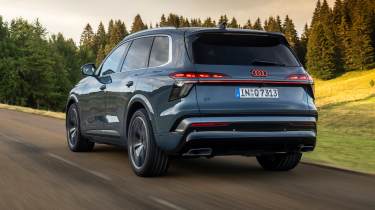
Drive is sent to all four wheels as standard via Audi’s latest iteration of ‘Quattro’, now said to require less space for improved package, create less resistance for improved efficiency, and weigh less too. The sole transmission is Audi’s eight-speed Tiptronic from ZF, and up to 18kw of mild-hybrid boost not only allows for torque fill and improved response off the line, but fully electric, engine-off running at low speeds. Performance stands in line with BMW’s equivalent, just a tenth behind the X5 40d at 6.2sec from standstill to 62mph and to a slightly higher 146mph top speed.
The Q7’s powertrain is quite conventional, then, but the tech Audi’s thrown at this car certainly is not. There are more lights and electric motors in this car than most cities, with each individual section of the (huge) grille downlit with independent LEDs. The rear lights are ‘third-generation’ OLED units and the indicators are capable of projecting animated directional arrows onto the ground at each corner of the car to make everyone around you more aware, in theory.
Performance, ride and handling
- Long-travel throttle in Comfort that improves in other modes
- Automatic Drive Select mode works seamlessly
- Low-speed ride occasionally lacking with 23-inch wheels
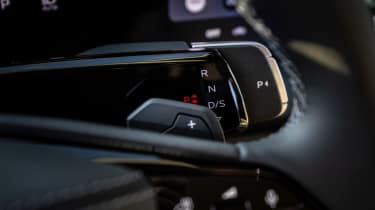
This is a car designed to move a fair few people and their luggage, so dynamic focus is far from the priority. Select drive via the unusual column-mounted shifter, a feature carried up from elsewhere in Audi’s lineup, and you’ll immediately notice the Q7’s appropriately relaxed nature, running silently in electric-only mode off-throttle and at parking speeds, with the rear-wheel steering making manoeuvering considerably easier than its huge dimensions would suggest.
It might have hybrid assist, but the Q7 requires a boot full of throttle at low speeds to achieve any sort of meaningful acceleration. This could well have been a deliberate move from Audi to make it a more comfortable, relaxed experience for the occupants. It can also be a little frustrating when you need to make quick progress away from junctions. This isn’t to say the powertrain is lacking though, as once that 3-litre V6 has received the signal to go, it does so with conviction – this is also when one of the Q7’s neat tricks come into play.
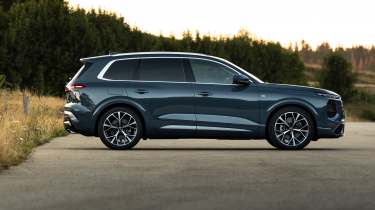
This is the first car to come with Audi’s automatic Drive Select feature, which allows the driver to forget about manually switching between Comfort, Balance and Dynamic. Monitoring various parameters such as steering input and speed, throttle input and lateral acceleration, the Q7 quickly switches between modes itself to extract the best from its hardware depending on the scenario. I’d be lying if I said I wasn’t sceptical, but in real-world use it chose the mode I was looking for each and every time, before quickly switching back to ‘Comfort’ should I suddenly change my driving style. It’s a neat solution to today’s endless drive modes, and something we hope to see in its more driver-oriented models soon.
Once in Balanced or Dynamic there’s plenty of response and torque available down low, with its transmission calibrated well to short shift on part-throttle to make the most of that torque – the V6 engine tone even increases marginally when you push on. The Adaptive air suspension (available optionally as a package with rear-wheel steering) firms up noticeably in Dynamic to enhance body control, allowing the Q7 to manage its mass and tackle these well-paved mountain passes with much more confidence than you’d expect for a car of this stature. The steering has no real feel but response is good, high-speed grip and stability excellent and the well-calibrated rear-wheel steer adds a sense of mid-corner agility that feels at odds with its dimensions.
It’s not perfect, though, as at lower speeds and dropped into the softer Comfort mode, there is still an occasional edge to the ride that upsets the cosseting experience you might expect. The worst imperfections make their way right into the seats, which we can at least partially blame this car’s huge 23-inch wheels for. On the UK’s mottled roads, smaller wheels are definitely a wise play.
Interior and tech
- Interior offers impressive space, especially headroom
- Heavy reliance on touch controls
- High quality materials and strong build quality
Those increased exterior dimensions aren’t just for show, as the new Q7 feels huge inside too. Headroom is especially impressive and contributes to a comfortable, airy feel when combined with the optional dimmable panoramic roof (£3125) – it felt as if the airport transfer Volkswagen Transporter I travelled in had less headroom. Audi says this is largely thanks to the Q7’s redesign, with a completely horizontal roofline increasing the height at the rear over the previous car.
Our particular test car was finished with homely wood trim, but the overall look is contemporary. The centre console is sparse now the gear selector has moved to the steering column, with an enclosed dual cupholder, a few buttons for vital controls such as the start/stop button and a dual MagSafe-compatible wireless phone charging zone which covers almost half of the available space.
A conventional V6 diesel, high-end materials and strong build quality all feel like a step in the right direction. However, for whatever reason, the Q7 still hasn't managed to dodge the plague of capacitive touch controls. Start/stop button aside, there are virtually no other physical buttons to be found, with the steering wheel getting touch pads similar in design to those Volkswagen has just been forced to ditch for real buttons.
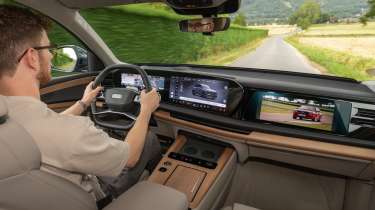
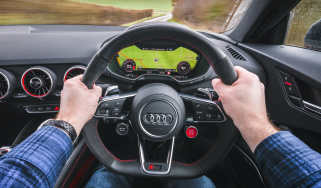
Thankfully the steering wheel itself is slim and firm to match the Q7’s premium positioning, and the 14-inch central infotainment display is snappy and relatively easy to navigate – just don’t expect to have anything other than a plain grey background behind your icons unless you pay a fee. There’s a 12.3-inch passenger display as standard, which will be great for some, and a complete gimmick for others.
The Q7 is just as much of a tech fest inside as it is outside, with Vorsprung models getting a 22-speaker Bang & Olufsen sound system including ‘seat shakers’ for improved bass response and headrest speakers for clarity. It won’t blow your mind like the Naim system employed by its Bentley relatives, but it’s strong for day-to-day use nonetheless. All four doors are soft-close, as you’d expect, but they’re also motorised in an effort to make them easier to open and close. The odd straining sounds of motors and sense of resistance you get as a result feels a bit clunky, especially when you know that other markets make full use of this hardware to allow the doors to fully open and close automatically at the touch of a button.
In the UK, the Q7 will come as a seven-seater as standard and while this is a configuration that usually sacrifices all useable boot space in some cars, the Q7 retains a good amount of luggage space with the third-row in place. You get 722 litres of capacity when they're in place and 1980 litres with them down, just 95 litres less than the five-seater. It will come in plug-in hybrid form at a later date but the UK won’t receive the option of a six-seater.
Price, specs and rivals
The new third-generation Audi Q7 starts at £81,665 for the S-line, which comes with 20-inch wheels, Dinamica microfibre inside, Matrix LED headlights and all three interior displays as standard. The Edition 1 stands in the middle of the range at £88,965 to bring elements like darkened exterior trim, 22-inch wheels and Nappa leather upholstery to the equation, with £101,665 the figure for the range-topping Vorsprung.
This might make the Q7’s starting point around £10,000 more than the outgoing car, but it’s likely that rivals from elsewhere in the market will match it – BMW is yet to confirm pricing for the new X5, but the Range Rover Sport only marginally undercuts the Q7 at £77,620.
2027 Audi Q7 specs
| Engine | 3-litre turbocharged 48V V6 diesel |
| Power | 295bhp |
| Torque | 465lb ft |
| 0-62mph | 6.2sec |
| Top speed | 146mph |
| Basic price | £81,665 |