Rolls-Royce Spectre Series II review – is this the world’s quietest car?
Rolls Royce’s first EV has been a sales success, and now there’s a new version with subtle updates and a longer range. We get an early taste on track at Goodwood

Who said high-end electric cars are a dead end? Well, we have, many times. With the proviso that when it comes to high-end electric performance cars, demand is nowhere near where it needs to be at the moment, as demonstrated by Porsche putting its electric 718 on hold, Lotus turning back on its EV-only plans and Lamborghini cancelling its first electric car. In this arena where sound and connection really matter, combustion is still king, without a doubt.
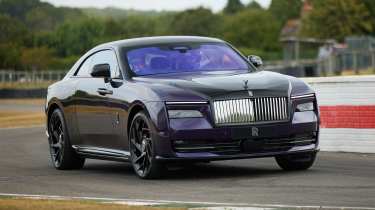
The Rolls-Royce Spectre, however, demonstrates that in the right application with the right execution, electric can be desirable in the premium sphere. The two-door, four-seat coupe is the brand’s first EV and four years on from launch, it’s established itself as Rolls-Royce’s best selling model in the UK, beating the Phantom, Ghost and even the (un)fashionable Cullinan. There’s a reason for that. While electric powertrains rob performance cars of their character and involvement, their smooth, silent power delivery are a perfect fit for a hyper luxury car. Less alluring than a V12, sure, but even better at facilitating the effortless, hushed driving experience of a Rolls.
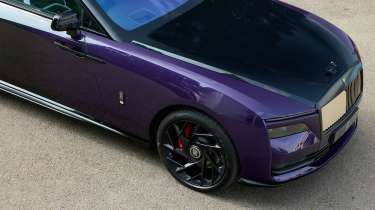
Now there’s a new Spectre, called the Series II. Given the success of the first generation Rolls hasn’t sought to change much, keeping the design and character largely the same while bringing the powertrain up to date, and offering new personalisation options for customers to seek their teeth into. As well as being the most popular model in the range in the UK, the Spectre is one of the most heavily personalised, acting as a 5.5-metre blank canvas for bespoke paint schemes, trim choices, upholstery and fine detailing from Rolls-Royce’s Bespoke division. Among the new options for the Series II are blended two-tone exterior paint options, plus a new interior fabric called Duality Twill. Imagine the fabric print of a Gucci bag with puffy quilting and you’re most of the way there.
More reviews
There’s a new 23-inch forged wheel design but aside from that, there’s not much to distinguish Series I from II visually. Instead most of the work has been carried out under the skin, targeted at the Spectre’s battery and motors. New battery cell technology has boosted capacity from 102kWh to 112.4, resulting in a range boost from 329 miles to 390. Charging times have been reduced too, a 10-80 per cent top up now taking 28 minutes at a 195kW charger, as opposed to 34.
As before there are standard and Black Badge models to choose from. In base form the Series II generates 593bhp and 749lb ft of torque – up from 577bhp and 664lb ft – while the Black Badge is the most powerful production Rolls ever, with peak outputs of 671bhp and 811lb ft available in its Spirited drive mode.
The goal for a Rolls-Royce has always been to have a surplus of power rather than chase peak performance, so you could argue that the extra juice is a token upgrade rather than a necessity. You could also argue that the location Rolls has chosen for our first drive of the Spectre II in prototype form isn’t exactly suitable for a 2.9-ton behemoth of an EV: the fearsome, zero-margin Goodwood Motor Circuit. Nevertheless, we won’t be lapping at full speed here – instead Rolls has laid on a few driving exercises to explore the car before we test it in production form. It’s far from a true test of the car’s capabilities in its intended environment but should give hints at what it can do.
In the pits at Goodwood the Spectre is even more imposing than it looks in pictures. Imagine a traditional luxury GT, say a Bentley Continental, blown up to 120 per cent-scale to give an idea of its sheer size. The height of the bonnet, the size of the wheels and the amount of metalwork on display seem closer to an SUV than a coupe. The motorised, reverse-hinged door provides access to a truly sumptuous cabin. It's far less digitised than most modern luxury cars, but that's a good thing. The relatively modest centre display is operated via a rotary controller, and most major functions are handled by physical (mainly metal) switchgear. I wouldn't say every surface is absolutely top notch – the piano black surfaces aren't the most premium, and you'll find more tactile switchgear in a previous-generation Audi – but the Spectre feels ultra luxurious without being fussy or try-hard.
It feels enormous from the driver's seat, where you're perched high and look down a tall, long bonnet. But once moving, the Spectre does a remarkable job of putting you at ease, offering just the right response to every input. The throttle calibration allows you to pull away perfectly smoothly, and rounds the edges off brisk getaways too. Likewise the steering, which has superb accuracy. Turning into Goodwood’s first corner, the Spectre has an unexpected level of precision, the nose seeming to follow exactly where your eyes are looking. To be clear, this doesn't make the Spectre feel like a sports car – far from it – but it plays a part in making it much more wieldy than a near three-ton Rolls should be.
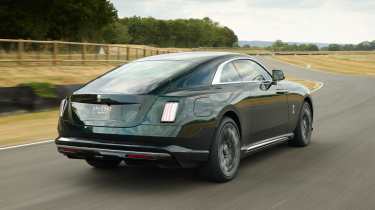
Goodwood is a huge test of a car's damping and control, and initially it feels like the Spectre's body is moving a little too freely on its air suspension at modest speeds. Expected for a luxury car and part of the wafting sensation a Rolls should deliver, but it means the Spectre needs a brief moment to settle after a bump and return to its equilibrium. Either way, the general feeling of calmness and comfort are excellent (although it's hard to gauge refinement levels with a lid on), and guiding the Spectre around the lap is effortlessly smooth. The brakes help here. They're beautifully judged in terms of travel and modulation, allowing you to step into the pedal and scrub just the right amount of speed almost imperceptibly, without disturbing the flow. As a test we perform an emergency stop from 70mph (which does disturb the flow), and the Spectre nosedives and comes to a halt in an impressively short distance, with no drama. You can hear and feel the ABS working but there's no kickback through the pedal.
A slalom course on Goodwood's pit straight demonstrates the power of the rear-wheel steering, which allows the Spectre to tuck in through the direction changes and shortens its turning circle at either end. It's also an opportunity to feel the effects of the active anti-roll bars. Below 10mph they disconnect to benefit ride quality, resulting in more body roll. Above that speed they tense up, which you feel as extra firmness in the steering and more resistance to roll, although you're still working with a fair few degrees of lean.
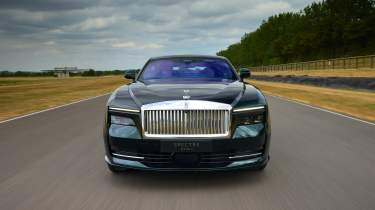
The Spectre isn't a car that encourages you to sink into the throttle for extended periods, but when you do there's huge performance on offer. It doesn't kick you up the road with the immediacy of most fast EVs but it piles on speed effortlessly, with only a gentle hush of increasing wind noise. The Black Badge’s Spirited mode makes it more potent still. In launch mode (yes, in a Rolls-Royce) it reaches 62mph from rest in 4.3sec, compared to 4.5 in the standard car. Top speed in both is 155mph.
Even when using the full performance the Spectre is measured and serene, and you feel like you can keep up with the rate it gathers pace. Get to a corner and you're very aware of how much momentum you're carrying, but there's good grip to lean on and the balance is stable. It's certainly not a car to be hustled and feels wayward if you're too aggressive, but grip falls away with plenty of advance warning and there are no nasty surprises at the limit. With the proviso that we only had the chance to push through a couple of corners, with the stability control switched on.
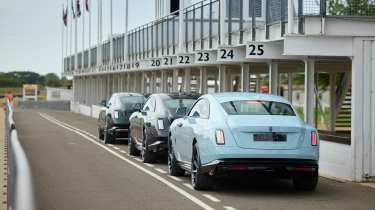
A one-pedal driving function lets you bleed out of the throttle to decelerate to a stop. The calibration is again smooth and seamless but it takes some getting used to. Even driving well below the limit you arrive at certain corners at 100mph, so you naturally want to use the brake pedal. But with time you learn to back off early and let the system trim off speed, before introducing the power again. And when coming to a complete stop, the Spectre gently rolls to a halt with no secondary jolt.
Driving a Rolls-Royce on track is like taking a GT3 RS on an M25 commute. You're so far from the car's intended environment that you won't draw any conclusions about its abilities beyond surface level impressions. But in a Rolls the surface level impressions are hugely important too – the finer points of how every touchpoint is calibrated, and how easy and effortless it is to drive. In this sense the Spectre Series II ticks pretty much every box, and though nothing major has changed, this early taste indicates not much needed to.