Volkswagen Golf GTI Edition 50 review – the best hot Golf in years, and the fastest hot hatch we’ve tested
With the Edition 50, Volkswagen has produced the most hardcore road-going Golf since the Clubsport S. It’s the best Mk8 yet, and the fastest hot hatch we’ve tested on track

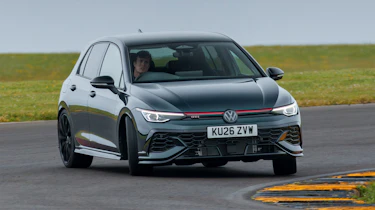
At the risk of beating a dead horse, it’s fair to say the Mk8 Volkswagen Golf didn’t live up to its promise at launch. Partly due to a frustrating touch-based HMI system, but also that the GTI didn’t drive with the polish and poise we’d come to expect from previous generations, or rivals such as the Honda Civic Type R and Hyundai i30 N. The updated Mk8.5 has addressed some of our key concerns with improved infotainment and refined dynamics, but the GTI still lacks ultimate star quality. It’s a good hot hatch, make no mistake, but not one you’d yearn to own.
The new Edition 50 version changes that. For the GTI’s fiftieth birthday celebrations, Volkswagen pulled out all the stops to produce by far the most focused Mk8-era Golf yet. Taking inspiration from the sensational Mk7 GTI Clubsport S – a certified all-time great hot hatch and Nürburgring record breaker – the changes are comprehensive, spanning the suspension and geometry, electronics, tyres and engine.
The goal? To follow the tyre tracks of the Clubsport S and reclaim the Nürburgring front-wheel drive production car record. An attempt last year in the damp put the Edition 50 over a second behind the current champ, the Type R, but the Golf has since gone quicker, beating the record by 0.3secs. In summary, this is a very serious hot hatch.
More reviews
Group tests
In-depth reviews
- Volkswagen Golf R (Mk7, 2014 - 2020) review – a brilliant bargain hot hatch of the modern era
- Volkswagen Golf GTI review – still the definitive hot hatch?
- Volkswagen Golf Mk8.5 review – still the hatchback benchmark?
- Volkswagen Golf R (Mk8.5) review – a better hot hatch but not the best
- Used Volkswagen Golf GTI (Mk5, 2004 - 2009) review – one of the best VWs of the last 30 years
The Edition 50’s key upgrades come as part of an optional Performance pack, which adds £3675 to the £48,075 list price. Where the base car gets the same suspension setup as the GTI Clubsport, the Performance pack drops the ride height by 5mm and includes stiffer springs, with a retuned calibration for the DCC dampers. The net effect is 12 per cent less roll than the Clubsport.
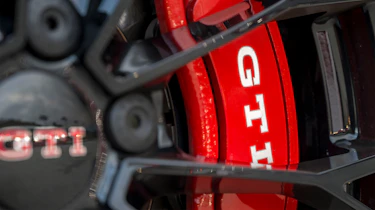
Lighter 19-inch forged wheels and uprated Bridgestone Potenza Race tyres trim 13kg, with a titanium exhaust saving a further 12kg, and there’s a host of smaller but equally significant changes throughout. Such as stiffer bushings in the front control arms and a stronger hub fixing for the rear track rods to minimise unwanted geometry changes under load, plus stiffer damper top mounts and revised tuning for the steering, XDS+ locking diff and stability control. New front hubs, meanwhile, enable more negative camber – up to 2deg, compared to 1.33 for the Clubsport.
The result of the changes is that the Edition 50 gives off a genuine sense of purpose from the moment you get rolling. There’s noticeably more precision and connection to the steering than the GTI Clubsport on which it’s based, and a stiffer edge to the ride. The Bridgestones kick up a fair bit of noise on rough surfaces, too. The whole car immediately feels more eager and intense.
It’s more powerful too. An extra 25bhp and 15lb ft have been teased from the Clubsport’s EA888 turbo four-pot, giving the Edition 50 a healthy 321bhp and 310lb ft. It’s never been the most characterful engine, but there’s a gutsy, gravelly delivery from down low that gives it a real sense of muscle. It sounds pretty good from inside too, and in the Golf’s racier drive modes (there’s Eco, Comfort, Sport, Individual and a ‘Ring optimised Special mode) there’s sharp response from the top of the pedal before the boost hits full force.
It doesn’t zip through the last 1000rpm like the more free revving Civic Type R motor, but more of a shame is that there’s no option of a manual gearbox. The seven-speed DSG shifts quickly and cleanly but there’s no joy to be had from its puny plastic paddles. Engineers admit that more tactile paddles were considered, as well as a proper manual – even to the extent that a three-pedal prototype was built. What a shame that didn’t materialise.
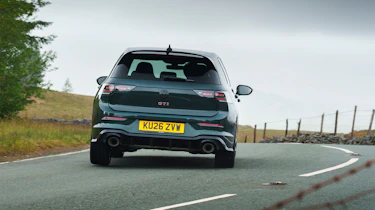
Though the powertrain delivers the goods in performance terms, it’s more of a supplement to what is a very grippy and tenacious chassis. On winding roads the Edition 50’s dynamics capture your attention above all else, for all the right reasons. Not since the mighty Civic Type R has there been a front-drive hot hatch that feels as nailed down at the front end, in both wet and dry conditions. The Edition 50 can take huge levels of commitment, to the point where you gradually carry more speed and wind on more lock to find the limit. Before you do find it, you’ll be in awe of the grip the GTI generates.
Special mode is a good starting point on the road, in that it dials up the responsiveness of the drivetrain while softening the dampers to work with lumps and bumps, but once you’re dialled in it’s worth venturing to Individual to fine tune things. On a slippery, technical road you can go a notch or two softer than the Comfort damper mode to introduce more roll and load the car up more progressively, while dialling back the steering to Comfort for lighter efforts, helping the car feel freer and more agile. More so than in lesser GTIs (or in fact the Golf R), you change the modes to tweak what is a fundamentally focused and exciting package, rather than trying to unlock more character from the car.
There’s also the option to dial the ESC back to a half-way Sport setting or fully off. Sport is well judged in that it minimises wasteful wheelspin while still allowing some rear movement to help you into and through corners. So configured, you can pick the road apart with real confidence, leaning on the engine’s mid-range and accurately tracking between the white lines, the body movements controlled and the inside rear wheel skimming the ground as you dig into the front grip. Hold the brakes through the turn in phase and there’s a sense of the car pivoting around its nose, which can turn into a flick of oversteer with more aggression. When you do eventually find the limits of the front end you can bring the car back to neutral with a slight lift and balance it neatly through the apex.
Turn the ESC all the way off and the GTI still inspires huge confidence – the rear is mobile but not nervous, and when it does break away it’s a progressive slide rather than a snap. When it’s wet, however, the absence of the systems is much more noticeable. Too much throttle out of slow corners and the diff locks up and sends the nose skating wide. At times you also get nasty oscillations that shake the structure when the fronts lose traction, something cars based on this VW Group-wide MQB platform seem to particularly suffer with.
In terms of the ride,you do notice more harshness and reactivity than a normal GTI. It thumps over sudden imperfections but as speed gathers, it becomes more fluid and much more settled. And unlike the regular car, which can feel floaty and lacking control in the softest damper modes, the Edition 50 still has plenty of control when wound back to Comfort, or even a couple of clicks below that. Sport is a better choice for attacking an undulating road, however, minimising roll and keeping the body in check when fully loaded up over bumps. At higher speeds there’s a fantastic sense of stability, and combined with the measured on-centre steering response, you can place the car with neat inputs and minimal corrections.
Does that make the Edition 50 a match for the Civic Type R? In terms of its grip, balance and how quickly it can cover ground, absolutely. But there’s still a gulf to the Honda in terms of the finer details of the driving experience. The steering doesn’t have the same stunning clarity and feedback, for instance, and the brake pedal is softer with less bite. Generally, the Honda feels more connected and finely polished, and gives you more joy when you’re not extracting everything from it.
On track
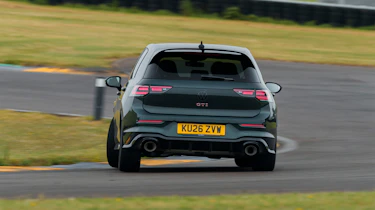
On track, however, the Golf lands a killer blow. While it's ultimately still not as satisfying as a Type R in subjective terms, it has a higher performance ceiling and generates a much faster lap time. In our hands on the same day at Anglesey Circuit, the Golf posted a 1:17.49, putting it one second ahead of the Civic, and not far off a 2014 Nissan GT-R. Not only is it the fastest front-wheel drive car around the Nürburgring, it’s the fastest hot hatch we’ve ever timed on track.
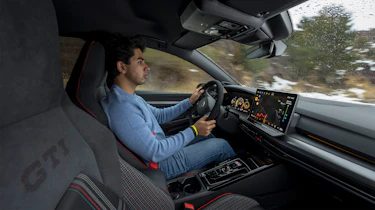
And that’s despite it not looking like a track-focused hatch in the way that, say, a Renault Sport Mégane or Civic Type R does. The visual transformation isn’t nearly as significant as the mechanical one – compared to the Clubsport you get darkened Volkswagen badges, naff stick-on decals along the sills and the upgraded lightweight wheels, and that’s about it. The cabin is pretty much unchanged too, aside from red seatbelts and bizarrely, red pedal faces. And unlike the old Clubsport S you won’t find a strut bar and netting behind you, because with the Mk8 Golf being five-door-only the Edition 50 retains its rear seats.
A strong front end is again the standout feature on circuit. You can attack the entries of corners where a Civic Type R needs a little more patience, the Golf diving in and holding a tight line without the rear becoming unstable. On the way out traction is excellent, the XDS+ differential shuffling torque to make best use of available grip. It’s less aggressive than a Civic Type R’s diff, with less of a sudden breakaway when both fronts lose traction.
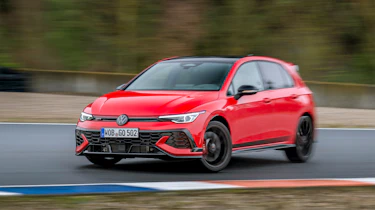
Slightly disappointing is that the brakes don’t seem as resilient as you'd expect for a car with a track-focused brief. They generate great stopping power but the pedal gets longer after consecutive hard laps, and doesn’t have the reassuring bite and fantastic feel of a Type Rs. Very few cars do, in fairness, but a more consistent pedal would help when modulating right at the limit of the ABS.
In high speed corners you can continue to lean hard on the front end without the rear becoming nervous, although a Type R offers a greater sense of precision and stability at very high speeds, feeling lower, wider and more composed, more like a sports car than a hatch. With better tyres (the Civic Type R comes on Michelin Pilot Sport 4 S’s, which are less sticky than the Golf’s Bridgestones) you sense the Honda would close the performance gap, but as they are the Edition 50 is the more capable track car.
It’s impressive in the wet too, considering the aggressive tyres it's running. You can’t hustle the car as you can in the dry; instead you brake deep and set up for a late apex, and then keep a straight wheel under power to give the front tyres a fighting chance of finding traction. In ESC Sport the car manages slip to soften the breakaway of the front axle when it loses traction, and also intervenes to stabilise the rear if it edges wide mid-corner.
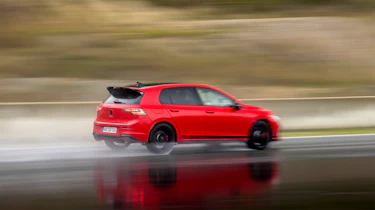
With the ESC Off it’s much more playful. A light mid-corner lift brings the nose towards the apex, while brushing the brakes induces bigger angles that can be caught by nailing the throttle, pulling the front straight. There’s a wide window to work with and the adjustability of a traditional hot hatch is present and correct, but crucially, this doesn’t come at the expense of a stable rear end.
On the way out of corners, however, trying to drive the Edition 50 quickly can be frustrating – as with most aggressively set-up front-drive cars in the wet. You want to chase the throttle, but get a little too greedy and the car suddenly walks itself wide as the diff locks up and the wheels spin. A side effect of more aggressive diff tuning than the Clubsport S.
Overall, though, the Edition 50 is undoubtedly the most exciting and engaging Golf GTI since the Clubsport S. So much sharper and more vivid than any other Mk8 in how it drives and pulls performance from the road, it connects you to the process of carrying speed rather than simply delivering the numbers. It’s a little more uncompromising but still perfectly usable, and the rewards are worth the trade-off – and then some. The attention to detail lavished on it shines through in how it drives.
Price and rivals
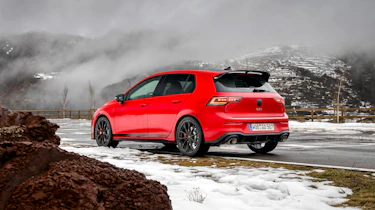
In its price and performance level, the £48,075 Edition 50 squares up against our undisputed hot hatch king, the Honda Civic Type R (although the Golf needs the £3675 Performance pack to unlock its potential.) The Honda has sadly been discontinued, but nearly-new examples are available for under £50k. The Edition 50 doesn’t have the same sense of absolute polish and fine-tuned brilliance as the Civic, but the balance and aggression of its chassis are a match.
Also at a similar price level is BMW’s M135, but even with its optional M Dynamic pack, it’s no match for the Golf’s intensity and focus. The same goes for the more subdued but still quick AMG A35. From Volkswagen's own stable there's the Cupra Leon 300, but while it's more involving than a GTI Clubsport, the Performance pack-equipped Edition 50 is a much more serious hot hatch.
Such is the current state of the hot hatch market that most of the GTI’s core rivals, such as the Hyundai i30 N and Ford’s Focus ST Track Pack, have fallen by the wayside. Which leaves the Edition 50 in a unique position as the most track focused new hot hatch you can buy for £50k.
Volkswagen Golf GTI Edition 50 specs
| Engine | In-line 4-cyl, 1984cc, turbo |
| Power | 321bhp @ 5500-6500rpm |
| Torque | 310lb ft @ 2000-5400rpm |
| Weight | 1395kg |
| Power-to-weight | 234bhp/ton |
| Tyres as tested | Bridgestone Potenza Race |
| 0-62mph | 5.3sec |
| Top speed | 168mph |
| Basic price | £48,075 |