SEAT Leon Cupra (2014-2020) review - ride and handling
Very quick and grippy, allowing for fantastic cross-country pace – but lacking in the last-word involvement of its most engaging rivals
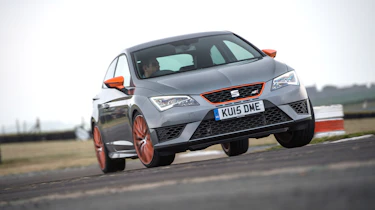
Sitting lower than the less powerful Leon FR by 10mm at the front and 5mm at the rear, the Cupra has the same MacPherson strut/multi-link suspension layout but with three-way adjustable dampers (so-called DCC) including a Cupra mode that sets everything to firm. As well as weighing some 55kg less than the previous Cupra R, the combination of the new car’s variable-ratio steering (dubbed ‘progressive’ by SEAT) and the mechanical diff is said to have knocked chunks off lap times round any circuit.
Where the similarly powerful Ford Focus ST does its thing in block capitals with a liberal sprinkling of exclamation marks, the SEAT’s approach is more chilled and measured and, as an ownership proposition, probably more satisfying.
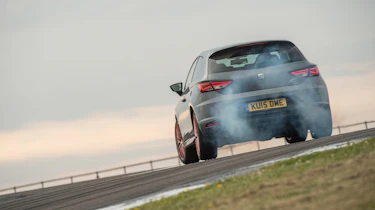
Partly it comes down to the pace it can carry into and out of bends. There’s a degree of looseness to the initial few centimetres of damper travel, giving a very slight sense of remoteness to the body control, but once you’re really into the corner with the car leaning hard on its outer tyres that sense fades entirely.
Similarly, the standard brakes are strong, but the big Brembo items on the Cupra R provide massive stopping performance, which is sustained over a fast run across a twisting mountain road. The electronically controlled LSD on the front-wheel-drive hatch does a good job of deploying the torque to the road, but a Quaife torque-biasing differential would be more effective still. Estate models fitted with the Haldex-style all-wheel-drive system fix the traction issue, and with the full 345bhp on tap and its slightly longer body, is more open to movement from the rear axle, utilising the extra momentum to rotate and then hitting harder out of the corner. It’s nothing like as tail-happy as the heavily augmented AMG A45 S or previous Focus RS, but does feel more willing to play.
evo Comment
‘Within the first few hundred metres, the Leon feels more potent than the Civic, pulling with an intensity I’ve never experienced in any other front-driven car. The Leon has two more aces to play. As the corners come thick and fast along this dark, cresting road, it occurs to me that braking in a Sub8 is more-or-less optional – but when you do eventually have to brake, you’ll stand the car on its nose so abruptly that the chasing pack will need to be paying attention.’ Dan Prosser, road test editor, evo 216 (evo Car of the Year 2015)