New Aston Martin Valhalla Spider – Ferrari’s 849 Testarossa Spider has a direct rival
Aston Martin’s long-awaited hypercar is now available with a removable roof. We have all the details from the people who developed it
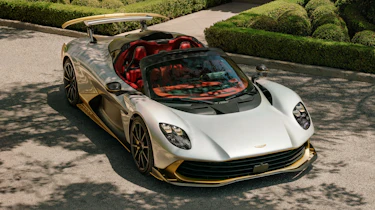
Aston Martin has officially revealed an open-air version of its Valhalla hybrid supercar. The Aston Martin Valhalla Spider is exactly as described: a roofless variant, available with a removable carbonfibre hardtop or fabric soft-top.
Aston Martin committed to building 999 Valhallas in total, and that hasn’t changed: the Spider will account for around one in four of all Valhallas sold, within that 999-car run. Although the Spider wasn’t planned from the very outset, when the Valhalla was first on the drawing board, it has been in the works for some time; the Spider’s development has been approximately a four-year process. Like the Valhalla coupe, the Spider features active aerodynamics, a carbonfibre construction and a 1064bhp hybrid powertrain, inclusive of the AMG-derived 4-litre, twin-turbo V8 and a trio of electric motors.
Exact pricing is yet to be confirmed however the Spider will have an approximate 40 per cent uplift in price over the coupe, making it around £935,000. Customer deliveries will begin around autumn 2027, with private viewings already having taken place before the Spider’s public reveal.
Aston Martin Valhalla Spider in detail
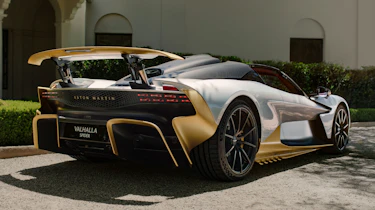
evo has been talked around the car in situ within Aston Martin’s Gaydon headquarters by chief engineer Andrew Kay. There are three possible roof configurations: a single-panel carbonfibre hard-top; a ‘semi-soft’ roof with solid cant rails and a solid element in the middle; and an emergency shower cover, for use in a sudden downpour, and not intended to be fitted while driving.
Like the Valhalla coupe, there is unfortunately no boot for luggage. However, the first two roofs are designed to be stowed behind the passenger seat (though that does mean losing a bit of seat travel). There is also now a new extra storage solution: having gone over the package with a fine-tooth comb, Aston’s engineers have found a small volume of space in the sill area behind the doors, and have created a 15-litre cubby hole on each side, in which the emergency rain cover can be stashed. The opening panels for the cubbies are inboard of the ducts which feed the transmission oil cooler on one side and engine cooling opposite. The spaces also allow storage of items such as the first aid kit and warning triangle.

The main change versus the coupe is in the Valhalla’s upper structure. Whereas the coupe has a ‘T-bar’ section of sorts between the door shut-lines, the Spider’s cockpit is naturally completely open when the roof is removed.
‘The carbon tub gives us a great place to start from,’ Kay says. As a result, weight increase is minimal over the coupe. The Valhalla Spider weighs 1680kg dry, with lightweight options fitted, compared with 1655kg for the Coupe. The dry weight has gone up because some lightweight options are not available on the Spider, plus the roof mechanisms and additional stowage space.
The removable roof created cooling challenges
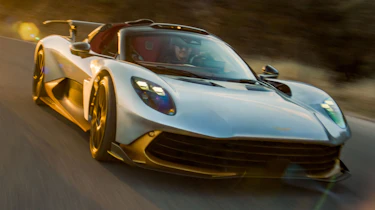
One of the key challenges in converting the Valhalla to Spider spec was maintaining airflow to its ‘snorkel’ intake at the rear of the roof. This has several crucial jobs; feeding the turbochargers through air boxes and the two large charge-air coolers directly above the engine, plus further cooling elements. ‘The car doesn’t work unless you feed that snorkel with air,’ Kay says.
Roof removed, the airflow cannot be marshalled into the snorkel as it is on the coupe. ‘One of the obvious challenges with taking the roof off is that the minute you take the [roof] panel away, the air tends to wander off unsupervised,’ is how Kay puts it. The Valhalla Spider therefore has a taller snorkel, and a crucial addition at the top of the windscreen: a deflector which is clipped into place when the roof is removed.
The deflector features aerodynamic elements to redirect air downward into the intakes, yet also directing it above occupants’ heads. ‘We wanted very high levels of comfort in the car because it's an Aston Martin, but we had to feed that snorkel, so that was probably the single greatest challenge in [creating] the car,’ Kay says.
Without the wind deflector installed, the Valhalla Spider is restricted to parking speed only. The deflector folds into three parts, and can be stowed in the side sill storage area. With the hard-top in place, more than 600kg of downforce can be achieved, as per the coupe. Without the roof fitted, the active aero systems rebalance the car continuously.
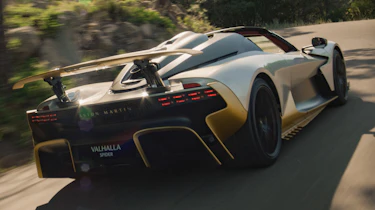
‘Because we've got active aero front and rear, we can control exactly where the balance point in the car is,’ Kay explains. ‘So if the rear wing is getting less “switched on,” we wind down what we do in the front to make sure we keep the balance. Generally we aim for a 40:60 aero balance, front axle to rear axle, which is the same as the weight distribution because you want the car to continue to feel natural. If you had lots more front downforce because you’re going faster, suddenly you might feel like you're driving a different car,’ he continues, ‘so we try to maintain a natural feeling through the speed range so that it doesn't suddenly change its character.’

Whether the hardtop is on or the roof is off completely, the top speed is limited to 217mph, the same as the coupe. That makes the Valhalla Spider the fastest open-top Aston Martin ever (since the Valkyrie Spider’s top speed was limited to ‘only’ 205mph with the roof open). With the soft-top in place, top speed is automatically limited to 200kph (124mph).
Sitting inside the cockpit, the dihedral door is much easier to swing closed than in the coupe, which requires a bit of muscle – Aston Martin has worked on the mechanism to make it an easier swing. The view out is very similar to the coupe: Kay explains that the low, cab-forward windscreen header height has been maintained in the transformation from coupe to Spider, creating a more open, airy feeling than most typical convertibles, where the header is positioned directly overhead.
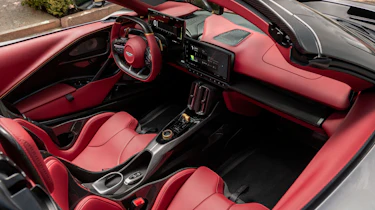
‘Sometimes in these cars, you take the roof off and you barely know because the header is right over your head,’ Kay says. ‘In this car, the header is so far forward, you get lots of sunshine.’
Other changes compared with the coupe have been minimal. Suspension alterations are limited to fine tuning, to account for the very slight differences in weight and balance. There’s likewise been a slight retune on the stability control and active aero systems to rebalance accordingly. The aim is for the Valhalla Spider to feel almost exactly the same to drive as the coupe, only with the added enjoyment of the open air. Although Kay adds, ‘We've been developing it through the winter, so all of our driving has been bloody freezing...’
Colour and trim is as customisable as you’d expect, with gloss, satin and tinted carbon finishes for various surfaces and split-colour breaks. There are new, wider seats with lower side bolsters, to make it easier to climb in and out when either roof is in place and allow a little more hip room. The original Valhalla ‘sports seats’ can still be specced as an option.
The Aston Martin Valhalla Spider is being revealed at an event in Las Vegas; the US is expected to be the car’s biggest market.