The engineer so good he got banned, and designed a £30k sports car you can buy
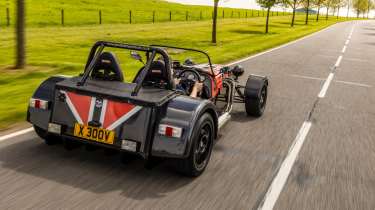
From 1:10-scale beginnings via building kit cars, Richard Hall’s passion for engineering led to the creation of his own modern‑day Lotus Seven interpretation, the GBS Zero
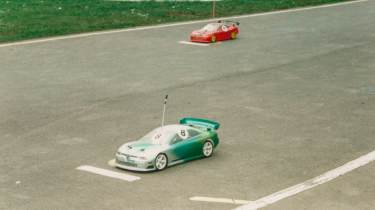
Racing radio-controlled cars is an underrated first chapter in a life built around cars. Speak to many racers or engineers and the seeds of their passion were sewn in karting, season upon season of competition ruthlessly funded to nudge the lucky few into their dream jobs. Richard Hall, founder of Great British Sports Cars, is proof that your future career can instead be held literally in the palm of your hands.
‘I’d always enjoyed mechanical things and started doing radio-controlled car racing when I was around seven,’ he says. ‘I got my first car, a Mardave, made in Leicester, and joined the local club in West Bridgford, racing at club level. By secondary-school age I was competing at national level in the Tamiya Euro Cup, then 1:10-scale Touring Cars, building all my cars and eventually getting sponsorship.
> GBS Zero review – a convincing Caterham alternative?
‘RC paddocks are a leveller; as a kid you’re on the same hierarchical level as adults and having conversations with them as peers. It had a different feel to school.’
Competitors also learn to tune their car on sight rather than feel, responding to the way it leans into corners as they spectate from the sidelines. ‘You can watch someone else and know what their car needs to go quicker. And it’s crucial. In a five-minute race you have probably two-tenths of a second between you and your nearest competitor. Over 30 laps, and god knows how many corners, how much you miss an apex by is a small but key difference.
‘You learn a lot about car dynamics. It’s probably harder than full-size cars, really, because with the “big” car you’re in it, you can feel what’s going on, and it’s all scaled up.’
Minute innovations and engineering nous seize the day on a shrunken RC circuit. ‘You have a rubber tyre with foam inserts,’ says Richard, ‘so you can use various densities of foam. Or drill a hole in the wheel to let the air out at different rates. I loved making my own bits for the cars, customising them and coming up with ideas that made them loads quicker… until I got banned.’
It’s this smaller scale (but no less intense) world that fully ignited Richard’s obsession for automotive engineering, a move from 1:10 to 1:1-scale assemblies following in short order. ‘There was a feature in one of the RC magazines about kit cars,’ he recalls. ‘I had never realised you could build your own car. Dad and I built a kit while I was at sixth form; I really enjoyed that. I ended up selling it, studied Chemical Engineering at university, then went on to make my own cars.’
GBS has sold over 1000 cars since its 2007 conception, its Seven-adjacent creations shipped as far as Chile and New Zealand. It not only pieces together the Zero sports car – fully, or in kit form for hobbyists – but lovingly crafts its own parts, too, the shelves of its Nottinghamshire base stocked with beautifully crafted components from Hall and his employees’ fair hands via the vast array of machinery he’s accrued over the years.
That first kit car was a Robin Hood, which ‘needed a lot of reengineering to make it nice’ according to Richard. ‘That was welcome, really. You learn a lot more that way. We made pedal boxes and all sorts. We did a few trackdays and ended up selling it to a guy at Donington. It was a bit weird. We were just chatting to him in the garage and he asked if it was for sale. We’d had no intention of selling it, but a deal was done then and there.’
Next came a Locost 1300 Crossflow, which Hall built to compete to 750 Motor Club rules. The full-circle moment was GBS’s acquisition of the Robin Hood business in 2006, a year before setting up its own stall.
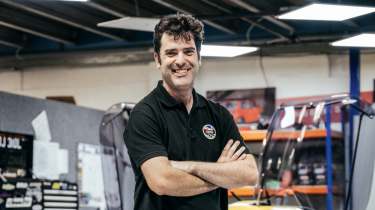
‘The idea was to build a modern-day Seven. Using those Lotus and Colin Chapman philosophies but asking: how would you build the car today, now that power and engineering design concepts have all moved on?’ Hall hadn’t long turned 21 and was now co-directing his own kit car company. Richard’s sister Ruth now runs the marketing side and their dad pops in and lends a hand too. ‘It’s quite a family business,’ he smiles.
Its avoidance of outsourcing sets GBS apart. ‘The kit car market has changed a lot since we first started. People were prepared to muck about a bit more, have a bit more hassle using older bits. We’re finding there’s still demand, but a lot more people are wanting polish. It’s a bit easier doing our own hubs and suchlike, where they can just fit and work straight away. We’ve still got a core kit using a donor car, but we’re a full component builder now, so you can spend more and have a Zero with no donor parts on it.’
GBS Zero kits start at four grand – if you’re willing to source a Mk1 Mazda MX‑5 benefactor – with fully built cars leaving the company’s Ollerton HQ from a mite over £40k. Around 85 per cent of its sales are currently self-builds, but Richard hopes to grow the share of factory-assembled Zeros. While the kit car market is much smaller than when GBS launched, the firm’s components end up in the hands of a wider demographic than one might imagine.
‘We have a few father-and-son projects. Also bikers that have had a few scares but still want something fun. And the education sector; we’ve just dropped a kit off at a college today. We’re building the idea of a GBS Academy where they either have a kit and we support it, or they come here for visits and we can create a bit of a community.’
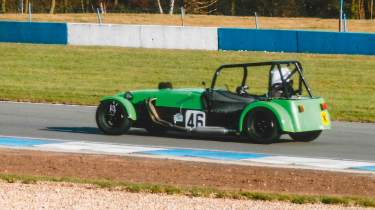
There’s a very open mind amidst Richard’s engineering brain, then, a point hammered home by the Zero EV. With 300bhp, it’s more powerful than a stock Zero Duratec yet commands little more cost than its ICE siblings in pure kit form.
‘We did the first electric Zero about six years ago, which I think was a little too early. We’re now at a point where it’s actually viable as a project. It’s going to be a little bit more niche but it’s a properly sellable product. It attracts a different customer to your typical petrolhead but there’s a bit of a market there. It’s also good from a company point of view. We’re learning all the technology in-house and there aren’t many small manufacturers that have actually built an EV platform from the ground up. It gives us expertise we could potentially put into something else.’
His GBS Engineering arm has seen other, more obtuse opportunities pass through the doors, from folks tying themselves in knots attempting to IVA their vehicle to an actual aerospace project. ‘We had a guy with an old Lola T70 which he wanted on the road, something it was never designed for. So it was getting all the lighting positions right and seatbelt points, that kind of thing. We had to lower the floor because of how little height is in the roof.’
Richard clearly thrives on such curious challenges. ‘I think from a commercial point of view, we probably shouldn’t take some of these things on, but it does generally all work out and something else will spin from whatever we do.’ He’s even worked with Vertical Aerospace on its electric take-off and landing gear. But when it comes to motorsport, Hall’s feet are more firmly on the ground – at least for the moment.
‘There are quite a lot of us who’ve got a real passion for motorsport. I was always very conscious that if we started racing, we might ignore everything else. It swallows money and resource and we wanted to build the business first, but we’ve now got our racing car demonstrator going out a few times a year. We’ve got full FIA homologation on the Zero chassis now. I think we’re the only Seven-type car to have that. So it’s a case of getting that out there in front of people wanting to compete, run race schools, etc.’
Hall’s own racing career is small, amounting to some sprinting when he’d first built the Locost, but he’s keen to dig into competition more. ‘We really want to get a car in British GT – if we can find someone that’s got a few quid and wants to team up and do it. Why race against other Sevens when our FIA approval means we can compete with Aston and Ferrari? It’s just finding a bit of funding. You look at how much they’re spending on some of these new GT racers. We could do something pretty good for a fraction of the cost and be competitive.’
It’s an ambitious target from very humble beginnings, chiefly the early, Pinto-engined Ford Sierra handed down from Richard’s grandad as his first car and thus the parts donor for his first kit. ‘I did loads of mucking about with that and then we pulled it apart and used all the bits from it. Then I had a Fiesta hot hatch, which was a right laugh.’
His transport for a long time has been an Audi A5 V6 TDI that now proudly wears 240,000 miles (and counting). ‘We’ve had other toys so that’s been the daily driver,’ he assures me. ‘It does 40 to the gallon and five-point-something to 60. It kind of does everything and – touch wood – it’s not been too difficult to run. It’s needed a couple of springs on it. Loads of tyres and brakes. The belt broke on the diesel pump, which was a 20-minute fix. Considering the mileage and the hammer it’s put under, it’s been pretty good.
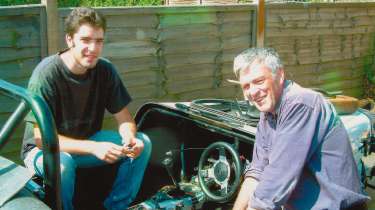
‘It feels like everything’s made to be throwaway now. You look at the old Mercedes stuff and it had a manual of how to replace door hinges and everything; components were designed to be replaced, whereas now, I’m not so sure. The A5 is still pretty much our everyday car but we probably need something better. Two doors are a pain for getting my son Rupert in the back and we should get a bigger car. But I’ve got to get it to a quarter of a million miles…’
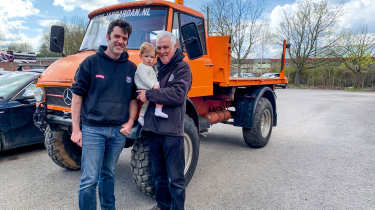
Richard’s priority clearly doesn’t lie in amassing an intricate or conventionally impressive collection of cars. ‘GBS has all grown organically – everything we’ve made has gone back to it – so if it’s a choice of buying a new car or a CNC machine, I’ll get the latter. I’ve started building my own Zero twice, but both times I ended up selling it to a customer. I do need to complete one eventually, but then we’ve been mucking about recently with an old Unimog, which operates completely at the other end of the spectrum. They’re at a value point where I could spend a bit on it and it’ll be worth at least what I’ve put into it.
‘It’s 1969, so quite an old one, and it might be a bit of a restomod by the time I’m done with it. I found it online one Sunday; I messaged the guy in Holland and ended up buying it unseen. The cab was a bit more rotten than we’d hoped, but mechanically it was pretty good. It’s got a massive bed on the back and it’ll tow stuff around.’
There’s ample opportunity to see what Hall and his team turn it into, as GBS opens its doors for cars ‘n’ coffee events and pizza evenings. ‘We get a mad turnout now, maybe 60 or 70 cars, and anything goes. We’ve got one customer who brought a 1900s steam car parked it next to a brand-new Ferrari. I think that’s the perfect mix.’ An unlikely social gathering brewed from the edges of his somewhat esoteric sports car business feels very Richard. ‘I’ve always loved taking stuff apart and making new stuff. If you can imagine it, you can create it.'
This story was first featured in evo issue 341.