900 miles in the Maserati MCPura – daily driving Italy’s underrated supercar
Maserati’s MCPura is as pricey as it is imperfect, but never let it be said it’s a supercar you can’t enjoy every day

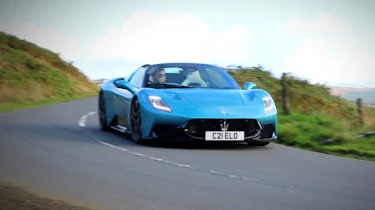
‘Was this a bad idea?’ I wonder to myself, as I edge the Maserati MCPura Cielo out of Maserati’s brand-new Kensington showroom into gradually intensifying West London traffic. The question arises again when the route out of Shepherd’s Bush and Notting Hill toward the northbound M25 requires me to navigate a spectacularly tight width restrictor. The idea in question was to answer the following: just how difficult to live with are supercars nowadays?
Could a carbon-tubbed, butterfly-doored mid-engined Maserati be as competent a daily as it is a thriller on a mountain road, or a crowd-pleaser at a wedding? And is there some other dimension of appeal that needs further acknowledgement to redeem what was once an eCoty-winner after its demotion during our supercar group test last year?
As I edge through the width restrictor without injuring the car or my ego, then glide over a succession of towering speed humps without so much as a cerebrospinal twinge, or a brush of the Maserati’s floor-hugging nose, hope for the cause is restored. Maybe even the most Italian of current supercars can unjarringly handle the rigours of modern everyday motoring.
My destination initially is a friend’s wedding in rural Hertfordshire. The journey there involves stop-start M25 traffic, motorway cruising, and a couple of quick stops to square away work and collect my suit, before a final dash across the countryside to the rendezvous. I find the car’s everyday credentials mixed along the way.
We’ve mentioned it before but it bears repeating: the inconsistency in the brakes of this car at best takes some getting used to, and at worst feels downright disconcerting. You ease into the pedal and find yourself wondering if there’s air in the system. You then press harder and almost bring the car to an emergency stop in the process. The whole middle of the pedal travel is a near-innavigable grey area at slow speeds.
More reviews
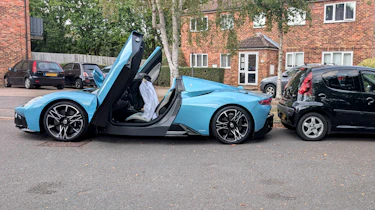
You need to watch where you park, too. The doors open at such a wide angle that the point of their being dihedral (beyond the theatre) rather than opening conventionally is almost moot. The boyish joy of shoulder-pressing your supercar’s door skyward wanes as the process of watching that you don’t drag the side skirt up an unsuspecting Qashqai becomes irksomely routine.
Boot space is far from spectacular, too. This isn’t always the case with supercars: some have impressively capacious ‘frunks’. But the MCPura isn’t one of them. You’ll get a bag of shopping in there at best. Meanwhile the rear boot, behind the engine, is enough for a sizable weekend bag but won’t take a proper suitcase, and you’ll find anything you put in there has reached quite a temperature come journey’s end, given it’s been sitting directly above the exhaust. All told, I find it best to drop the roof and hang my suit from one of the roof hooks in the windscreen frame – making practicality with ingenuity is often part of the supercar experience.
Credit where it’s due, though. I hinted at it earlier, but both the ride quality and the clearance on the nose, even without the lift engaged, always come as a genuine pleasant surprise. As does the car’s manoeuvrability. The turning circle isn’t the sort of Suez crisis-inciting shocker you expect from most supercars, and the calibration of the dual-clutch ’box is spot on, meaning back-and-forthing for a bit of wedding video filming along a rural lane is a doddle. Eat your heart out, Cambiocorsa boxes of old. It’s even relatively frugal, the sophisticated but spiky Nettuno engine delivering an indicated 9l/100km, or roughly 26mpg, along motorway stretches.
The pillowy ride does come with a downside, mind. That being an eye-widening dearth of vertical control that has the Maserati’s underside making regular cringe-inducing contact with the surface of a country road should it dare to present the MCPura with bumps or ruts. The ‘mid’ damper setting that comes when you twist the drive selector into Sport goes some way to curing this, but the full ‘Corsa’ shebang – which is quite unpleasant at anything under 40mph – is all but necessary to prevent bottoming out on a road with serious undulations.
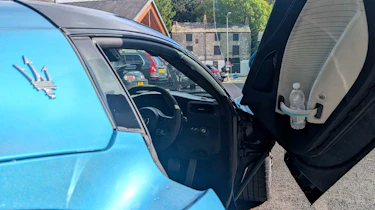
Wedding done and it’s a long schlep up for a weekend in the Borders. This is a 300-mile run that in some supercars could be a bit of a chore. Not so in the Maser, its squishy-soft ride and decent cruising economy once again coming to the fore. Refinement inside, for a carbon-tubbed machine, isn’t terrible either. There’s a bit of wind whistle from the mirrors, inlets on the side and roof rubbers, but road roar is surprisingly minimal. The long drive and a couple of stops also reveal the MCPura’s door pulls are perfect for squeezing a 500ml bottle of cola into, easing the pain of there being only one proper cupholder.
Lots of time cruising means time to poke around. It’s a mixed bag, the MCPura’s cabin. A new steering wheel is about it for changes compared with the MC20, with the Fiat 500-derived infotainment screen and Tonka-toy drive mode selector carrying over. The screen doesn’t bother me – it’s functional and not particularly low-rent for being a shared part. The drive mode controller? A different story. Here was an opportunity to create something properly crisp and tactile. Instead, it’s tinny with sloppy tolerances. A bit of a miss and at odds with the increased exoticism of the Fuoriserie-spec cabin on this particular MCPura Cielo.
Being a Cielo, rear visibility isn’t much to write home about thanks to the letterbox hole high up between the seats. You can drop the glass to get a bit more of the Nettuno’s rough and ready sound, but that doesn’t help the view out. Happily, the MCPura is still an easy thing to place, with a good view out the sides and ahead and a good sense of its extremities. For its exoticism, you quickly get used to it.
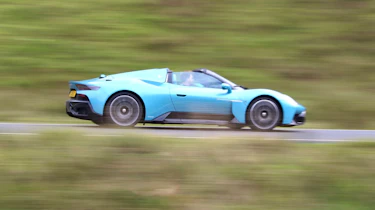
The last section of my journey is a dash across the Pennines to Alston, where I can stretch the Maserati’s legs a bit. Raised pace means Corsa is needed for vertical control. Nonetheless, the biggest takeaway from a run along the B6277 is that the MCPura feels special even when you’re not delving fully into the vast well of its performance and dynamic capability – rare in a lot of sanitised modern performance cars. You relish the Maserati’s balance, its steering, its damping and the industrial, angry character of the engine even at a six-tenths canter.
It’s not a traditionally exotic engine, the 626bhp Nettuno, but it has a visceral, serrated, unsanitised energy to it, with chirrups and wheezes not alien to a Jaguar XJ220’s aural playbook. Needless to say, there are deep performance reserves to enjoy, a big belly of torque and a frantic top end. It ensures the MCPura is as fast as you’d want a supercar to be before feeling like you could never use it on the road.
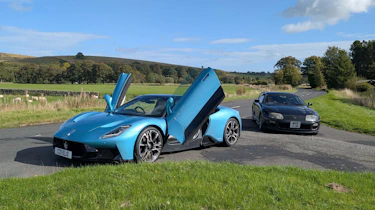
Trundling into Alston, I feel like my question’s answered. This really is a supercar you could daily, if you make allowances for its smaller boot… and the silly doors. I’d forgotten about the latter again until I had to reverse onto my friend’s driveway, carefully positioning the car so there was no risk of the doors interfacing with the neighbour’s dry stone wall.
I clamber out feeling no more fatigued than I would if I’d made the journey in a Bentley Continental GT. Yet you never find yourself so lost in the MCPura’s usability that it stops feeling special. Some GT cars can offer such competence that you forget you’re in something more than an executive saloon. Never in the MCPura. Not beating you up but never feeling ordinary, marrying talents a proper GT wouldn’t be ashamed of with genuine supercar theatre (and some compromise, admittedly), is a delicate and impressive dance indeed.
The MCPura (and MC20 really) is vindicated in my mind. It’s not perfect in that clinically McLaren-esque way; it has its flaws and things that would get in the way. But conversely, it’s such an inviting drive, whether your hair’s on fire or you’re going for a Sunday afternoon cruise, that I can’t help but fall for it. A weekend of driving in Scotland, where it’s never anything less than eye-wideningly thrilling and the long run back down south, where it goes right back into grand tourer mode, do little to assuage that conclusion. It’s a lovable, broadly talented car that deserves more recognition (and sales) than it gets.