Maserati GT2 Stradale review – can Modena best the Porsche 911 GT3 RS?
Maserati’s GT2 Stradale might look like a race track refugee but this supercar is at its best on the road
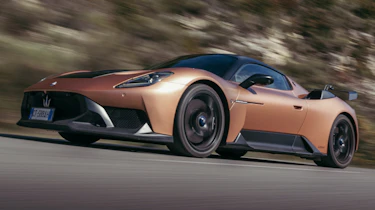
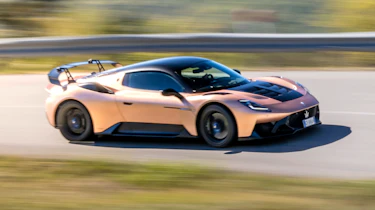
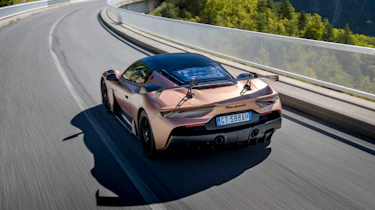
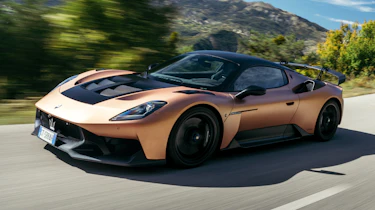
To appearances the Maserati GT2 Stradale is quite a dramatic departure from the smooth MC20 on which it’s based. Not since Clark Kent popped into a phone booth has there been quite such a costume change. The base car is elegant but very clean and simple in its surfaces. The GT2’s bodywork has turned from a millpond into a wind-whipped sea with a plethora of vents, scoops and aero devices. As a whole, the car looks not only more aggressive, but also more compact. Based purely on the GT2 Stradale’s new clothes, I would have expected something more akin to the Huracán STO or 911 GT3 RS in terms of a hardcore ride and aggressive demeanour.
Waiting at the track is the Stradale’s inspirational cousin, the GT2 Corsa. It’s only on hand for static display duties today. It’s won a dozen races and both the drivers’ and teams’ titles in the Am class of the GT2 European Series since we drove it last year. That sounds a little like I’m trying to claim some sort of reflected glory for the victories. I’m not.
Anyway, the Stradale is certainly a close aesthetic relation of the race car, only really missing a huge roof-scoop and the ability to run a taller, wider, sharper rear wing. Can it mix race car intensity and capability with the MC20’s refinement and engagement on the road?
Engine, gearbox and technical highlights
- 320kg of downforce over doubles the MC20 in the low setting
- Rising to 500kg in the high setting
- Mild jump in power to 631bhp, drop in torque to 531lb ft
More reviews
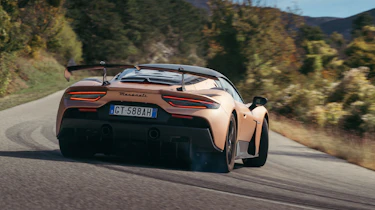
It can’t quite generate the race car’s 1000kg of downforce, but it is a big step up from the MC20. Such is the work on the floor that even without the rear wing a Stradale almost doubles the MC20’s 145kg of downforce. Add in the rear wing and the number increases to 320kg, 420kg or 500kg depending whether you choose to (manually) set it in its low, medium or high-downforce position. In terms of aero balance, 130kg of that number is always generated by the front of the car.
The Stradale’s drive modes have apparently taken inspiration from the race car’s as well, with no less than four Corsa options to cycle through in addition to the Wet, GT and Sport modes. These essentially decrease the ESP, TC and e-diff intervention, with Corsa 1 leaving you free from stability and traction intervention entirely, ABS intervention reduced to 30 per cent and the limited-slip diff behaving as much like a passive, mechanical one as possible. Steering assistance is a rare electro-hydraulic system while damping is three-way adjustable with ten per-cent stiffer springs.
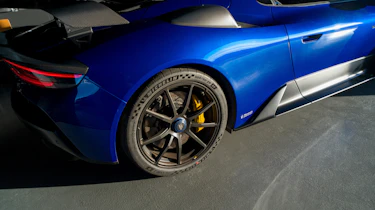
As we know, the regular MC20 is bafflingly heavy for a non-hybrid, carbon-tubbed car – the UK press car with fluids and nose lift topped 1700kg on our scales. Maserati claims to have lopped off 60kg for the Stradale, for a supposed 1365kg dry weight if you spec it correctly with the forged-centre wheels (shod in Michelin Pilot Sport Cup 2 Rs) that save 20kg and the carbon buckets for another 20kg.
Made in-house in Modena, the engine is the same 90-degree V6 as the one in the MC20 and the GT2 race car. Maserati claims a 10bhp uplift for the Stradale and shouts less about the 7lb ft drop in torque, for 631bhp and 531lb ft versus 621bhp and 538lb ft in the standard MC20. In charge of swapping ratios is an eight-speed DCT gearbox that has been tuned to deliver really quite pronounced thumps when it’s dialled up to the max.
Performance, ride and handling
- Silky feelsome steering
- Smooth yet controlled ride, sense of weight remains
- Ferocious engine
Before hopping in I had been expecting quite a different sort of experience. I’m not suggesting a good car has to have the barely disguised pent-up fury of a recently caged wild animal, but there’s a suspicion that style might have a bit of an upper hand over substance with the Stradale.

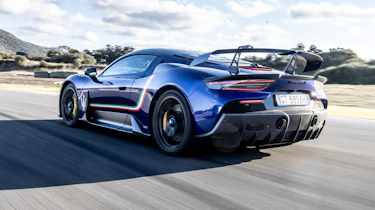
You need the full, motorsport-mimicking spec for the maximum GT2 Stradale experience, which includes not only the bucket seats but also Blu Corse paint (a slightly glossier version of the finish the race car wears) and an ice hockey stick-shaped Tricolour stripe down the side, culminating in a big trident. It could be naff, but perhaps because the blue is actually relatively subtle I think it looks terrific.
There’s a broad piece of stiff material with PULL stitched into it in a vaguely ’80s script to let you know the preferred method of closing the dihedral door. Push the small starter button on the slightly thicker steering wheel, hear the gruff Nettuno V6 come to life, pull the big carbon paddle through a nice amount of travel (not long-winded, but more than a mouse click) for first gear and we’re on the move.
At which point everything changes. Imagine going to a silent disco and hanging out without a pair of headphones. That’s the passenger-seat experience. Now pop on the cans, suddenly soaking yourself in the sounds of Sigala, Solveig or Swedish House Mafia. Now the room comes alive and all the movement makes sense. That’s what it’s like holding the steering wheel in the GT2 Stradale.
If you’ve been on a diet of EPAS systems for a while, which is entirely possible even if you drive a lot of high-performance machinery, the hydraulically assisted rack of the Maserati is a feast for the hands. All the textural feedback from the soft, Alcantara-clad wheel as it almost trembles in your palms is a flashback to better times, with purer weighting and delicious feel.
I don’t venture above Sport in the settings initially, but the whole car feels alive, engaging and fun, primarily thanks to this fabulous steering. There are plenty of questions to be answered about other aspects of the car, but it’s a good start.
I’m not sure anyone other than a human incarnation of a rolling road would be able to discern the difference between the performance of the MC20 and the GT2 Stradale; My internal G-meter certainly isn’t calibrated in 1.5 per cent increments.
The big carbon paddles add to the theatre, as do the Stradale’s shift lights, which are hidden neatly behind the lacquer in the top carbon portion of the steering wheel. There are nine little LEDs in total, the first three illuminating white, the second three blue and the final three red. Although maximum power is delivered at 7500rpm, the fact that you live in the 3000-5500rpm torque band is even more apparent on the road and as a result I found myself shifting up with the first white lights that flash up at 5500rpm.
You can choose between three damper settings independently of drive mode, and the middle, Sport setting feels like the best on the road unless you really need the extra control, though some British bumps may undo that theory in a matter of metres.
Turning off into the countryside, I decide to try Corsa on the road, and it really does deliver an intoxicating hit. All you need to know is that the Nettuno engine has the same, shocking Jekyll and Hyde character as before, capable of cruising calmly one moment and then delivering a wild punch the next. It’s like a shark that’s swimming serenely and then with a couple of swishes becomes all teeth and savage speed.
The noise that accompanies this ferocity is interesting because the V6 is not a screamer, instead producing a more guttural roar that’s a bit dirty in its gravelly, bass-led tones. It’s not a sound that tingles my spine, but it does give the Stradale a distinctive character. If you want more, Maserati will be offering a 7kg-lighter titanium exhaust that circumvents the legal need for some of the baffling by being sold as ‘track only’, a stipulation that I’m sure owners will stick to religiously…
The eight-speed box isn’t great for keeping the car settled on track, but I rather like it on the road. Sometimes dual-clutch gearboxes can be a little bit soulless in their perfectly smooth shifts and this has had some character dialled in, which I suspect was inspired by the sequential ’box in the GT2 race car.
With dusty, slippery roads, I had thought that the GT2 Straddle might be a bit of a handful, but traction is surprisingly good, and even if you really provoke the rear with the throttle in tighter bends it doesn’t just snap (you can feel the e-diff kick in to help here).
Driving quickly, I found I wanted a slightly firmer brake pedal to go with the uprated Brembo carbon-ceramics, as although there is plenty of feel deeper into the travel (and you don’t want an overly sensitive system), it sometimes felt like it took a fraction too long to get into the meat of the pressure. Some might prefer it that way.
Driver’s note
‘When it does slide, it’s often on momentum rather than loss of traction, owing to the 40:60 front:rear weight distribution. You occasionally need fast hands to stay on top of it, but for such a powerful mid-engined car it’s a grippy, mostly benevolent machine. It takes me a little while to dial into the steering’s response, but it has plenty of clarity, particularly in Corsa. I wish it had a bit more front-end bite – and better brake feel – but it’s a deeply likeable machine. It’s an exciting challenge to get the best from the Stradale.’ – James Taylor, evo deputy editor.
On track
After some caffeine and a briefing, I’m in a Sabelt passenger seat that has a little ‘Made in Modena’ decal visible on the outside of the shoulder bolster as you get in. There are harnesses (which require an additional bar behind the seats) and an ex-Alfa Romeo BTCC driver, although he can’t be found on the configurator.
If you were around in the ’90s, then you would have heard Giampiero Simoni’s name ringing out on the BBC’s Grandstand programme as he and Gabriele Tarquini took the British Touring Car scene by storm in their aerodynamically eye-catching Alfa 155s. Indeed, Simone’s first question to me when I get in the car is about where I live in the UK, and when I say that I’m based near Milton Keynes he beams and proudly informs me that he lived in Banbury when he was with Prodrive. We have a chat about rallying (obviously) and he tells me that he knew Richard Burns, but that he also used to go for coffee with Sandro Munari and Piero Liatti, which sounds like it would be a fun round of espressos.
Then it’s out onto the track in the GT2 Stradale and everything is as smooth as steamed milk. Simoni’s quick, but he’s pouring the car into corners, being very patient on the throttle through Ascari’s myriad tricky turns. As soon as I’m behind the wheel, it’s clear that this wasn’t just as a demonstration of how he’d like to be driven; it is also how the GT2 Stradale wants to be driven.
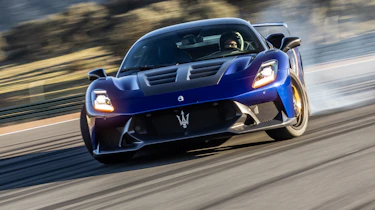
You want the dampers in their firmest setting to help control the mass, but nonetheless you still notice a slight reluctance through higher-speed direction changes, where you need to be patient and have smooth inputs to keep it settled. Get on the throttle too early and you’ll feel the nose start to push wide. Carry a bit too much speed on turn-in and you’ll feel the 40:60 rear-biased weight distribution start to manifest in a bit of easily caught momentum oversteer.
Even in its stiffest setting, the suspension can’t prevent the front from catching in the compression on the way through the first chicane, but the upside is that the Stradale rides all the other kerbs beautifully. The big carbon-ceramic brakes have plenty of feel, but even with ABS assistance reduced in Corsa mode and all stability assistance turned off, the hazard lights still trigger under hard braking, which feels a little silly.
In some ways the V6 engine feels at its best and certainly most spectacular when it’s able to be thrashed to within an inch of its life. But such is the fury right at the top end that it often feels more natural (and quicker) to stay a gear higher than initially seems optimal and instead rely on the huge reserves of torque lower in the revs.
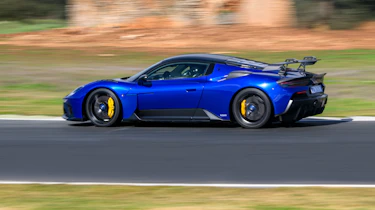
The Stradale is certainly enjoyable on track and, like the GT2 race car, it feels easy to get to grips with. But there isn’t the sense that it was born to attack a circuit as hard as possible like a Porsche GT3. It still feels like a road car.
What’s really good is that the GT2 Stradale is a car that makes you think about these nuances. It’s not perfect but it is engaging and it makes you ask questions of both it and yourself. I found myself comparing the Stradale to McLaren’s LT cars in terms of its character on the road, skewing slightly more to road than track, more focused than outright hardcore, despite what the Stradale’s bodywork says.
Perhaps the steering has something to do with the Woking association too – islands of hydraulic assistance in a sea of EPAS. Then there is the fact that despite their big names, both companies feel like smaller, almost family affairs at times.
Interior and tech
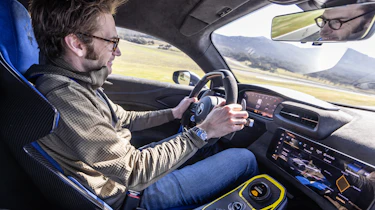
- MC20 cabin is familiar…
- … though elevated by Sabelt seats, Alcantara and fluorescent trim
- Seats do improve, if not perfect, the driving position
The GT2 race car’s influence isn’t so pronounced inside the Stradale, but the new centre console has been slimmed down (saving 2kg) and a carbon structure now hosts the gearbox buttons and the drive mode selector, the latter combining a rotating collar with a slightly unresponsive touchscreen.
These controls have all been adorned with fluorescent yellow, just like the race car’s main switches, to make it easier to spot in the heat of the moment, but regardless of any practical considerations, I think it just makes what is otherwise a fairly humdrum interior (with a lot of plastic switchgear) more memorable.
A word of warning about the seats, because there are two versions available with different padding and you need to choose wisely. The car I drove on track felt fine, but the road car felt like a massage function had got stuck mid-kneed, with all the support in the wrong place.
The buckets really help differentiate the GT2 from the MC20, with a seating position that is a bit better too (although I felt like it could go lower still), but it would be unfortunate to find yourself with a passive pummelling system built in.
evo Car of the Year 2025 – result
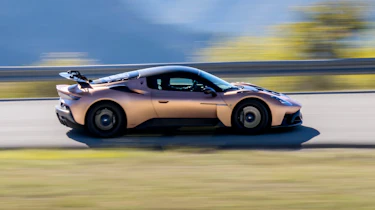
A previous winner of eCoty in MC20 form, and now turned up to 11, so why didn’t the GT2 Stradale finish higher? James loved ‘the looks, the character and the atmosphere’ and thought it deeply desirable, but felt it too flawed to trouble the podium; despite starting strongly, it slipped down his order as the week went on.
Henry loved its character, but wasn’t completely won over, saying: ‘It’s as though they created an animal of an engine and then realised that they were going to sell it to people in a rear-wheel-drive package and got cold feet.’
Several of us thought the GT2 felt more cohesive and together than the last MC20 we drove, although Yousuf was expecting a bit more: ‘The way it looks and the name – GT2 Stradale – you think it’s going to be really, really hardcore and uncompromising, but it’s closer to being a notch up from the regular MC20 than being a car like the A110 R Ultime.’ ‘I found it infinitely preferable to the MC20,’ said Dickie, before adding: ‘but given how much it costs it should be a much better car.’
Its brakes were a big flaw – we all agreed they eroded confidence. ‘Exciting but feels unfinished and six months from completion,’ was John’s assessment. Yousuf and I placed it highest, in fifth, but with it failing to reach the 90s on three scorecards, it finished 0.1 point ahead of the E-Ray and the same margin behind the Morgan.
Price, specs and rivals
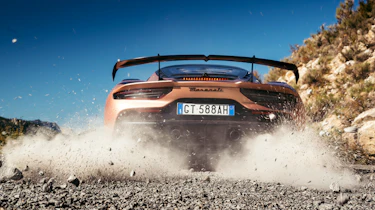
At £273,510 before you add in the almost obligatory Performance Pack (Corsa drive modes, Cup 2 R tyres, e-diff, carbon-ceramic brakes, front arch louvres) and Sabelt bucket seats, I suspect the 914 GT2 Stradale buyers are quite brave to take the leap and choose this over the competition. However, as with the MC20, the GT2 Stradale feels like something appealingly different, something slightly left-field and rare. In other words, something very Maserati.
Driving it brings a number of cars to mind. As aforementioned, McLaren’s 600LT has the same kind of heightened intensity while maintaining its talent on the road – an intensity the current, arguably more talented Artura doesn’t quite match. Perhaps strangely though, the Artura feels the more focused machine, on road and track, than the Maserati. A wedge more money will get you into a Ferrari 296 Speciale though arguably, the same money as the Maserati or less would be better spent on a used or nearly-new 296 GTB, or a brand new 911 GT3. Time moves quickly in the world of tarted-up track specials and as such, not even a year on from our first drive of the GT2 Stradale, Maserati’s introduced the MCPura, a replacement for the MC20, benefitting from some of the incremental improvements the GT2 boasted.
| Engine | V6, 2992cc, twin-turbo |
|---|---|
| Power | 631bhp @ 7500rpm |
| Torque | 531lb ft @ 3000-5500rpm |
| Weight | 1365kg (dry) |
| Power-to-weight | 470bhp/ton |
| Tyres as tested | Michelin Pilot Sport Cup 2 R |
| 0-62mph | 2.8sec |
| Top speed | 201mph |
| Basic price | £273,510 |