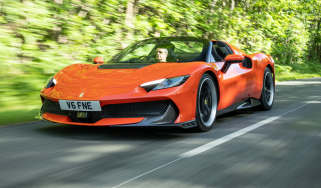
Ferrari 296 Speciale review – does it live up to its legendary name?
Ferrari’s 458 Speciale is simply one of the greatest driver’s cars there’s ever been. Can the new 296 Speciale possibly live up to the legend? Here’s where we find out
In the long history of performance cars, there have been few tougher acts to follow than the 458 Speciale. The holy grail of hotted-up mid-engined Ferraris, this exquisite V8 screamer – light, beautiful and spine-tinglingly sonorous – remains one of the very best road cars Ferrari has ever built. And now it has a successor.
Such is the weight of expectation that comes with the Speciale tag that Ferrari chose not to reveal its intended name to the team charged with delivering the new 296 flagship until well into the project’s development phase.
> Best Ferraris – Maranello’s masterpieces from 296 Speciale to F40
The choice of Speciale is telling. Where the other names associated with Ferrari’s sharpest mid-engined models –Challenge Stradale, Scuderia and Pista – speak of street cars with an overt track vibe, Speciale affords the latitude to create a more focused street car with a seriously expanded skill set that gives equal weighting to improvements that can be readily enjoyed on the road and fully explored on track.
The changes required to effect these improvements are as extensive as they are impressive, a fact demonstrated by Ferrari’s 65-page technical briefing document. Much of the content had been revealed some months ago when the Speciale was first announced, but they bear repeating because they describe a scope of works that touch almost every area of the car. Powertrain, chassis, brakes, aerodynamics and electronics have all received serious attention, as have the exterior and interior, which differ considerably from the standard 296 GTB’s while avoiding wholesale reinvention.
More reviews
Visually the Speciale gives mixed messages. Though stopping a long way short of mimicking the overt aero kits of a Porsche RS or Lambo STO, it boasts plenty of authentic race-bred details. At the front you’ll spot a larger front splitter combined with a large duct that channels air into the nose and vents it through the frunk lid before sending it up and over the windscreen and roof, just as with the 296 GT3 race car. Similar to the arrangement found on the SF90 XX and F80 (and indeed the triple Le Mans-winning 499P) this so-called Aero Damper is central to the Speciale’s aero concept, pinning the nose to the road for an immediate and relentless sense of front-end bite while maintaining a more consistent level of downforce.
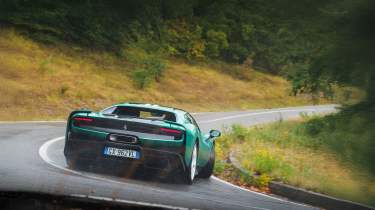
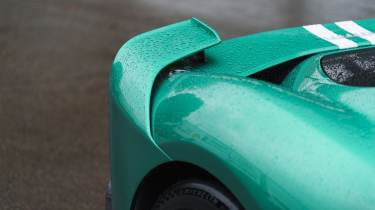
There are wider sills with a big intake in the trailing edge, a more pronounced diffuser and an active rear Gurney-style flap that rises into the airstream on demand (50 per cent faster than on the GTB) and now features a middle setting in addition to full deployment or retraction. Most distinctive of all the aero features are the boomerang-shaped rear fins, which are a mash-up of the vertical elements found on the 296 Challenge race car and the horizontal winglets from the FXX K. Combined, the aero package develops 435kg of downforce at 155mph. That’s approximately half that of the 992 GT3 RS, but still a significant 20 per cent (75kg) increase over the standard 296 without resorting to a plethora of oversized wings.
Weight savings amount to some 60kg, resulting in a claimed dry weight of 1410kg with the lightest options fitted. Impressively, 15 per cent of the saving comes from the engine, with new and extensively machined crankcase castings, titanium fixings, a nitrided steel crankshaft and new pistons and conrods taken from the F80, together shedding 9kg.
Powertrain-wise, the gains in output aren’t massive but are most definitely meaningful, with increased combustion chamber pressures and more precise control of the air-fuel mixture and engine maps (again influenced by the 296 Challenge) contributing to a 36bhp increase from the ICE. Improved cooling of the hybrid system yields a further 13bhp, lifting the combined power output to 868bhp, 49bhp more than the GTB and a new record for a rear-drive Ferrari. The full 868bhp is only available when Qualify mode is selected on the eManettino, which enables the electric motor’s extra boost function. To keep temperatures in check you get a limited number of full-fat shots, the running tally displayed on the dash in a curved indicator on the right-hand side of the rev counter.
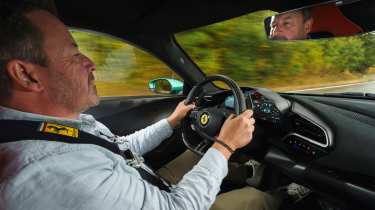
The shape and specifics of the aero package do a fine job of distinguishing the Speciale from its siblings, not to mention clearly expressing its objectives and higher dynamic calling (higher price, too, starting at £359,779 before any options, compared with £245,000 for the GTB). The interior is similarly satisfying. Especially when fitted with red cloth seats, which look fabulous and provide exceptional support without going to such extremes that they compromise ingress or egress. One-piece carbonfibre door cards and the (optional) full harness add to the competition car vibe, but there’s enough style and attention to finish and detail to ensure the Speciale doesn’t feel raw or stripped of luxuries. It’s a fine place to be.
Reflecting the Speciale’s promised gains in road and track performance, Ferrari has structured the launch around both street and circuit driving elements. With Fiorano still drenched from an overnight downpour, we head out onto wet roads for our first taste of this eagerly awaited model. The weather forecast suggests there’s a fighting chance Fiorano will be dry by the afternoon. Fingers crossed.
If nothing else, the sodden run from Maranello to the familiar roads that snake their way into the hills prove that the Speciale is no skittish road-racer. Yes, you immediately sense it has quicker wits and sharper claws, but such is the civility with which it conducts itself at low speeds that you quickly relax into the job of guiding it through the ’burbs of Ferrariville.
Reminders of what distinguishes the Speciale are visible wherever you look. Those neat and distinctive gill-like vents can be seen on the tops of the wheelarches, peeping above the low-set scuttle to give you a bead with which to aim the inside front wheel at an apex. Glance in the door mirrors and you see the side intakes and those blades – or ‘Gamma wings’ as Ferrari calls them – rise from the flanks and curve over the rear deck.
With the manettino set to Wet you can make progress with absolute confidence, the electronics ensuring all that power and torque never get the better of the Cup 2s. That’s no mean feat, and while it’s doubtful many owners would choose to venture far in such conditions, it’s good to know the Speciale can cope if you get caught out by the weather.
Once up in the hills, switching to Sport releases more performance but retains a deeply impressive degree of digital control as the threshold of grip-slip-grip is raised. It takes a few miles to trust that the 0s and 1s have got your back, but once you’ve tested it a few times it’s amazing how clean and swift your progress can be in a car with such a surfeit of power in slick conditions.
The lower (by 5mm) and firmer suspension doesn’t fundamentally alter the Speciale’s character from that of the GTB, but when you ask more of it you immediately sense its wits are quicker and its resolve more steely. Roll has been reduced by 13 per cent and you feel that added cross-car support as soon as you make a steering input. It’s not darty – Ferrari has calmed its tendency for overly rapid steering response – but the alertness with which it initiates a direction change, be it a minor adjustment of line or major change of tack, is inspiringly energised and sweetly measured.
We’ve been heading to these hill roads on evo assignments for almost three decades, so they are as familiar as a British B-road. Sadly, they’re almost as crumbly, though at least Italy has the excuse of seismic activity to blame for the fractured tarmac. As ever, Ferrari’s beautifully simple Bumpy Road function – selected by pushing the manettino rather than turning it – offers an instant solution when you feel the need to relax the damping.
The conditions are improving but the roads are still slick. You might expect the Speciale to be snappy on its lightly treaded Cup 2s, but there’s plenty of feel, even as you make mid-corner transitions from wet to damp and dry sections. Switching to CT Off feels a bit like making an early call for slicks during an initially wet race, but so long as you’re progressive and not too greedy with your throttle inputs, you can feel when the rising swell of torque starts to get the better of the rear tyres. What happens next is up to you.
It’s testament to the ICE and hybrid powertrain integration that you can play with the throttle just at that point where the car is poised at the limit of traction, the ebb and flow of fluctuating turbo boost pressure balanced against the immediate delivery of battery power. With ESC Off, you can slide the tail pretty much at will but it needs fast hands, at least during the initial breakaway phase, but thereafter it’s a case of smoothly syncing your steering and throttle inputs to ride out the slide.
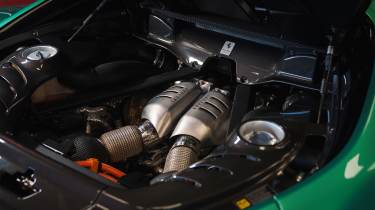
Adding to the enjoyment is a faster and punchier gearshift that’s reminiscent of the F80’s, and a soundtrack that is louder, grittier and more expressive than the regular GTB’s thanks to a new system of acoustically tuned ducts that transmit a range of sound frequencies from the engine bay to the cockpit. With twice as many ducts drawing sound from new positions around the 120-degree V6, the sound is richer and more immersive. It’s a welcome improvement, one that communicates the Speciale’s increased intensity and brings out more character from the V6, which – to my ears at least – sounds sweeter and more stimulating than the old twin-turbo V8.
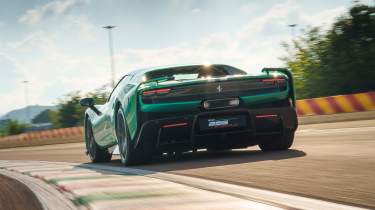
In those moments when you’re not driving like someone has just put a match to your trousers, the Speciale is surprisingly chilled. There’s some additional road noise, but it’s not harsh, and the ride is extremely supple. The exhaust isn’t boomy and the seats – lightweight carbon-framed items in this car – are genuinely comfortable. Better, they’re not too deep or painfully sharp-edged; important if you’re fiftysomething and wish to retain a degree of dignity when lowering yourself in or pulling yourself out.
Road driving done, we arrive at Fiorano’s famous gates. It’s always exciting to be here, especially when the barrier slides open and you drive slowly towards the fabled courtyard and park by the pit building that has provided shelter for Ferrari’s engineers and test drivers since the early ’70s. Media test sessions at Fiorano are always intense. The lap is a challenge, as with all test tracks worth their salt, and the cars get faster and more powerful with every passing year. The F80 was deemed to have outgrown the place, hence its launch being at Misano, but Ferrari clearly feels the Speciale is right in its sweet spot on home tarmac.
It’s a claimed two seconds quicker here than the 296 GTB, lapping the 1.86-mile circuit in 1:19 dead. For context, the outright record for a street-legal Ferrari is 1:15.3 set by the F80. Prior to that it was 1:17.3, set last year by the SF90 XX. LaFerrari? 1:19.9. And the 458 Speciale? 1:23.5. Of course, lap times aren’t the be-all and end-all, but they are a clear demonstration of what an additional 270bhp combined with highly developed chassis, tyres, brakes, aero and electronics can deliver.
The car we’re driving on track differs from the one we drove on the road in so much as it is fitted with the optional passive damper set-up. The Multimatic hardware is lighter than the semi-active Magneride system that UK cars are expected to get as standard, and the set-up is firmer (towards the upper end of the adaptive suspension in its stiffest mode), but there’s no claimed difference in terms of lap time. This said, it’s worth noting that when test driver Raffa di Simone set that new Fiorano record in the SF90 XX last year he elected to run on that car’s optional passive set-up because he said he preferred the feel it gave him, and ensured that the car was in its lightest configuration.
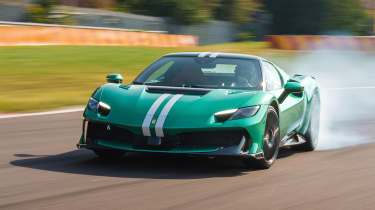
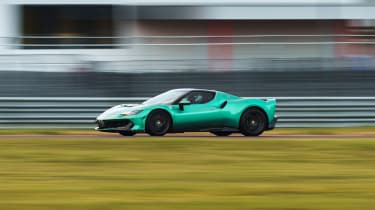
Where my immediate impression driving the Speciale on the road was of greater steering connection, the first impression on track is the flatness of the cornering. There’s still some lateral ‘give’, but it’s just enough to give you a read on how hard you’re working the front end. It’s magic through the tricky, medium-speed direction changes before the bridge, likewise the faster sequence that follows the tight hairpin. Where you imagine you’ll need to give the car a moment to settle between steering inputs, the Speciale cuts from right to left and left to right with the briefest of micro-pauses.
It used to be that Porsche brakes were the absolute benchmark, but Ferrari’s ABS Evo system really is redefining on-limit braking in street cars. You can’t work the Speciale quite as hard as an F80, but it’s remarkable how you can have it standing on its nose and fully loaded longitudinally yet still put significant lateral load into it, extending the braking zone into the phase where you’re turning the car into the heart of the corner.
It might be a monster on the stoppers, but there’s fabulous feel. You can make delicate changes to brake pressure once the immediate slam of retardation has been delivered, blending out of the pedal j-u-s-t enough to keep the weight on the nose but still allowing the car to carry more speed into the apex. It’s one of the few cars in which trying to find the limit of the brakes is as absorbing as working the throttle.
Speaking of which, though the chassis and aero improvements bring a tangible increase in stability, grip and traction, with the best part of 870bhp sent exclusively to the rear axle, the Speciale definitely demands respect if you’re chasing the throttle in CT Off or ESC Off modes.
It’s playful exiting the low-speed corners and manageable through the medium-speed turns, but there’s so much power and torque on tap that it’s possible to get it out of shape on the exit of the high-speed stuff, too. This is something that I and the development driver I’m following both discover on our last flying lap, when each of us has a career-critical moment exiting the circuit’s fastest corner. Cue much nervous giggling on the cool-down lap (we’re on the phone hands-free to one another instead of using two-way radios), followed by a cheeky twin drift round the final corner in an effort to get back on the prancing horse, so to speak.
The laps prove a number of things. Firstly, that although the Speciale is seriously fast, it’s also seriously entertaining. Secondly, while it has significant downforce, the mighty powertrain ensures the aerodynamics do not have a disproportionate influence over the driving experience as they do in, say, a 992 RS. Perhaps most usefully, hammering round Fiorano confirms that the Speciale makes the same significant strides on track as it does on the road.
It’s tempting to suggest that the Speciale is a junior F80, but to do so would be a gross exaggeration. There’s certainly scope to make it more hardcore if Ferrari fancied giving it the XX treatment, but whatever the future might hold, the good news is that the F80’s influence can be seen and felt in the meaningful trickle-down of technology, amplifying the character and capability of the 296.
Comparisons with the 458 Speciale are inevitable, but the gulf between it and the 296 render the exercise moot; it would be akin to evaluating the relative merits of an apple and an orange. Better to look back on the 458 as the zenith of Ferrari’s naturally aspirated V8 era and see the 296 as a rising star.
Frustratingly, whatever your chosen frame of reference, without dry running on a broader range of roads it’s hard to give a definitive verdict on just how good this new Speciale is. Extremely good, certainly, but exceptional? That proclamation will have to wait.
Still, from what we learned in the wet, followed by lapping sessions around a dry Fiorano, the Speciale is meaningfully sharper, keener, grippier and more connected than the GTB, yet also more agile and expressive. It intensifies the 296’s already rabid performance and deepens the sense of excitement and occasion. Not just at the limit, but from the moment you fire it up. The 296 has come of age.
Ferrari 296 Speciale specs
| Engine | V6, 2992cc, twin-turbo, plus e-motor |
| Power | 868bhp @ 8000rpm (combined) |
| Torque | 557lb ft @ 6000rpm (ICE) |
| Weight | 1410kg (dry, with lightweight options) |
| Power-to-weight | 625bhp/ton |
| Tyres | Michelin Pilot Sport Cup 2 |
| 0-62mph | 2.8sec |
| Top speed | 205mph |
| Basic price | £359,779 |
This story was first featured in evo issue 340.