Honda Prelude v Toyota GT86 – controversial Japanese coupes face off
A lack of new coupes means we look to the past for a left-field rival to Honda’s new Prelude

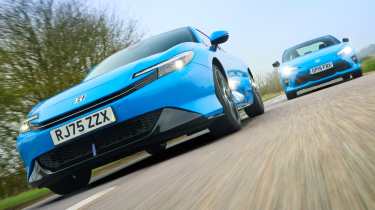
It may at first be difficult to see how the Toyota GT86 and the new Honda Prelude are comparable. One is rear-wheel drive with a flat-four engine, the other is a front-wheel-drive hybrid, lacking not just a stick and three pedals, but much in the way of what you or I would call a gearbox at all. One only arrived in dealerships in 2026; the other departed them five years ago.
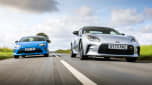
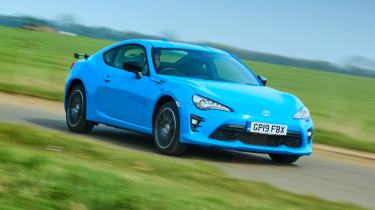
There are some obvious similarities, though. Both hail from Japan, beginning their long journey to UK shores via the port of Nogoya. Both are small, light, ‘affordable’ coupes that stand apart from the herd. Both also look resplendent at our meeting point in near-identical Electric (Toyota) and Racing (Honda) Blue hues, in spite of the grey miasma suffocating the spring skies that, only a day before, were as clear and richly blue as the cars’ paintwork.
They are also both cars with which evo has an uneasy relationship. In the first instance we found both to be flawed in some ways, yet also intriguing in others. That’s why this is a GT86 and not a GR86 – the pre-debug version of Toyota’s sports coupe. Back in 2012, we got out of legendary Toyota chief engineer Tatsuya Tada’s lightweight, rear-driven, drift-happy analogue antithesis to dull motoring and declared that it had missed its mark.
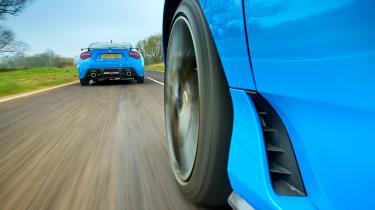
‘The engine isn’t nice when extended to the red line, but more critical is the lack of torque – just 151lb ft,’ Richard Meaden wrote. ‘The energy-saving Michelin Primacy tyres allow plenty of sideways fun, but unsurprisingly they’re not as progressive as a high-performance tyre, so you don’t get the grip you need through the high-speed corners and under extreme braking. It’s entertaining for a few laps, but after a while the experience feels contrived to suit the low-grip, high-fun objective.’

Fourteen years later, the GT86’s light weight (1240kg), 197bhp naturally aspirated engine and largely assistance-free driving experience are an even starker contrast to the heavier, boosty and ever-more-complex performance cars that are populating showrooms. But does that – combined with used prices starting at around £8000 – serve to increase the Toyota’s appeal? We’ll find out shortly.
If the GT86 arrived on a bow wave of hype but ultimately disappointed, the Prelude was a slightly dazed fish in a barrel of internet vitriol the instant its spec and tech sheet went live. It has a 2-litre petrol engine, yes, but it’s hybridised, most of the time feeding a 1.1kWh battery that powers an electric motor, and only sometimes driving the front wheels directly.
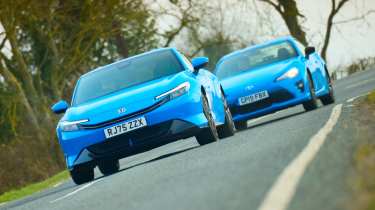
The curious concoction offers concerningly modest numbers: 181bhp and 232lb ft and a 0-62mph time of 8.2sec (0.6sec behind the Toyota). It also shirks one of Honda’s lovely manual transmissions for a CVT… Honda says that’s fine, though, because its S+ software can emulate gears, controlling the engine’s revs and offering eight ‘speeds’ via paddleshifters. You can well imagine the comment section bloodbath.
Our greatest unease stemmed from Honda’s insistence that the minnow Prelude is heir apparent to the mighty Civic Type R and NSX as the brand’s halo model. Punchy for a £40,995 car with middling Civic Hybrid innards boasting stats that would leave it vulnerable at the lights to a sporty Renault Clio from the days before the iPhone.
But there were glimmers of brilliance on our first drive (evo 340). For when the Prelude wasn’t straining in slow motion along the hillside straights of the Route Napoléon, it was braking with strength and fidelity on its Civic Type R-derived stoppers, squatting and bobbing on its Civic Type R-derived dampers, digging in on its dual-axis front struts. It was like a world-class figure skater hampered by a heart defect – a car of two halves.
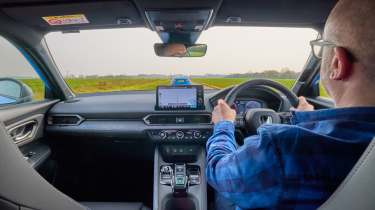
Some months later, I’m saddling up in a right-hand-drive Prelude for the jaunt to the aforementioned rendezvous, so the ghosts of entry-level sports car past and present can meet. It’s a pretty thing, the Prelude – a proper coupé for coupé’s sake, redolent of the genre’s (and the Prelude’s own) ’90s heyday. The cabin is Type R reminiscent, the climate controls and steering wheel carried over, likewise the mix of material quality. The toggles in the air vents look better than they feel and the less said about the material covering the ‘plus two’ rear seats the better.

Missing from the taller central tunnel is the Civic’s delicious teardrop shifter. In its place, a congregation of various buttons and switches: drive, reverse and park, and to their left, set within an extruded blister of piano black trim, the ‘S+’ button, which brings into play the crisp alloy shift paddles that ride the back of the steering wheel’s spokes. The wheel itself lacks a red-backed ‘H’ badge, while there are no roaring red bucket seats either. In their place less aggressive but still premium and decently supportive items with a grand touring vibe.
On start-up there is no noise – this is a hybrid and the battery gauge is two-thirds full. Four driving modes range from Comfort to Sport, with GT in the middle and Individual to mix and match settings across the powertrain, steering and suspension. S+ and Sport mode awakens the motor and reddens the digital driver’s display, and I’m reminded that, in spite of its diminutive figures, the Prelude is at least eager to deliver them: Honda’s engineers are insistent that the electrified powertrain is good for its 232lb ft instantly, meaning more torque is available for more of the time than even in a Type R.
Cruising miles averaging 40mpg pass comfortably before I spear off onto more challenging asphalt. The lumps, bumps, divots and cambers of these Cambridgeshire roads seem to suit the Prelude better than the wider climbs of the Alps. It takes this kind of motoring in its stride, gets up on its toes and brings a smile to my face, even if I’m seething at the difficult-to-turn-off ADAS nannying.
The Honda’s size is well suited to tighter roads, likewise its grip levels and body control. It’s decently responsive on turn-in, neutral to movable in direction changes, especially on a trailing brake, and balletic in its damping strokes, even in Sport – and these dynamic qualities are enjoyable at perfectly sensible speeds. It lacks the final three-tenths of control of a Civic Type R, but the Prelude’s more relaxed flow is far from uninspiring, its delicate demeanour reminiscent of the kind of engineless gliders Honda claims inspired its design.
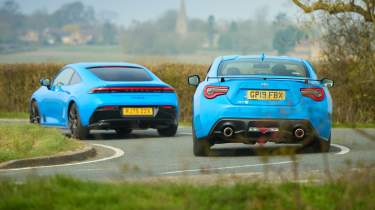
I arrive smiling, and a few minutes later managing editor Ian ‘Ev’ Eveleigh pulls up in the GT86. Suddenly, the Prelude looks quite high-of-ride and cab-forward, the cars’ differing mechanical layouts clear to see in their external forms. The Toyota isn’t as pretty as the Honda, though, this facelift example bearing fussy extra details, around its front bumper in particular, that chip away at the purity of the original.
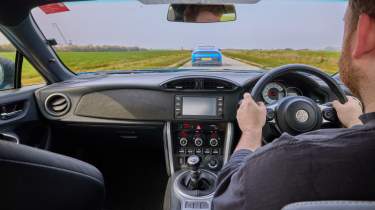
Time for a refresher on how it drives. The GT86 is a compact thing to contort yourself into after the roomier, hatch-based Honda. You’re immediately hugged more by the smaller, sportier seats and hemmed in more by the door on one side and the traditional handbrake and chunkier central spine to which it’s affixed on the other. The Honda’s seating position is good but the Toyota’s feels more purposeful. I doubt anyone has ever chosen a GT86 for its interior appointments, but the innards here are better than some thanks to the mix of leather and Alcantara – a deliberate upgrade on the facelift car to improve perceived quality.
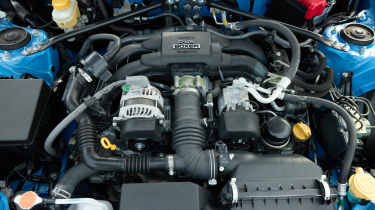
Press the start button and that 2-litre 4U-GSE flat-four motor coughs into life and settles into a rattly idle – it makes a GR Yaris’s chattery three-pot seem as smooth as a Lexus V8. The six-speed manual gearbox isn’t entirely collaborative even when warm, requiring a forceful thrust into first gear. That’s juxtaposed by the millimetrically careful clutch control required to get away without stalling. Save for its mid-level Track stability setting, the GT86 is all but modeless, and there are no ‘assistance’ features asking to be turned off.
Once rolling, the Toyota feels bright. Immediately the steering is heftier yet quicker and more precise than the Prelude’s – it’s quite lovely, in all honesty. The ride is definitely more serious, even without the upgraded Sachs dampers that featured on cars equipped with the optional Performance Pack. It’s far noisier in here too. I’d say the refinement has almost halved by comparison with the Prelude. (This was something the GR86 addressed with a hike in cabin quality and liquid-filled engine mounts.)
Then, as you get up to some speed and find a rhythm with the GT86, you sense some similarity with the Honda. It feels light on its feet, lacking any need for excess pace to bring it to life. You can feel it leaning on its Showa dampers and using the sidewalls of its 215-section Michelin Primacy tyres. Body roll isn’t as pronounced as in the Honda but there’s less mechanical grip.
Its brakes aren’t as strong, either, lacking as it does the optional Brembos. The Prelude, meanwhile, is surer-footed on its 235-section PremiumContact 6 Continentals and over-braked on its Type R-inspired Brembo stoppers, with feel unpolluted by regeneration.
Still, the GT86 is pointier, more adjustable. At the risk of stating the obvious, being rear-driven adds a welcome dimension to its dynamic character over the Prelude too. Where in the Honda you’re using the brakes and measuring your steering aggression to plumb the adjustability of the chassis, in the Toyota you can also use the throttle to conduct your line.
Feeling so compact, it’s beautifully placeable too, as Ev notes: ‘Its slim frame is a real benefit on narrower roads. Where wider cars would have you wincing and breathing in as you pass oncoming traffic, or slowing cautiously, in the GT86 you find there’s still plenty of room. It pays off elsewhere too, giving you more road to play with, more lines to choose from.’

That we found it to be out of its depth on track 14 years ago comes as no surprise. Here, at a brisk canter on sinewy B-roads that would feel restrictive in today’s sports saloons, is where the GT86 does its best work. Like the Honda, you sense its junior billing unlocks more potential from a wider range of roads.
The elephant in the room isn’t going away though. This engine feels every bit the misstep today as it did in 2012. It’s positively breathless, demanding that you live in the top third of the rev range to get anything out of it, and sounding like a thrice-overclocked cement mixer filled with bricks in the process. The dysrhythmic ‘pit’ in the torque curve after 3000rpm is detectable, even in the lethargic no man’s land of performance below 5000rpm. The fact that the (pleasant-ish) manual change isn’t one you can rush exacerbates the issue too.
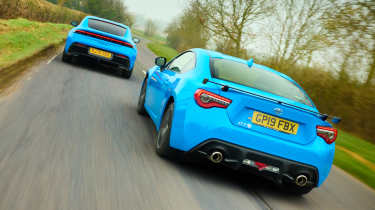
It makes for a stark and slightly painful comparison with the instant full-torque delivery of the Honda. When setting off almost nose-to-tail, the Honda pulls the Toyota’s pants down. Make the mistake of selecting second gear early in the GT86 rather than getting the engine screaming in first and you’ll drop even further back. And when you’re finally up to speed, you’ll be working the GT86’s powertrain hard to keep pace with the Honda. The Prelude doesn’t have a big chest but it puffs it out convincingly by comparison.
In fact, the Honda does a great deal convincingly. I feel in no way short-changed stepping back into the Prelude after the more physical experience that is the GT86. Its steering may be lighter and doughier, its responses overall more relaxed, but there’s a real sense of cohesion to relish in the Honda. Ev is impressed too and to my surprise nods in agreement when I somewhat ambitiously propose the Prelude feels like you could restyle it, tart up its interior and slap an Alpine badge on it.
‘The ride is refreshingly supple, even in its firmest Sport setting,’ he says. This next bit really does sound Alpine-esque: ‘And there’s roll too – remember roll? But it doesn’t feel like it’s to the car’s detriment; it feels like it belongs there. It’s clearly a car that has been set up to shine on the road, not a racetrack. It smothers imperfections rather than telling you all about them in minute detail.’
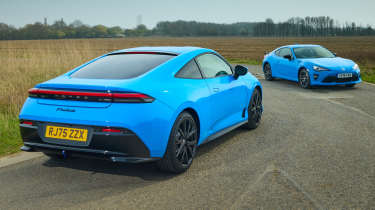
Like the GT86, question marks remain over its powertrain. Not its low-down delivery, but when the road opens out enough that you can fully extend it. Its four-cylinder motor, while not gruffly ogre-esque like the Toyota’s, is hollow-cheeked up towards its 6000rpm red line, making extended flat-footed periods feel abusive rather than rewarding. The S+ system feels better than it did on that first drive, though – still with nice short ‘ratios’ and simulated downshift ‘kicks’, but somehow more convincing, more natural, if still lacking a proper interference-free manual mode.
It’s clearer in my head now what the Honda Prelude and Toyota GT86 share: that squeezing the pips is sort of missing the point. So subtle is the way the Honda looks and drives that it never suggests anything else should be the case. The Toyota is actually less comfortable in its own skin: as the richer, grittier, more involving drive, it eggs you on harder, which is actually counterintuitive, as the grass is not greener beyond that flowing, eighth-tenths, country-road Goldilocks zone.
Which you favour will come down to how you prefer your performance car to cover ground and how much you want to pay for the experience. Smooth and flowing, with new-car reassurance? That’ll be the Prelude. Analogue, interactive and a bit of a bargain? The GT86 is for you – or the newer and improved GR86. The GT86 was far from perfect when it launched, but it evolved into one of the best of its kind. The first part is true of the Prelude, too. Now we wait to see where Honda takes it next.
Specs
| Toyota GT86 | Honda Prelude | |
|---|---|---|
| Engine | Flat-four, 1998cc | In-line 4-cyl, 1993cc, plus 135kW e-motor |
| Power | 197bhp @ 7000rpm | 181bhp |
| Torque | 151lb ft @ 6400rpm | 232lb ft |
| Weight | 1240kg (161bhp/ton) | 1480kg (124bhp/ton) |
| 0-62mph | 7.6sec | 8.2sec |
| Top speed | 140mph | 117mph |
| Basic price | £27,464 (new), from £7995 now | £40,995 |