Best Japanese cars – performance icons from GR Yaris to NSX-R
The Japanese have produced some of the most compelling performance cars we've ever tested, from hot hatches and rally cars to full-on supercars
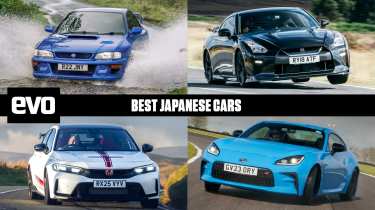
The Japanese go about the job of performance cars a little differently to everyone else. There are often no compromises when it comes to a car’s dynamic attributes – whatever the core metric is by which the car is being measured, it will take priority, sometimes to the detriment of other areas. If you’ve ever enjoyed a Japanese car and it didn’t have an interior as tinny as the dynamics were fabulous, its maker probably didn’t make any money (hello, Lexus LFA). Speaking of which, sometimes the singularity of focus and stubborn commitment to the cause can override any authority the bean counters wield. Can you imagine a European brand’s board of directors authorising something like the LFA, Toyota GR Yaris or Nissan GT-R to be produced today?
The Japanese approach is a methodical and calculated one, demanding not just performance but durability, whether that’s for lap after lap of Fuji or the Nürburgring, or victory on the special stages of the WRC. The priority is always second-to-none engineering. The job is never done either, with the first release of many Japanese performance cars often being followed by incremental updates introduced year after year, directly addressing any shortfalls and keeping the cars competitive with rivals. The result can be models that both took a long time to arrive and, through continuous retouching, live for a long time too (hello, Nissan GT-R).
Yet almost always, these cars are incredibly compelling. Whether it’s pursuing the more ambiguous, sensational definition of the thrill of driving, like the Lexus LFA, Toyota GR86 and Mazda MX-5, or chasing raw speed against the clock, like the Nissan GT-R and Honda Civic Type R, they’re objects of enormous appeal. We adore Japanese performance cars. Here are the best we’ve ever tested – a cohort Toyota’s GR GT surely hopes to join.
Best Japanese cars
- Lexus LFA
- Honda Integra Type R (DC2)
- Toyota Celica GT Four
- Subaru Impreza RB5
- Nissan GT-R (R35)
- Honda Civic Type R (FL5)
- Mazda MX-5 ND
- Toyota GR Yaris
- Honda NSX-R (NA2)
- Toyota GR86
- Mazda RX-7 FD
- Mitsubishi Lancer Evolution TME
- Nissan Skyline GT-R
- Lexus GS F
- Toyota MR2 (Mk1)
- Honda NSX NA1
- Mazda RX-7 FB
- Subaru Impreza 22B
- Honda Civic Type R (EK9)
- Nissan Skyline GT-R Nismo 400R
Lexus LFA
- Prices from: £750,000
- Pros – Explosively entertaining tech-fest, dripping with stunning details
- Cons – Imperfect transmission, still expensive
- evo rating: Five stars
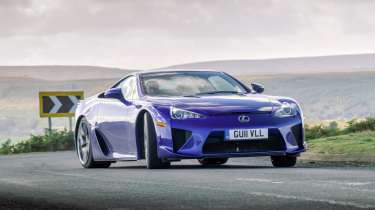
We lead with the king in the eyes of many. The Japanese car that’s one of very few from the East to be truly accepted in the upper echelons of supercardom, at least with hindsight. As well it should be, with a bespoke Yamaha-tuned V10 that revs so fast an analogue tacho can’t keep up.
The Lexus LFA is the poster child for that camp of Japanese car that takes an age to arrive. It’s what happens when the iterative perfectionism and obsession of a determined enthusiast CEO goes unchecked at a multinational car company with bottomless pockets.
The irony is, the result was far from perfect, still sporting a lurchy single-clutch paddleshift transmission at the dawn of the dual-clutch supercar age, and priced like a hypercar at £340,000, but with only supercar potency at 552bhp. Some got it straight away while for others it took a while, but objective performance measure really isn’t the point of the LFA. It’s about sensation, the music of that engine, the craftsmanship and quality of its build, and the balance and beauty of the driving experience. More have got with the programme as the years have tumbled by and we’ve all come to realise that the likes of the LFA – and more specifically the LFA’s astonishing engine – are unlikely to be seen again.
Honda Integra Type R (DC2)
- Prices from: £14,000
- Pros – One of the best front-wheel drive cars ever
- Cons – Too raw for some
- evo rating: Five stars
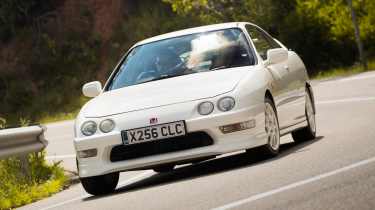
Then again, perhaps leading with a near-unobtainable supercar misses the point when it comes to Japanese performance cars, for the same level of obsessive engineering can often be found in more attainable machines. The Honda Integra Type R is a case in point, with its 187bhp 1.8-litre four-cylinder engine putting out over 100bhp per litre almost 30 years ago. And that was only the one we got in the UK, with hotter JDM-spec cars producing closer to 200bhp.
Honda might sometimes be tarred as an engine maker that happens to build cars too, but the Integra Type R is much more than just its singing B18 mill. That fabulous engine is joined by a chassis and transmission that, when awoken, engage to the point of near perfection.
In fact, back in 2006 (a while ago, we admit) we proclaimed that the DC2 Type R was the best front-wheel-drive performance car ever made. Getting one alongside the FL5 Civic Type R (more on which in a moment) today sounds like a good idea, to see if that proclamation holds true…
> Honda Integra Type R (DC2) review
Toyota Celica GT-Four (ST205)
- Prices from: £7000
- Pros – Potent engine, feedback, composure, balance
- Cons – Not as thrilling as rivals from the era
- evo rating: 4.5 stars
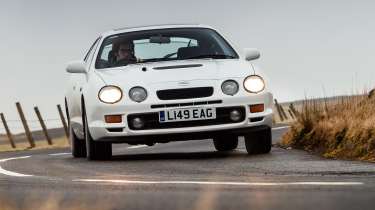
Before the GR Yaris (don’t worry, it’s coming) there came the Celica GT-Four. ToMoCo is no stranger to spitting out road cars whose primary purpose is ensuring the racer they’ve devised reaches compliance under a ruleset that demands a civilian version. It’s not afraid of the extremes either – just look at the road version of the GT One Le Mans prototype, with a fuel tank that Toyota claimed was luggage space for the purposes of homologation.
The GT-Four is a figurehead for Toyota’s creative interpretation of the rules too, with an air restrictor on the 1995 ST205 rally car that would stay closed for inspection by the WRC’s officials, before opening with pressure and heat at pace to unlock extra horsepower. Knowing the rally car’s problem with authority, it comes as a surprise to find that the 239bhp road-going GT-Four is the more grown-up of its rally-bred contemporaries – enormously capable, stable and balanced, with a less frenetic powertrain than some. It’s still a wondrous thing to drive, but without the same ability to throw the hairs on the back of your neck skyward. All things are relative – it’s still a wondrous device with which to attack a winding road.
> Toyota Celica GT Four review
Subaru Impreza RB5
- Prices from: £15,000
- Pros – Perfect blend of poise and power
- Cons – Built in low numbers, pricey now
- evo Rating: Five stars
Impreza or Evo? Unfortunately, it’s not a question raised often these days – these four-wheel-drive heroes having been gone from the UK market for some time.
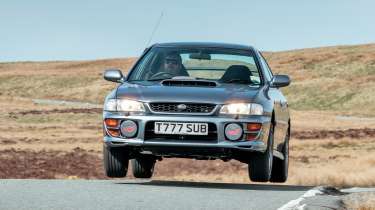
The RB5 is among our favourite Imprezas. The core components are familiar of course: a warbling turbocharged flat-four motor, a sophisticated torque-splitting all-wheel-drive system encased in a blistered-arched body. The result is a car that’s involving and rewarding in equal measure, and makes the ‘bug-eye’ GD Impreza that followed a year later seem slightly less special.
Way back when, the RB5 was accomplished enough to finish third in evo Car of the Year 1999, behind only the Porsche 996 GT3 and Ferrari 360 Modena, and ahead of the E39 BMW M5, Peugeot 306 Rallye and R34 Skyline GT-R. Upon a revisit in 2025, we found its appeal undiminished, the car flattering but still thrilling its driver, absorbing the most technical of roads with a pace that belies its age. In many ways, its character lives on in Toyota’s GR Yaris. For context, that’s a huge compliment to the modern hot hatch, not the other way round.
Nissan GT-R (R35)
- Prices from: £35,000
- Pros – Staggering capability; grip, power, poise and engagement
- Cons – A little rough around the edges
- evo Rating: Five stars
Back in 2000, Nissan took the decision to develop a standalone halo model that would drop the name Skyline and be called simply GT-R. Like the Lexus LFA, it took its time to arrive, with the production car not being revealed until 2007. Cars wouldn’t reach UK dealers until late 2008.
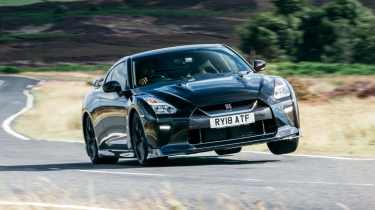
Undoubtedly, it was worth the wait. This imposing, angular machine was no saloon in drag, but a 473bhp supercar-killing coupe all of its own. Never mind the Tesla Model S, this was the ultimate disruptor of the last 25 years, conquering the Nürburgring and consequently putting a bee right in the bonnet of Porsche. Even its infamous 997 Turbo-conquering 7:38.54 lap was said to be conservative, set as it was in damp conditions. Our love for the GT-R at the time is well known, with the first iteration claiming evo Car of the Year honours over the 997 Porsche 911 GT2 and Lamborghini Gallardo LP560-4.
And that first R35 GT-R was only the beginning. Model year upgrades came thick and fast, with power boosts to 478, 523, 542 and finally 562bhp over the course of its near two-decade run. In that time its appeal only strengthened.
Some dismissed the Nissan GT-R as too computerised to be a proper driver’s car, but that only revealed they’d never driven what was in fact an incredibly tactile, analogue-feeling brute of a car. Yes it was incredibly capable and beautifully balanced, but it also forced every sensation of the experience on you, from the chuntering of the drivetrain and roar of the engine, to the feedback-filled steering and the feeling through your backside. All stuff that, over the GT-R’s extended tenure, faded slightly in some rival sports and supercars and made its offering more distinctive with every passing year.
Honda Civic Type R (FL5)

- Prices from £40,000 (used)
- Pros – Astonishing capability, engagement and quality
- Cons – Could sound better
- evo Rating: Five stars
With a car as good as the FL5 Civic Type R, you start with the flaws. Because you’ll be able to count them on the fingers of one hand. Or maybe just the thumb. The turbocharged 2-litre engine doesn’t sound great… and that’s about it. It goes without the same rabid, rev-hungry character of the old naturally aspirated K20 units, but viewed in the emissions-conscious, power-hungry context of the 2010s and 2020s where this engine originates, it’s a star motor – the best out of its rivals.
The Honda Civic Type R has always been at its best when fully embracing its touring car-like hunger for hard driving, and that’s never been more the case than in the latest, now discontinued car. You just grow horns and hunt the horizon, extracting everything from that 324bhp four-cylinder, your left arm seeking every opportunity to swap between the gears with a sublime manual transmission that offers the kind of feel that even Porsche’s engineers could do well to study.
The chassis is the best it’s ever been too, in FL5 form finally gaining some flexibility thanks to an Individual mode. For road driving, keeping the suspension in Normal and switching everything else to the most aggressive setting is just about perfect, the very best Type R character finally free to take on almost all roads without jarring its pilot. It is surely one of the all-time-great hot hatches, if not in the compact, flickable, mobile sense of the sub-ton French stars of old.
> Honda Civic Type R (FL5) review
Mazda MX-5 (ND)
- Prices from: £15,000 (used)
- Pros – Lightweight and balanced; fab transmission; great fun at road speeds
- Cons – Engine a little dull; not for those wanting ultimate speed and grip
- evo Rating: Five stars
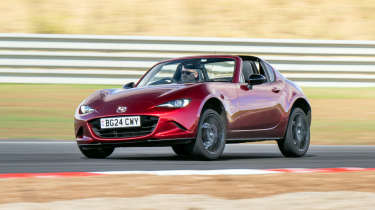
Quite on the other end of the scale to the brain-scrambling capability of the GT-R and the rabid, road-going touring car that is the Type R, is the Mazda MX-5. Here is a car that’s changed barely a shade in its 35+ years on sale. Now, as then, it’s all about back-to-basics sensation, about revelling in the process of driving. We’ve not always resonated with a car that has sometimes been criticised for erring too far on the side of minimalism, but in amongst the multi-ton electrified crossover hellscape that is today’s car market, the MX-5 is a delectable detox.
That said, the current Mazda MX-5 is a little more serious than those of the past. The 181bhp output of the naturally aspirated 2-litre engine is just about enough to be getting on with and meets the rear wheels via a new limited-slip diff, while the Bilstein dampers afford it more control and more serious speeds. But the ultimate joy of the MX-5 is uncorrupted. Its limits are entirely explorable, its weight and dimensions refreshingly diminutive, and its six-speed manual gearbox and steering a total tonic of interactivity.
Against all the odds, the MX-5 is an exemplar of the unwavering Japanese dedication to a stated brief that we mentioned in the opener. The MX-5 is a lightweight, back-to-basics sports car, and so it shall remain as long as Mazda is allowed.
Toyota GR Yaris
- Prices from: £25,000 (used)
- Pros – Huge cross-country pace belies figures on paper; sense of purpose; gutsy engine
- Cons – Expensive; difficult to get hold of; not especially playful
- evo Rating: Five stars
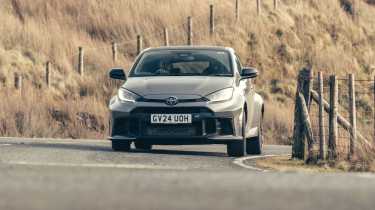
We owe a great deal to Toyota chairman Akio Toyoda, or Morizo as Toyota refers to him. The father of the LFA (and Lexus F as a whole), the GT86 and GR86, eventually set his sights on delivering an era-defining Toyota hot hatch. Far from just being a harder-riding Yaris with a more powerful engine, the GR Yaris is a rally stage reject that has its own four-wheel-drive system and a bespoke 1.6-litre three-cylinder engine producing 256bhp, or 276bhp in Gen 2 specification. The platform is a Frankenstein of Corolla rear end and Yaris nose, with a three-door body no other Yaris uses.
In the tight-margined car industry of the last few years, it shouldn’t have made sense. Yet such was the resonance this car had with the enthusiast audience, it sold in numbers greater than Toyota ever expected, and deservedly so. This is a joyous little car – balanced, excitable and downright fun. The Japanese aren’t ones to rest on their laurels, so an update strengthening the engine (276bhp), revising the cabin and lowering the high driving position was deployed for 2024.
Toyota then carried on tinkering, continuing to stiffen the shell and improve the aerodynamics. Believe it or not, the aero isn’t the best new feature on the new GR Yaris Aero Performance. It’s the repositioned rally-style manual handbrake. More updates to come will also bring a more intuitive steering wheel with control placements and tactility inspired by motorsport. Long may the GR Yaris, and the kind of dedication that spawned and continues to hone it, live on.
Honda NSX-R
- Prices from £1million
- Pros – evo Car of the Year 2002
- Cons – Hard to find, and costs over £1million when you do
- evo Rating: Five stars
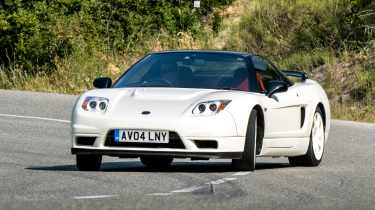
The Japanese have a habit of deftly executing a late-game Hail Mary move, delivering era-defining versions of certain cars towards the end of their life cycle. One moment, they’re here and everything is amazing. The next, the whole model is dead, after a decade and a half. The Honda NSX-R is the ultimate case in point. The standard NSX shook up the industry all the way back in 1990, but it took until 2002 for the arrival of the NA2 facelift and the second-gen NSX Type R.
This is a car that typifies Japanese attention to detail, with myriad changes that add up to a car that can lap the Nürburgring in under eight minutes with just 276bhp… and did so in 2002, on tyres from 2002. Said changes include a balanced, high-tolerance engine rotating assembly, a lighter hand-machined clutch, flywheel and pulley assembly, a carbonfibre bonnet and wing, thinner rear glass and much more. That engine feels more lively in-gear too, thanks to a 4.1 per cent shorter final drive.
The result is absolute cohesion, in a car whose components fit together like a perfect puzzle. Even by comparison to the Lamborghini Huracán STO and Porsche Cayman GT4 RS, the Honda NSX Type R that’s 20 years their senior demonstrated what a truly rounded driver’s car feels like. By our reckoning, only the 458 Speciale bests it.
Toyota GR86
- Prices from: £27,000
- Pros – Punchier engine matches the sublime chassis
- Cons – It was tough to buy one new
- evo Rating: Five stars
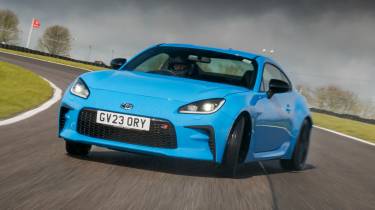
The Toyota GT86 was a phenomenal little coupe in terms of offering a raw, back-to-basics driving experience. It’s a car in which you can learn the fine art of car control, almost from scratch. But it did have its flaws. That engine was a bit gutless, the limits of the skinny tyres a bit too low, the cabin just a bit too tinny and the gearchange just a bit too notchy. The Toyota GR86 that followed is perhaps the best example of how the Japanese really do listen when it comes to their cars. Because, well, the GR86 fixed everything, with a gutsier 2.4-litre engine that delivers its torque sooner, a stiffer shell, proper tyres and improved refinement. The gearbox, too, is more collaborative, making it almost a shame that you’re not constantly swapping cogs to keep the boxer four-cylinder on song.
The result is such a cohesive little coupe that it managed to outscore both the McLaren Artura and the Ferrari 296 GTB in 2022’s evo Car of the Year. It’s an astonishing driving machine for the money and the answer you’ll hear from many evo staffers when they are asked what car they’re the closest to just taking the leap and buying right now. Used, of course, as the GR86 is now off sale in the UK and Europe due to new frontal impact regulations.
Mazda RX-7 (FD)
- Prices from: £25,000
- Pros – The high point of Mazda's rotary efforts
- Cons – High fuel consumption, too
- evo Rating: 4.5 stars
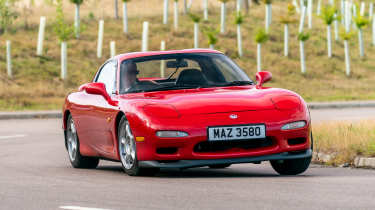
Not many cars can claim to have a more dedicated cult-like following, even if few would actually put their money where their mouth is. The Mazda RX-7 was the Hiroshima marque’s flagship sports coupe that, on top of being light, lithe and beautiful, uniquely sported a rotary engine.
In FD form the RX-7 ran the 13B-REW twin-rotor sequentially turbocharged engine for 237bhp. That might sound low compared with some other ’90s Japanese powerhouses, but with just 1310kg to shift, it was more than enough. Especially given what a joy it is to exercise to access that power, which comes in at a heady 6500rpm. It’s not an engine that suffers neglect, though. It needs to be diligently serviced and it needs its throat cleared before you switch it off, to save excess fuel nibbling away at the apex seals. But for many, nothing else will do.
The chassis and transmission to which it’s bolted are a delicate complement to be revelled in. With responses dialled just so, from the steering to the damping, it’s a sports car that has you revelling in developing a sustained flow. The RX-8 that followed was a novelty, if not a true successor, but Mazda has never stopped teasing the possibility of the return of the RX-7.
Mitsubishi Lancer Evolution
- Prices from: £20,000
- Pros – Prodigious grip and otherworldly agility, frenzied responsive engine
- Cons – Yaw control system takes some acclimatising to
- evo Rating: Five stars
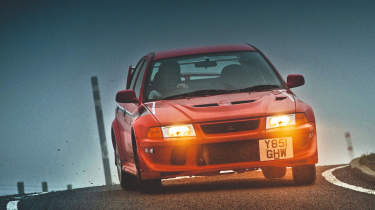
Like with the Subaru Impreza STI, one can view the Mitsubishi Evolution as a dynasty rather than a single model. Sure, it evolved (pun intended) from its arrival in 1992 until its demise in 2016, but the formula remained the same: take a fairly nondescript family saloon, drop in a monster turbocharged four-cylinder engine and sophisticated all-wheel drive system, and crash it into a rally team’s body shop. Forged in the fires of Group A, for a car so inexorably linked to rallying, it’s odd that Mitsubishi only clinched a single constructors’ title, in 1998.
It was Tommi Mäkinen who made the Evo his own, taking four drivers’ titles from 1996 to 1999, thus informing the creation of the Mitsubishi Evolution VI Tommi Mäkinen Edition. In spite of the prodigious talents of the Evo 7, 8, 9 and (controversial) X that followed, the TME is for many the favourite and certainly one of the most valuable. It has just the right amount of power to complement its tyres, suspension setup and braking appointment. Truthfully.
This is a car that rewards at all speeds, that gets up on its toes and closes a protective fist around you as you embark on a drive, no matter what the technicality of the route or the road conditions. Casual observers may have fallen into the Subaru camp for the love of the warbling boxer, but the rabid 4G63 engine has an old-school turbo, red line-hungry nature of its own.
> Mitsubishi Evolution VI Tommi Mäkinen Edition review
Nissan Skyline GT-R
- Prices from: £80,000
- Pros – Big, brutal and great fun
- Cons – Needs more than the standard 276bhp
- evo Rating: Five stars
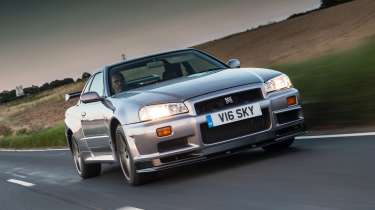
The Skyline GT-R is as much a dynasty as it is a pop culture icon in R34 form and an infamous motorsport dominator in R32 form. All Skyline GT-Rs share the same basic make-up of manual transmission, the incredible ATTESA all-wheel drive system, HICAS four-wheel steering and the RB26 DETT straight-six engine, with incremental chassis, damper and powertrain upgrades splitting them.
The R34 Skyline GT-R is best-known thanks to its role in the Fast & Furious franchise. The R34 brought with it a six-speed transmission and ceramic ball-bearing turbochargers, was much more modern-looking, and more high-tech inside, with a new 5.8-inch LCD display giving live readings from the powertrain. You could even spec a multi-function display with a G-meter and lap timer.
To drive, in standard form, it’s a car that belies the inflated internet legend. With the factory prescribed 276bhp, it’s a fast, agile, capable, engaging sports car, rather than the outright supercar slayer that forum commenters will have you believe it is. What they might be right about is that the standard power figure is modest. Somewhere between this gentleman’s agreement amount and the 1000bhp that every keyboard-warrior JDM evangelist thinks all GT-Rs have would be the sweet spot, properly bringing the R34 to life and aiding exploitation of its gloriously capable dynamic technical make-up.
> Nissan Skyline GT-R (R34) review
Lexus GS F
- Prices from: £32,000
- Pros – Superb engine, exploitable chassis, quality
- Cons – Gearbox off the pace, structure less rigid than some rivals'
- evo Rating: Four stars
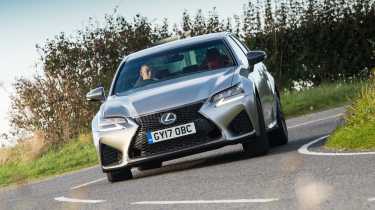
The Japanese on occasion try to imitate their European rivals, albeit with their own twist. In the case of the Lexus GS F, it was almost a tribute to a type of European saloon that was confined to the history books – naturally aspirated, with more subtle dynamics.
For those drivers just a little tired of the technological arms race, the Lexus GS F will came as a refreshing tonic. There’s no turbocharging or four-wheel drive here. Yet while it lacks the sophistication and outright performance of many rivals, the Lexus’s charms are hard to resist.
At the heart of the GS F’s appeal is its large-capacity naturally aspirated V8. With 471bhp, the 5-litre unit has a huge power deficit to models such as the BMW M5 and Mercedes E63 S, but the way it goes about delivering what it has got is properly addictive. Because there’s no wall of turbocharged torque from idle, you really have to work the V8 hard to make progress, with most of the action only really taking place once the needle on the rev counter climbs past 4500rpm. Then there’s the gloriously symphonic soundtrack, which ranges from a subtly gurgling idle through to its banshee howl at 7100rpm.
String the Lexus through a series of corners and you’re constantly reminded that it’s a big old bus, but it never feels ponderous or wrong-footed. The steering is slower than we’ve come to expect, but its decently weighted and precise, plus it’s linked to a front axle with strong grip. And because that engine dishes out its performance in such a consistent and oh-so-accurate manner, you’re able to steer the Lexus through corners with the throttle as much as the steering – it’s possible to get into a real groove with the GS F.
Toyota MR2 (Mk1)
- Prices from: £10,000
- Pros – Like an MX-5 with added mid-engined exoticism
- Cons – Hard to find a good one
- evo Rating – Five stars
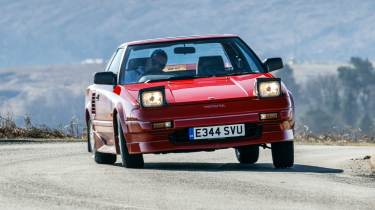
Think of small Japanese sports cars and it’s usually the likes of the Mazda MX-5 and Toyota GR86 that spring to mind first. But Toyota’s original MR2 is absolutely worth a seat at the table – it’s a brilliantly executed, stylish mid-engined coupe (or ‘midship runabout two-seater’, according to its name) that has more than a hint of Lotus in how it drives, and is dynamically a cut above the much-loved Mk1 MX-5 that arrived shortly afterwards.
It’s hard to pinpoint why the original MR2 has flown under the radar while the Mazda went on to become the world’s most beloved and best-selling sports car. The Toyota’s 8-bit design has aged very nicely, its cabin is delightfully whacky and there’s real depth to how it goes about its business. The 4A-GE engine is borrowed from the AE86 Corolla, mounted behind the driver rather than in front, producing a respectable 122bhp and driving through a five-speed gearbox, where contemporary British sports cars usually made do with four ratios. It weighed just 977kg and had disc brakes all around. It’s a specification that could easily belong to a Lotus, and there are rumours that Hethel carried out some of the Mk1’s chassis tuning.
Whether they actually did is a mystery, but if you’re a fan of the Elise, you’ll enjoy the MR2’s blend of suppleness, light-footed adjustability and delicate response. It’s a real treat to drive and makes the most of its modest power, feeling sweeter and more resolved than a similarly aged MX-5. Go for the targa version and you add open air to the mix, too. It’s an unsung hero of a sports car and one of the very best of the 1980s.
Honda NSX NA1
- Prices from: £70,000
- Pros – The original usable supercar
- Cons – 276bhp is a little weedy today
- evo Rating: Five stars
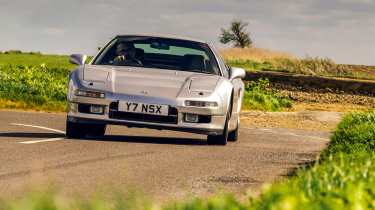
For all its undoubted gifts, the original Honda NSX always seemed essentially ‘safe’ rather than ‘scary’, always inspired enough confidence to be conducted at a considerable lick without putting undue pressure on the driver. Arguably, it was the world’s first truly friendly supercar. It was certainly user friendly – easy to operate at normal speeds, more practical than any supercar before it, cheaper to run and demonstrably more reliable. Its arrival made an impact in Modena, Ferrari seeing the NSX and suddenly realising that, with the 348 in particular and its whole range really, it had become perilously complacent. The NSX really did catch Ferrari napping.
Though lacking all the sinews and hard edges that we so adore in the last NSX-R, the original NSX of the early 1990s has the building blocks baked in. The sound of that V6 as VTEC arrives is aural caramel and the chassis is hugely advanced – the first alloy monocoque used in a road car, with double-wishbone suspension at each corner. That’s reflected in the quality of the dynamics, which were super sweet, offering great balance and biddability. Every control is beautifully judged, from the steering to the pedals to the gearshift. The view out is excellent too, as is the driving position. With the NSX, Honda debugged the supercar.
Mazda RX-7 FB
- Prices from: £8000
- Pros – Lightweight, balanced, smooth engine
- Cons – Not fast, imperfect steering, delicate engines
- evo Rating: Five stars
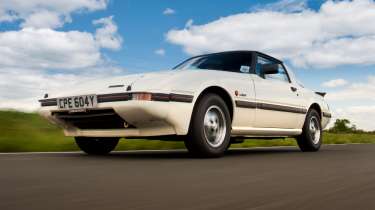
The RX-7 everyone remembers is the FD. It’s a beauty and a bit of a movie star thanks to its brief moment on the silver screen in The Fast and the Furious. But the RX-7 had been around over 20 years when that film came out, first arriving in the 1970s as a modest, attractive, keenly priced coupe to battle Porsche’s 924. It also made quite the impression as a competition car. Indeed, to us, wins at the Daytona and Spa 24 Hours hold a bit more Kudos than being Dom Toretto’s weapon of choice for Race Wars.
RX-7s were never enormously powerful as standard, but the FB really is a product of its time, arriving first with just 100bhp and needing all of the revs to access it. Like all RX-7s, however, it was light. Really light, at just 1099kg in its original form. Its suspension might have been somewhat unsophisticated (with a live rear axle) and its steering slightly dull, but conducting an original RX-7 feels like an artform. Not to mention an alien experience given how large, remote and heavy most cars are today.> Mazda RX-7 (SA/FB) review
Subaru Impreza 22B
- Prices from: £250,000
- Pros – The ultimate official Impreza…
- Cons – … for which you’ll pay the price
- evo Rating: Five stars
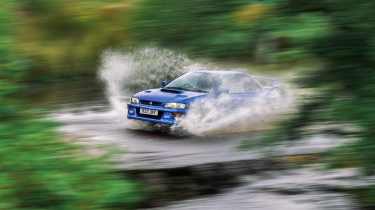
The Impreza 22B STI has been the halo model of the hot Subaru lineage ever since its introduction. It’s one of the most extreme iterations of the formula forged in the afterglow of the marque’s peak rallying era.
An Impreza 22B featured in the very first issue of evo. Amusingly, or perhaps confusingly, it actually missed out on the five-star verdict the first time around, but this is one of those cars that has improved with age. It’s impossible not to be charmed by the shape, the closest any road-going Impreza has got to the pumped-up WRC cars of 1997 onwards (until the Prodrive P25 arrived, of course).
The 22B is 80mm wider than a regular two-door Impreza, and its engine was bigger too, displacing 2.2 litres rather than the usual 2.0 – affording it not just the Japanese gentleman’s agreement 276bhp (in the brochure, anyway; they were thought to produce a fair bit more) but also more torque, all delivered through a close-ratio gearbox. Quicker steering, wider wheels and firmer suspension gave it a more serious feel on the road, too. All the usual Impreza sensations, but heightened. It’s no affordable hero though, with modern values in the six-figure range.
Honda Civic Type R (EK9)
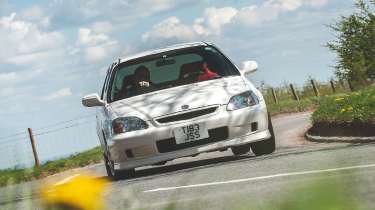
- Prices from: £15,000
- Pros – Sublime early incarnation of the Type R recipe
- Cons – Good ones are few and far between
- evo Rating: Five stars
The ‘EK9’ Civic Type R never came to the UK officially. We didn’t miss it too much, as the DC2 Honda Integra Type R was a more than worthy substitute, but it did mean that UK buyers never really got to enjoy the full potential of Honda’s mid-to-late ’90s Civic.
With a similar treatment to the Integra – think extra seam welds in the chassis, thinner glass, and a hand-built engine (1.6 litres here, with 182bhp) – it’s just as serious under the skin. When we finally got our hands on one in the UK, we discovered something of an overlooked gem. It has the same raw feel as the Integra, and its import-only status gives it the rarity factor too.
The Type R dynasty that followed, and which did make it to the UK, came with the rev-hungry K20 four-cylinder, but it never quite carried over wholesale the sheer rabidity of the old B16 and B18 engines. The rest of the EK9 is there to meet it too, surprisingly so on the UK roads for which it was never designed. The damping is just right at pace, the balance sweet and adjustable, the steering sharp with enough feel to conduct the car with confidence.
Nissan Skyline GT-R (R33) Nismo 400R
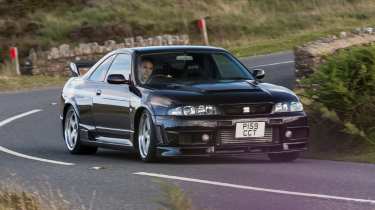
- Prices from: £1million+
- Pros – Early proof that Japanese high-tech could work (superbly)
- Cons – Limited supply, ludicrously expensive now
- evo Rating: Five stars
The R33 Skyline GT-R of 1995 is the unloved sibling for being 100kg heavier than its R32 predecessor right out of the gates, without adding more power. It also didn’t have the same motorsport provenance, but the R33 accrued accolades of its own, being the first production vehicle to go round the Nürburgring in under eight minutes, its 7:59.887 time earning it the title of fastest production car. The R33 that is beyond reproach, however, is the Nismo 400R – the 44-off supercar slayer that deviated more from the standard Skylines on which it was based than any factory-sanctioned machine before it.
Here is a car overhauled. The engine was so different that it had its own name – RB-X GT2 – with N1-spec turbochargers, a forged crank and connecting rods, a bespoke engine management system and upgraded intercooling and oil cooling. It sent that power from its transmission to the rear axle via a 50 per cent lighter carbonfibre driveshaft, while elsewhere you could find a carbon bonnet, an adjustable wing, a 50mm wider track and Bilstein dampers. It’s a thriller to drive, albeit one that doesn’t reveal its full nature easily.
Rather it’s a car you have to really lean on, to wake the ATESA-ETS Pro all-wheel-drive system and electronic Super HICAS rear-steering, and rouse the monstrous motor. Do so and the 400R meets you with agility and a natural feel, its systems coalescing into a character that takes acclimatising to but which stuns once you’re there to meet it. Its rarity and rare qualities put it in that NSX-R/LFA club of c/£1million Japanese icons.