Mazda RX-7 (SA/FB, 1978-1985) review – the lighter, tighter Porsche 924 alternative
Built on a shoestring to undercut Porsche’s 924, the original Mazda RX-7 was a rare sight on British roads. Beguiling balance and rotary power meant it was sensational to drive
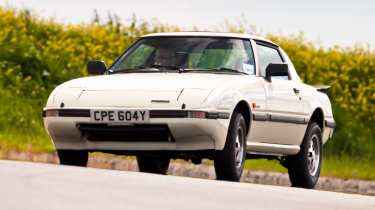
The Mazda RX-7 is known today as the company’s bygone halo model – a car that still knows fame and reverence for its mythical rotary engine among car enthusiasts that were born long after its 2002 discontinuation.
It stood in the middle of the ‘90s pantheon of iconic Japanese sports cars – a long-bonnetted coupé like the Supra, but lithe, lightweight and compact like the NSX. The curvaceous machine known as the FD RX-7 was not where its story began though. Rather, the RX-7 first arrived in SA (and FB) forms 13 years before the FD's birth, in 1978.
History and specs
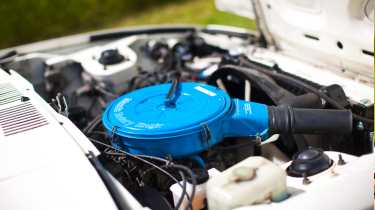
- First ‘12A’ motor good for just 100bhp and 105lb ft
- But it weighed only 1099kg
- 0-62mph time of 9.5sec was brisk in 1978
In a bid to establish compact, lightweight spinning rotors as a viable alternative to reciprocating pistons and make the technology synonymous with the Mazda brand, the Hiroshima-based car maker decided to enter the first Wankel-powered Mazda, the Cosmo, in the ridiculously gruelling 1968 84-hour Marathon de la Route at the Nürburgring. Two were entered – one retired with axle damage just two hours from the finish, the other made it to the end in fourth place overall.
> Mazda MX-5 review – the last surviving affordable sports car
More reviews
More a publicity stunt than the beginning of the Cosmo’s racing career (it ended there and then), the car’s audacious sci-fi style and promise of the future today fired the public’s imagination and laid the foundations, via models like the R100 and RX3, for the RX-7 – the first Wankel-engined car to take the world, and the USA in particular, by storm.
By the late ’70s, having sold almost a million rotary-engined cars and trucks, Mazda reckoned it had put to rest the ghost of the Ro80’s rotor tip failures and flaky reliability. But nothing it had done before clicked with the prevailing automotive zeitgeist like the RX-7. Its sleek European look was an artful fusion of Lotus Elan Plus 2 and Porsche 924 that nevertheless seemed fresh and original.
And with an aggressive pricing initiative (at around $7000 it cost about half as much as the Porsche in the US), plus impressively light weight, a low centre-of-gravity and a 51:49 chassis balance achieved by tucking the small, freakily smooth twin-rotor motor behind the front axle line, the RX-7 flew out of showrooms at a rate the factory couldn’t keep up with. It even led to a black market in the States, with early examples changing hands for $3000 over list.
As fitted to the RX-7, Dr Felix Wankel’s contra-spinning masterpiece was a somewhat evolved proposition, boasting better lubrication and harder-wearing rotor tip seals than the units in previous R and RX models. Weighing a mere 142kg, the ‘12A’ motor displaced just 573cc in each combustion chamber, though this was equivalent to 2.3 litres of conventional piston engine. In Euro spec, peak power was quoted at a bewilderingly modest 100bhp.
> Mazda RX-8 (2003-2010): review, specs and buying guide
Bewildering because – no fanciful boast in the brochure – the car really could crack 9.2sec to 60mph and therefore kick sand in the more powerful Porsche 924’s face. This was all the more remarkable when you consider that torque peaked at a pitifully sub-burly 105lb ft. Mazda would later bump it to 113bhp and then 133bhp in later Series 2 and Series 3 guises.
There’s something that chimes distinctly modern about the way the Mazda extracted more from less. With just 1099kg to haul around, the RX-7 was lighter than a 924 and made Datsun’s 1272kg 280ZX look like the victim of a chronically sedentary lifestyle.
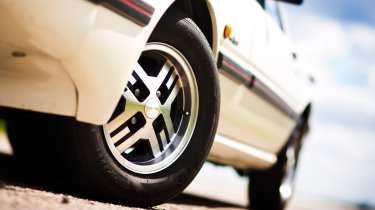
Yet, apart from the engine, there was nothing very exotic about the nuts and bolts of the spec. Reflecting the need to sell the RX-7 at a price that made the Porsche look cynically expensive, the suspension was pretty conventional fare. A live rear axle located by a Watt’s linkage and trailing arms sourced from the Mazda parts bin stood in for a fully independent rear end, with MacPherson struts rather than more desirable double wishbones making do at the front.
Steering was by recirculating ball instead of a crisper rack and pinion setup and the rear wheels were braked by drums and not discs. So, hardly the most sophisticated chassis ever to turn a wheel, but arguably the front-mid layout, even weight distribution and low-slung engine mass counted for as much.
Cost-paring also scuppered the original design plan to give the RX-7 a one-piece, steel-framed tailgate. It ended up with a rather less robust, though lighter, all-glass hatch with external hinges. Making the best of economic necessity, Mazda remarked in the RX-7’s original brochure that the ‘aerodynamically designed’ rear window assembly resembled ‘a jet canopy with its wraparound expanse of tinted glass for better visibility’. Nice catch. Then again, the brochure also called the cabin ‘mission control’.
Performance, ride and handling
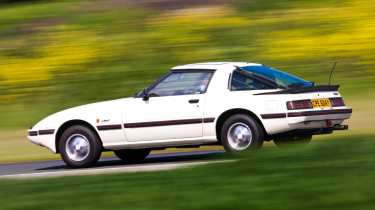
- Rotary engine is impossibly smooth
- Handling balance is blissfully neutral
- Nicely damped on the road
I might as well have called the long-term RX-7 I ran in the early days of my career ‘home’. It wasn’t that I didn’t have a new wife or domestic life to get on with, just that any evening after work I’d chose the long and winding road back to my front door. After the suffocating sloth, feeble grip, under-bonnet knitwear machinations and wholesale sogginess of the Chrysler Sunbeam 1.3 GL I had previously, the Mazda could have been a Lamborghini Miura and I was totally in its thrall.
There were a few unintended consequences. Growing familiarity with the turbine-like smoothness and revvability of its engine began to recalibrate my still embryonic powers of assessment. Any test car with a four-cylinder engine that turned up at the office was irreconcilably crude, noisy and uncouth by comparison.
Small-capacity V6s I’d previously been apt to describe as ‘silky’ suddenly seemed as silky as hemp underpants. Somewhat absurdly, given the engine’s meagre power and torque, I started to have delusions that I was the ‘owner’ of a junior-league exotic (the engine would spin to ‘crazy’ heights and blow flames out of its exhaust after all). A nasty scrap with a BMW 325i put paid to that.
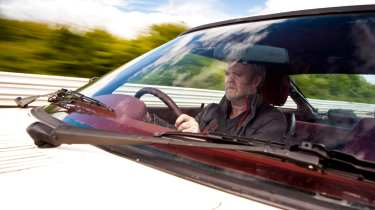
I couldn’t help thinking I’d have had the better of the German if the road had been twistier, though. Even back then, the unassisted recirculating ball wasn’t great, exhibiting a distinct slackness about the straight-ahead. More weight than genuine feel, too. But the cornering balance really was blissfully neutral and gave the 185/70 HR13 tyres every chance to hang on without any unseemly squealing. The thing could be hustled with virtual impunity, surfing a benign rather than ragged edge. Ride comfort wasn’t bad either, save for the occasional live-axle thud and judder over transverse ridges. Otherwise, body movement was well controlled and nicely damped.
> Performance Link Mazda MX-5 R300 review – an MX-5 with Honda VTEC power
Anyway, these are the things I remember most vividly about ‘my’ RX-7. Yes, it was horrendously thirsty, seldom returning above 20mpg. And, no, it wasn’t terribly practical, with possibly the most tokenistic ‘+2’ rear seats ever fitted to a car, though my 4ft 10in mum did manage to sit in the back for an emergency dash to the Kent & Sussex Hospital in Tunbridge Wells when my dad was suddenly taken ill at work. Remarkably, she got out again without requiring any medical attention herself.
Tellingly, it was the only occasion a passengering member of my family had told me to drive faster when I was already going as fast as I dare. But then the RX-7 was deceptive in that way, preserving a level of hush and decorum in the cabin that was frequently at odds with its speed across the ground. He was OK by the way.
Track test
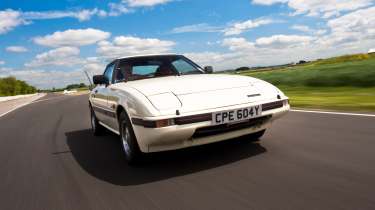
Mazda’s UK’s heritage fleet features a sound first-generation car – the car with which I reacquainted myself with the RX-7 at Blyton Park. I never took my long-termer anywhere near a circuit, this should be a fitting coda to my education.
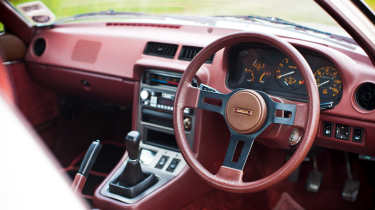
As a Series 2 – by which time Mazda had begun to adorn the beautifully pure bodywork with rubber spoilers and plastic rubbing strips – this particular car has the plusher Series 3 interior. I can’t really remember anything about the cabin of my long-termer beyond it being black, plasticky and broadly functional.
This one has velour upholstery with beading round the edges, so I guess that’s the difference. It also has a choke, which, I later recall, used to be a way of life, but I neglect to use this one as I crank the engine briefly into spluttering life before it quits in protest of my ignorance.
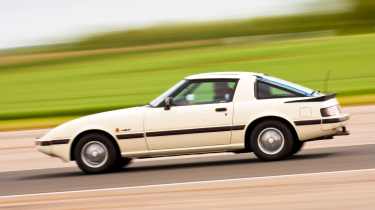
Out on track, the RX-7 is more fun than I ever would have expected. Choke-nourished Wankel warmed and the steering’s manoeuvring-speed heaviness shed, it feels far brisker than 113bhp should down the straights, the soft whoosh of the twin rotors sailing into the rev-limit warning buzzer so frequently I have to keep reminding myself this is one of the smoothest and most free-revving engines ever made. The steering doesn’t actually feel that bad, a bit vague and low-geared maybe, but more feelsome than I remember – possibly because most of today’s electrical systems are feedback-free zones.
> Mazda MX-5 RF 2025 review – evo Car of the Year 2024’s people’s champion
Wearing tyres so ‘budget’ no one has heard of them, it’s surprising this RX-7 feels so secure and grippy. Well, up to a point. Despite the lack of torque, the rear end can be brought into play more or less at will on any of BP’s tighter turns simply by going in hot and backing out of the throttle at the right moment. A subtle tightening of line or full-on, old-school lift-off oversteer, the choice is yours. I would say, ‘Ah, the memories,’ but trackdays as we know them today hadn’t been invented in the late ’70s.
The RX-7 might have drifted towards overblown Fast & Furious debauchery over the years, but the original is a remarkable and clear-sighted machine.
Mazda RX-7 values and buying guide
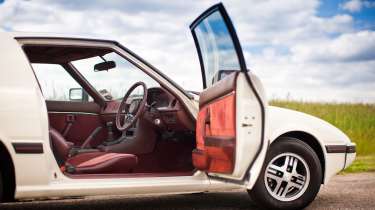
I’d love to believe that red RX-7 was still rolling, but it would have done a zillion miles by now – it was closing in on 100,000 when I finished with it – and, as history has shown us, Wankel engines, even ones extensively developed over many years by Mazda, simply don’t do that sort of thing. That being said, it felt sweet and fit for every day of its time with me and I’ve little doubt some genuine owners subsequently enjoyed its company before whatever fate eventually befell it.
The sober reality is, you just don’t see first-generation RX-7s on UK roads anymore. By the time production ended in 1985, Mazda had sold nearly half a million, making it the best-selling rotary-engined car of all time and one of the most successful sports coupes. But age, and waning Wankels have retired most, the better runners residing in the kinder climes of America’s sunny West Coast.
Indeed these are cars that require close attention to be paid to their maintenance. In the UK where salt spreading is a yearly ritual, RX-7s have a high rate of attrition due to rust. Rotaries require diligent caretaking too – regular 3000-mile oil changes help while worn rotor tip seals can be staved off with a tactical rev before shutting the engine off, as this clears the combustion chambers of excess fuel that’d otherwise eat into them. Do get a compression test done that shows 75PSI all round – ideally the car will have had one recently anyway.
We’re now at a stage where most of the cars that are left are only still here because they’ve been looked after well, so cars hiding nightmare issues aren’t so common. That also means you’ll pay a pretty penny for a nice one. Cars needing tidying up are upwards of £8000, while examples get nicer from the £10,000 point. You’ll pay upwards of £16,000 for decent examples and well north of £20,000 for concours-condition and tiny miles.
| Mazda RX-7 FB | |
|---|---|
| Engine | Twin-chamber rotary, 1146cc |
| Max power | 115bhp @ 6000rpm |
| Max torque | 112lb ft @ 4000rpm |
| Weight | 1050kg (111bhp/ton) |
| 0-62mph | 9.5sec |
| Top speed | 120mph+ (claimed) |
| Price new | £8750 (1980) |
| Value now | £8k-£25k |