Jaguar F-Pace (2016 - 2024) – ride and handling
The excellent chassis remains – it’s polished, precise and perfectly suited to the UK

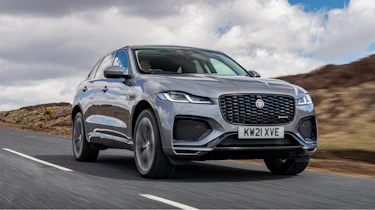
The F-Pace’s saloon-derived chassis is what defines the way it fundamentally drives, which is to say very well. Like most Jaguar products of this generation, its construction is mostly aluminium, with strategic use of high-strength steel in places, benefiting both structural rigidity and crash safety. However, overall weight for the F-Pace is equivalent to that of most rivals, ranging from 1822kg for the lightest P250 to 2114kg for the PHEV at its heaviest.
The suspension design up front is of a double wishbone design, paired with what JLR calls an integral link rear suspension design that provides improved stiffness across both longitudinal and lateral planes compared to a traditional multi-link set-up. Passive dampers are standard on all four-cylinder models, with adaptive units optional (these are standard on Ingenium 6, PHEV and SVR variants).
> Jaguar F-Pace SVR 2024 review – a brutal and charismatic fast SUV
In general terms, the F-Pace drives very well for its size and stature. The chassis feels balanced and settled, and has a considered but not excessive amount of body roll that does a good job of feeding back the amount of available grip left on offer. It’s not quite the transparent sheet of cellophane that the XF is, but compared to most rivals it’s certainly one of the more sophisticated SUVs to drive. The overall ride quality is also very good on all but the largest wheel option, which can sometimes get tripped up on complex undulations and shudder on sharp impacts.
More reviews
In-depth reviews
Long term tests
Reviews
- Jaguar F-Pace SVR (2019 -2024) review – F-type character and Range Rover practicality from £45,000
- Jaguar F-Pace SVR Edition 1988 2023 review – V8 range-topper takes inspiration from Le Mans
- Jaguar F Pace P400 HSE 2021 review – popular SUV refreshed, but can it take on a Macan?
- Jaguar F Pace (2018-2020) SVR review - SVO upgrades combine to create Macan Turbo rival
This ride quality is helped by the steering which feels superbly judged for local roads, with a calmer ratio than many modern rivals without feeling too languid or slow to react. Genuine feedback is generally hard to come by, but the steering’s accuracy and weighting as speeds rise make up for it.
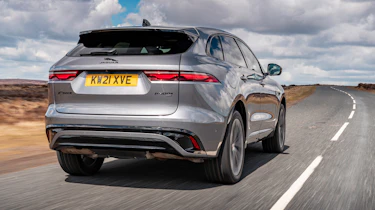
Drive a little harder and the F-Pace’s character reveals more of itself, which is actually to the benefit of the driver, as this just highlights how fundamentally sorted the chassis is. Start really leaning into the suspension travel and the whole car finds another layer of polish. Front grip is excellent, and getting on the power nice and early reveals its ability to transfer its considerable weight cleanly and without losing composure. It’s even a little bit tail happy if your chosen powertrain has enough grunt to elicit it, revealing yet another layer of class that’s been dialled in from former JLR chassis wizard Mike Cross and his team.
With the exception of the Porsche Macan and Alfa Romeo Stelvio, it’s easily the best SUV in its class to drive, and while the Porsche probably has a touch more polish overall, its iron-grip body control doesn’t elicit much engagement unless you’re driving at some serious speeds. Alfa’s Stelvio, meanwhile, has the opposite problem, with super-quick steering that combines with a relatively low kerb weight to make it the most agile and hot hatchback-like. However, this agility sometimes goes beyond and can make it feel a little messy when just trying to find a fast flow.
SVR models stand out as their huge power reserves get the most out of the F-Pace’s chassis. Lateral control is at its finest here, and on the smaller 21-inch wheels it’s able to attack a challenging road with all the composure and engagement of something that’s considerably smaller. Its rear bias to the all-wheel-drive system is augmented further with a limited-slip differential, making any foray into power oversteer a predictable and highly satisfying exercise.