Koenigsegg reveals CCGT1 – hypercar tribute to a lost Le Mans racer
Koenigsegg’s latest hypercar looks again to the past, in tribute to a Le Mans racer that never was


Koenigsegg’s paying tribute to its GT1 Le Mans racer that never was, with the new CCGT1.
Based on the CC850 supercar, which itself was a callback to the original CC Koenigseggs of the early 2000s, the CCGT1 garnishes what was an elegant and restrained supercar with downforce, performance and track focus; though garnishes is perhaps an uncharitable description, given only the CC850’s doors and removable roof are unchanged.
Aero and downforce
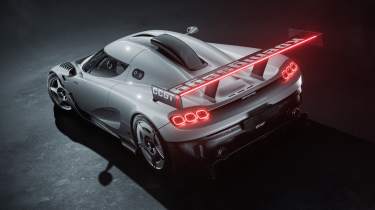
Let’s start with the obvious visual changes. The CCGT1 wears a more purposeful, less flourishing style of aero addenda more familiar to actual racing cars. The rear wing is flat, the diffuser uncomplicated in its shape, the exhausts without exotic form, with simple circular exits. It’s all a reference to the stillborn CCGT. The racer at the time in the mid-2000s was set for battle with Aston Martin, Ferrari and Maserati at Le Mans before the homologation rules changed, increasing the number of road going examples required.

Very much not just for show, the wing has an active element with 30 degrees of automatic adjustment (enjoying the freedom of not needing to be a homologated racer) plus a width-spanning brake light. It has three modes, spanning low drag, high downforce and an air brake. There are also vents to evacuate air from the front arches, NACA ducts on the front clam and behind the side vents and a new roof scoop, which cools both the new oil cooler (we’ll get to the powertrain next) and the inboard rear dampers, for increased endurance on track. In total the CCGT1 is good for 800kg of downforce at 155mph.
That gives it more downforce than the Koenigsegg Jesko Attack (700kg at 155mph), but less than the Sadair’s Spear limited-run special (850kg at 155mph). Complementing the wing and enormous front splitter is a reprofiled underfloor with active flaps that can counter the load that increases on the wing as speeds increase. The CCGT1’s goal is for its downforce to be accessible and usable for the driver.
Those up on their niche Koenigsegg knowledge will also note the ‘Ghost Fibre’ white carbon fibre as a nod to the Trevita CCXRs of 2009. It’s a new construction that’s tougher and has sound-deadening properties, while being lighter than traditional carbon.
Track package
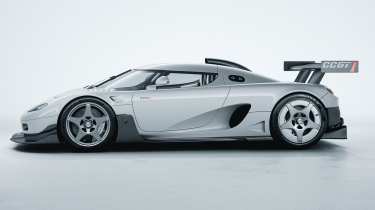
Koenigsegg is also offering as an option a Track Package that effectively makes the CCGT1 a full-on track car, with a full carbon roll cage, HANS-compatible race-spec seats, a fire suppression system, race exhaust, air jacks, a more aggressive suspension set-up and track wheels shod in track tyres. Much like Ferrari’s Corsa Clienti days, or Pagani’s Arte En Pista events, Koenigsegg will also put on CCGT1 track days with full factory support for owners. The car’s already upgraded cooling system does not need further optimisation for extended track use. With the Track Pack – inclusive of those track tyres – Koenigsegg claims the CCGT1 is its fastest ever car on track.
Engine and gearbox
Koenigsegg is famed for its monstrously powerful engines and clever transmissions. The CCGT1 benefits from that expertise, inheriting the 5-litre twin-turbo V8 and Light-Speed multi-clutch transmission. Engine first. While it was detuned to a relatively modest (for Koenigsegg) 1363bhp (on E85), the CCGT1 bumps that back up to 1578bhp (on E85). That’s 1263bhp on pump petrol.
The Light Speed Transmission’s dexterity is what allowed Koenigsegg to engineer a manual actuation system in the CC850. In this case, it now features what the Swedish firm calls Koenigsegg Sequential Shift, or KSS interface. That’s a large forward-backward shifter, millimetres from the steering wheel for ideal access to control the ’box, that can now simulate a sequential transmission in terms of its pace and aggression. There’s also a clutch paddle behind the wheel and ignition cuts on shifts. You can adjust the transmission to shift automatically and if you don’t want a sequential shifter, the ‘manual’ from the CC850 is also available as an option.
Interior
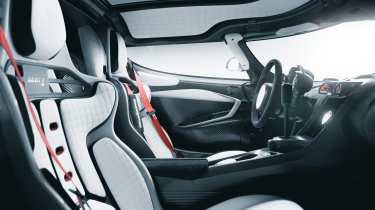
The CCGT1’s interior is a version of that seen in the CC850, with an increased track focus. New ahead of the driver is what Koenigsegg calls its third-generation ‘Chronocluster’. Read, intricate analogue dials for power use and oil pressure on the left (along with quadrants for various temperatures and fuel levels) and revs, speed and boost on the right. In the middle, an analogue G-meter powered by the very G-forces it’s displaying. The seats are standard (as seen on the CC85) but as above, upgradable to race spec with a six-point harness and fire suppression.
Unlike the CCGT racer it pays tribute to, the CCGT1 will not be a one-off. Koenigsegg plans to produce 70 examples and as you’d expect, all were spoken for before the car was even revealed.