New Range Rover Electric is ready to meet Bentley’s Torcal head-on
The Range Rover is now available with an all-electric powertrain, and while the technology is all-new, it’s all reassuringly familiar
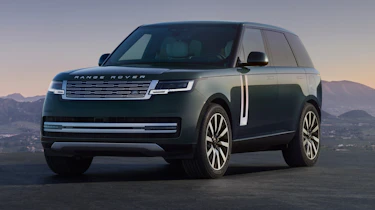
It’s been on its way for some time, but the Range Rover Electric has finally arrived. The high-end EV market has been a tough nut to crack for some manufacturers, but Range Rover is convinced it’s found the winning recipe. ‘We listened to what our customers want’, said Simon Fairbrother, Range Rover Electric Programme Chief. ‘The overwhelming response was, first and foremost, it needs to be a Range Rover. Don’t change it, just make it better,’ and it seems that’s precisely what it’s done.
Priced from £154,070 for the ‘EV550 Autobiography’, buyers pay a £50,000 premium over the entry-level combustion model, but given the Autobiography trim entry point, it’s quite clear that no Range Rover Electric is basic. Its dual-motors (one on each axle, manufactured in-house in the UK) produce a total of 542bhp and 627lb ft of torque to put it ahead of the V8-powered P530 in terms of outputs with a 4.3sec 0-60mph time a tenth quicker too. It won’t trouble a Tesla Model X Plaid, but the Range Rover has never been a car for drag racing on YouTube.
> Bentley Torcal charged up to take on the Range Rover Electric
Range Rover’s approach to building an EV couldn’t be more different to what Jaguar’s is doing down the road in Coventry. Jaguar is going unashamedly bold – to the point of being unrecognisable – in a bid to entice new customers, with an all-new platform, its own bespoke powertrain and a look both inside and out that is certain is cause as much conversation as the concept revealed in December in 2024 did.
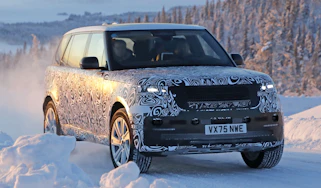
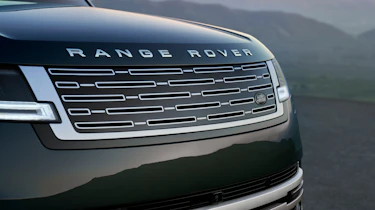
The Range Rover EV, however, flies completely under the radar. If it wasn’t for the flash of green on its number plate you wouldn’t know it was battery powered, although the keen-eyed will spot a sleek, blanked-off grille, low-drag aero wheels and a slick underbody too. Range Rover’s approach to EVs is about giving buyers a choice of powertrain to suit their lives, rather than forcing them down a certain path, hence why petrol, diesel and PHEV models will continue to be sold alongside the Electric, and the latest Range Rover was designed from the outset to accommodate all types of powertrain.
Therefore, while the Range Rover’s MLA FLEX platform is retained both the front and rear subframes are bespoke to the Electric, and 76 per cent is now aluminium increasing stiffness over the current plug-in hybrid model by 56 per cent. The Range Rover Electric also gains an 800-volt electronic architecture and an enormous 118.5kWh floor-mounted ‘double-stacked’ battery, powering two electric drive motors. Maximum range is quoted at over 372 miles WLTP and 333 miles in the ‘real world’ with 350kw charging capability allowing for a 137-mile range boost in 10 minutes.
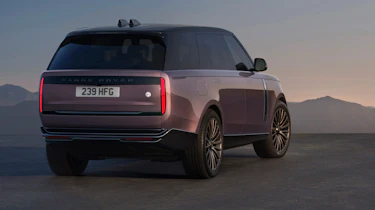
Having spent the best part of five years in development, everything that's required to turn a V8 Range Rover into a battery electric vehicle is bespoke to the car, with nothing taken from the Jaguar project. The testing programme resulted in the originally intended induction electric drive units (EDU) on the front axle being swapped for permanent magnetic motors, the original items overheating during tests; it took four weeks from the decision to switch the motors to having prototypes to test. The front EDU is positioned where the internal combustion engine normally lives, with the rear EDU positioned where the rear-differential is installed on ICE models. In the majority scenarios the Range Rover Electric is only driving through one axle.
Rob McKay, Head of Public Charging Services explained that 97 per cent of all daily journeys of current Range Rover owners will be able to be completed on the car's electric range. 10 to 80 percent charging can be completed in 22 minutes providing in the region of 200 miles of range. On a 22Kw charger you'll be looking a up to seven hours of charging to reach 100 percent.
Comfort, refinement and off-road ability have been the key areas of development. To this end, the battery helps stiffen the shell (although it isn’t integral to the structure), the electric motors are of course near silent, and the acoustics of the Electric have necessitated bespoke insulation to keep the cabin as quiet as possible. NVH levels are reduced by 7dB compared to a V8 engined model and the high-voltage cables have been fixed in a way to reduce 'machine noise' in the cabin.
There is, however, the small matter of weight to contend with. It won't surprise you to hear that the Range Rover Electric carries a weight premium over combustion models, its weight increasing by 75kg over the 2,585kg plug-in hybrid models. The rear EDU weighs 100kg, a 50kg increase over an ICE powered model's rear e-diff.
Matt Becker, Vehicle Engineering Director at JLR, said: ‘The defining characteristic of Range Rover Electric is its ability to perform across every surface, with effortless comfort and refinement. We’ve worked tirelessly to ensure it retains those qualities. From challenging low-grip and rough terrain to smooth, high-speed roads, it remains incredibly composed and refined, with a real sense of control and confidence. The responsiveness and precision of the new driveline control systems, enabled by electric propulsion, perfectly support this. We’re very proud of the result.’
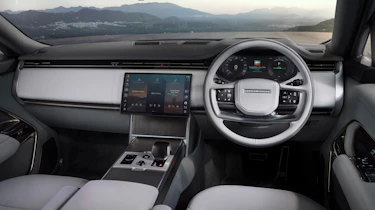
With that said, the floor-mounted battery means the mass is concentrated lower in the car (the Range Rover Electric's centre of gravity is 88mm lower than a combustion engined model), which has negated the need for active anti-roll bars to minimise roll. Instead, softer fixed roll bars are used that allow for the required levels of wheel articulation off road. It also makes use of an advanced traction management system that can respond to changing conditions in 50ms, 100 times quicker than its combustion counterpart.
Dual-chamber air-suspension with twin-valve Bilstein dampers are fitted and taken from the Range Rover Sport SV and the electric powertrain has negated the need to fit a low-range transmission due to the instant torque available. The Range Rover Electric does sit 28mm lower than its ICE equivalent and its approach a departure angles are 33.2-degrees and 28.1-degrees respectively. There's 262mm of ground clearance and the wading level has increased by 60mm to 960mm. And why no individual wheel motors? They don't offer as much usable capability according to JLR'e engineers.
In terms of drive modes there three to select: Eco, Comfort and Dynamic with different outputs depending on the mode you're in. In Eco the motors generate 276bhp and 493lb ft, Comfort provides 493bhp and 564lb ft and Dynamic 542bhp and 627lb ft. And despite the increase in performance over a V8, the brakes are smaller due to the lower unsprung mass. Range Rover also claims the brakes should last the lifetime of the car due the regenerative braking software.
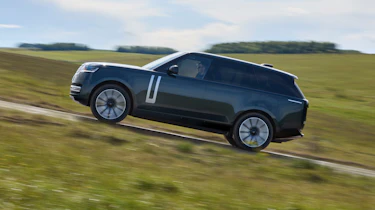
Driving the Range Rover Electric
'The Electric rides on retuned suspension, comprising two-chamber air springs and adaptive dampers, but the all-season tyres we’re driving on aren’t an EV-specific compound. This, says Range Rover, was important for a more seamless ownership experience, without the need to seek out specially-designed rubber when it’s time to swap. Surprisingly, the Electric also doesn’t have a locking differential on either the front or rear axles. Instead it uses the precise torque delivery from the motors to manage traction, while applying the brakes on unloaded wheels to transfer torque to the opposite side. On the slipperiest uphill sections you can feel the system nipping away at the wheels to find grip. Why not go for a Mercedes G580-style quad motor system for precise control of all four wheels? ‘We can deliver all the attributes we need for a Range Rover with the twin-motor solution,’ says Fairbrother. We didn’t get stuck so perhaps that’s fair enough, but you’ve got to assume that four motors would offer a higher ceiling of capability.
The floor-mounted battery also reduces the ground clearance by a 28 millimetres – we lightly grazed the underbody a couple of times during our briefest of drives – but the unit is shielded against knocks and scrapes. By and large, though, the Range Rover Electric strolls through the course with very little effort, the light control weights and rear-axle steering making it easy to swing around tight turns and the torque delivery being smooth and progressive. The brakes are easy to modulate at low speed too, although the one-pedal driving option doesn’t feel especially intuitive off-road. On downhill slopes you sometimes need to consciously apply the throttle to keep moving rather than letting the car roll, which doesn’t feel natural.
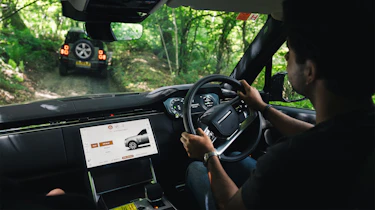
Look around the cabin and all is as it should be – no lumps in the floor, no raised footwells and no compromises in practicality. The boot is unchanged too, and this could be an electric car that isn’t hopeless at towing. It can officially pull 2.5 tons - 'up to three or four horses' - and the range prediction can take into account whatever it is you’re towing. How much range will actually be left is another matter, of course.
After this very brief taste, the signs are positive for the Range Rover Electric. It’s set to be one of the most luxurious, refined and versatile vehicles of its type, as a Range Rover should be. The bigger question is whether enough customers want a Range Rover powered by batteries. The company says that over 80,000 clients have signed up to the waiting list – let’s see how many actually take the plunge.' Yousuf Ashraf, Senior Staff Writer