Rejoice! A restomod that isn't based on a 911. Meet the Encor Series 1
British firm Encor has revealed the S1, a carbonfibre bodied, 400bhp twin-turbo V8 homage to the original S1 Lotus Esprit. Yours for at least £500,000.

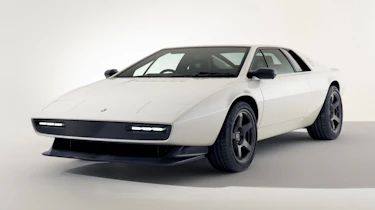
Think restomod and inevitably US-based Singer springs to mind, its Porsche 911s having cemented themselves at the top of the resto-tree for more than a decade. There are others, of course, from Kimera’s rather lovely Lancia 037 tribute to pretty much everything that Alfaholics produces, not forgetting the Eagle Lightweight E-types. And now there’s a new contender for a place in the top flight of restomods. Introducing the Encor Series 1, an update of a late-1990s modern classic, inspired by an ice-cool 1970s icon.

This lithe, light wedge – under 1200kg is the target weight – is a homage to the original S1 Lotus Esprit. It’s designed and manufactured by Encor, a UK start-up with backing from a company you’ve never heard of, Skyships, though if you’re fortunate enough to have been in a Pagani or Koenigsegg you’ll have experienced their expertise in the electronic controls, systems and equipment world.
Encor’s first car is based on the late-’90s Esprit V8 and has a projected power-to-weight ratio of c340bhp per ton. It’ll cost £430,000 plus a donor V8 Esprit (£30,000-60,000) and taxes. Don’t expect change from £500,000.
If that price has caused you to take a sharp intake of breath, you certainly won’t be alone. But this is a car for that other world where the garage is already full with everything you care to mention and a model such as this is an addition to an already eclectic fleet and rarely a replacement.
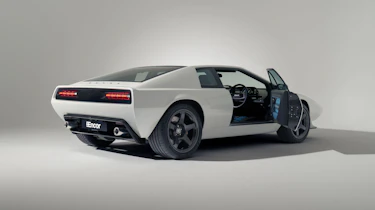
For those who want to get off the treadmill of spiralling horsepower/performance and are looking for an alternative to the latest must-have all-singing all-dancing supercar, this is something different, something very bespoke, to be appreciated by those who know. Don’t expect the supercar spotters to know what it is. That’s the point.
What you get for that not insubstantial sum starts with an Esprit V8 whose galvanised chassis is stripped of every component, vapour-blasted clean and reassembled by hand with new components and some carefully selected upgrades along the way. Such as Eibach springs and Bilstein dampers that are set to Esprit Sport 350 specification and will be fine-tuned once the final weight distribution is signed off.
AP Racing-sourced ABS brakes with six-piston front calipers are also included. The wheels – 17-inch at the front, 18-inch at the rear – are billet machined aluminium and Encor has gone to great lengths to retain not only the wheel sizes but the tyres’ profile too.
‘We were strongly advised not to change the profile,’ says Dan Durrant, the former lead designer at Group Lotus who has joined Encor and taken on responsibility for the Series 1’s look. ‘This caused an issue with the 17-inch wheels. The V8s all came on Michelin Pilot Sport 3s when new, which is the newest Pilot Sport you can buy from Michelin today [for 17s]. You can’t get a PS5. So we’ve been on a search for a more modern performance tyre and Bridgestone’s new Potenza Sport is what we have settled on.’
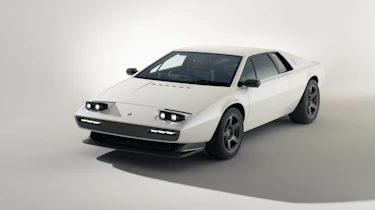
Being based on the later V8, the front and rear tracks are wider than those of the original S1 Esprit, hence the slightly wider stance. Yet parked alongside an original, it’s abundantly clear how faithful this 21st-century remake is to the car that inspired it.
Dimensionally it’s also uncannily close to a Porsche Cayman. At 2420mm the wheelbase is five centimetres shorter, but the Series 1’s 4370mm overall length and 1880mm width are identical to the Porsche’s, though its 1150mm height is 15cm shorter. Its squat, square-shouldered lines are as striking as ever.
> Best sports cars – the last true driver’s cars
‘Ferrari and Porsche had curves, so when the S1 arrived as it did it must have looked out of this world. I hope we’ve retained that impact,’ says Durrant before showcasing the Series 1’s details.
Feed your finger inside the air intake to find the door release, then it’s a bit of a squeeze to fold yourself through the opening and into a cockpit that was designed before meal deals, grab bags and the Snickers Duo, and some might find the windscreen header rail a little close for comfort.
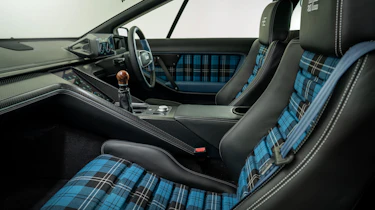
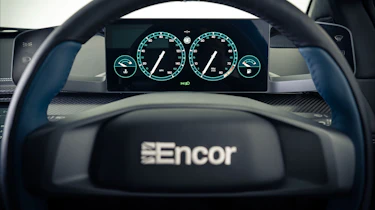
It’s beautifully finished once inside, the design a modern homage to the S1 Esprit. Where that car’s instrument binnacle was an imposing injection-moulded wraparound structure that dominated the driver’s view, here it’s a two-piece, technical slice of machined billet aluminium with an LCD display fixed to the frame, showing elegant and simple dials for road speed, engine revs, fuel and water temp.
The two-spoke steering wheel looks and feels just right, and it’s connected to the original Esprit’s hydraulic power-assisted setup, thoroughly overhauled of course. The seats – refurbished Sport 350 items – feel supportive and grippy (trim can be any colour and material your wallet can stomach) and if you need some height taken out, the bespoke nature of the car means the cushions can be thinned to your requirements to provide a few extra millimetres of headroom.
A central screen controls the HVAC, nav, phone, vehicle settings and so forth, while the carbonfibre transmission tunnel forms the spine of the interior and the car as a whole. The environment feels snug and somewhere you’d want to embark on some serious journeys in.
To take you on those journeys is the Type 918 3.5-litre twin-turbo V8 that Lotus developed for the 1996 Esprit. Now, chat to anyone who worked on this engine when new, even those charged with developing it, and they won’t be especially complimentary about it.
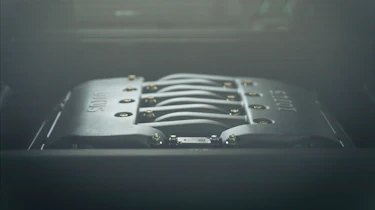
Timing belts require regular replacement unless you enjoy running the gauntlet of expensive failures, and cooling more suitable for a four-cylinder engine than one with double the cylinder count can cause alarming overheating issues. It’s why some Esprit V8 owners have spent nearly as much on an engine rebuild as the car originally cost them.
To address this, Encor decided that every V8 engine not only had to come out of the donor car for inspection but should be stripped to its core constituent parts and rebuilt. Once extracted, the V8 is sent for inspection, which includes not only the condition of the cylinder blocks and heads, but also every component part to gauge its health and what kind of life it has led.

Any remedial repairs are made before the engine is rebuilt, using new components where needed, with the original cast pistons replaced with forged items and a new electronic throttle body – designed and developed by Encor parent company Skyships in-house – replacing the old cable unit, allowing for far better throttle control.
There are new, high-capacity fuel injectors, and while the Garrett T25 turbos are retained, their internals are all new and include billet impellers and upgraded wastegates that will allow for a higher boost pressure than the original’s 0.7-0.85 bar. Crucially a new exhaust system has also been designed and developed to bring the flat-plane-crank V8’s rather, er, flat soundtrack to life acoustically. The engine’s electronic brain, also created by Skyships, is all new, too. The net result is 400bhp and 365lb ft of torque, compared with the quoted 350bhp and 295lb ft for the V8 Esprit in period.
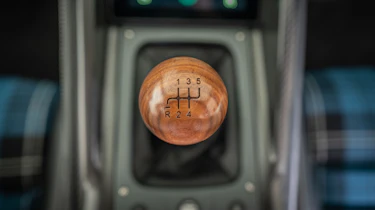
Along with the engine, the V8 Esprit’s five-speed transaxle manual gearbox is also retained, and it too is stripped, inspected and rebuilt using new components, with first and second gear shorter than before (both are a notorious weak point in the original). An uprated twin-plate clutch is also fitted and Quaife has supplied an ATB helical limited-slip diff. The powertrain overhaul alone is a six-figure cost.
But it isn’t the largest expense in the creation of the Encor Series 1. That’s down to the carbonfibre bodywork. Born of 3D scans, it is faithful to Giugiaro’s original but with far tighter tolerances in terms of the fit, finish and panel gaps. The sharp, square edges of the 1970s S1 have been softened, the need for rubber trim strips done away with. That’s primarily because the original required the top and bottom sections of the glassfibre bodywork to be two individual pieces secured together with the use of adhesive and rivets, with a thick rubber ‘pinstripe’ running around the body to hide the join, whereas Encor has created single-piece carbonfibre panels with no awkward junctions.
It all makes for an exquisite piece of automotive art, proportionally perfect. Helping the aesthetic is the retention of the original glass-house, albeit with the glass itself having been remanufactured to Encor’s own specification and now including a heated front windscreen to banish the Esprit’s interior fogging issue for good.
Approaching from the other side of Encor’s Essex facility, where each of the 50 examples will be built (equating to just three per cent of total Esprit V8 production), the Series 1 could be mistaken for a two-thirds scale model. The Sport 350 and Exige 430 Cup parked alongside dwarf both the Giugiaro original and Encor’s recreation. Even as you get closer, the 21st-century S1 remains low and lithe, the front bumper at shin height, the roofline around chest height. Its wider track catches the corner of your eye, but what draws you in is the simplicity of the design and the quality of the finish.
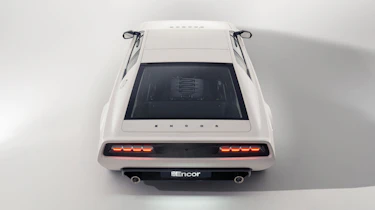
In every dimension, Durrant claims that the Encor Series 1 is no more than a few millimetres larger than the original: ‘It’s a by-product of us finessing what was already there,’ he says. ‘We haven’t added anything for the sake of it.’ Any departures from the original have been introduced to solve challenges that Colin Chapman and his team weren’t able to address in the ’70s, often simply because the solutions had yet to be found or invented.
The pop-up headlamps are a good example: they remain an iconic piece of design, but today’s LED lighting technology allows for far superior – and smaller and lighter – components to be used. In turn this means that the light units, when raised, sit 50 per cent lower than the originals, improving airflow over the car. Improving it under the car is a subtle front splitter and a smoothed-off underbelly. But there are no aero elements for the sake of it, only further refinements of what was already there.

Encor has improved engine cooling at both ends of the car. In the nose, fitting more efficient radiators in the space designed for the originals meant there was no need for any changes to the front of the chassis. Towards the rear, a vent at the leading edge of the opening hatch helps manage heat-soak in the engine bay, while the cooling system runs in reverse when the V8 is shut down.
The use of more modern materials throughout has not only allowed for the much cleaner look, but the changes have also enabled Encor to stiffen the Esprit’s structure, including the integration of a composite rollover protection frame around the cabin. Larger carbonfibre sills made up of twin box sections –made possible by the replacement of the mechanical handbrake with an electric one – further improve torsional stiffness and replace much of the original steel structure.
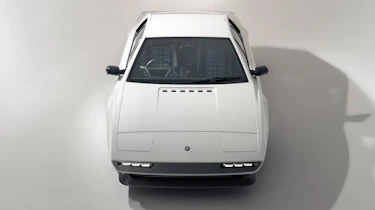
External lighting at both ends is by LED, and it all sits in bespoke billet aluminium housings that are designed to manage heat whilst maintaining the desired design aesthetic. These hard surface details complement the soft-edged design just so. Everywhere you look, the latest technology allows the original ethos to remain but in a more useable, capable and reliable package.
One of the consequences of Lotus’s current plight at Hethel and the associated job losses has been that Encor has been able to call upon a high degree of expertise to build, develop and hone its car, especially when it comes to ride and handling.
In a world of bloated supercars, the Encor Series 1 is refreshingly lithe and compact. The original S1 and later V8 Esprits shared a near-identical wheelbase length, hence why the Encor team has managed to create such a faithful homage to the original. And its size means enjoying its 400bhp and a 350lb ft of torque won’t require you to use every inch of available road. It’s a classic car for the modern world, not unlike an Alpine A110.
The team behind Encor are seasoned industry professionals. Managing director William Ives co-founded parent company Skyships and leads the technical side of the project, drawing on his experience of developing electronic solutions in the worlds of aviation and automotive. Design director Durrant is a former lead designer at Lotus, responsible for the Emira.
Commercial director Simon Lane possesses an enviable black book of customers who seek out cars such as the Series 1, given that his time at Aston Martin saw him responsible for the firm’s Q division and special projects before he moved to Lotus to oversee similar areas for the Evija. Few know the market and customer demographic better.
> Lotus Evora (2009 - 2021) review: an everyday sports car for hot hatch money
All three have a clear vision for Encor and an understanding of the high-end vehicle market, one that today is stepping off the new super- and hypercar treadmill in search of something more bespoke, special and unique. The Encor Series 1 offers all three of those qualities but with a sizeable side portion of nostalgia, too. The 50 buyers who will take delivery over the next two years will be driving a very special car created by a team who have poured their passion and experience into a project that, on first exposure, appears to have left no detail untouched.
Projects such as this will always raise eyebrows: why spend so much on something that is so far away from being original? For the answer to that you’ll need to ask those with the means to purchase at this level. But in a world where new cars are finding it harder to find customers, the market for reimagined icons from a car-buying generation’s formative years remains stronger than ever.