McLaren GTS review – the forgotten McLaren that will soon be no more
McLaren’s new era is approaching, which will mean the death of the GTS. Here’s what we’ll be missing

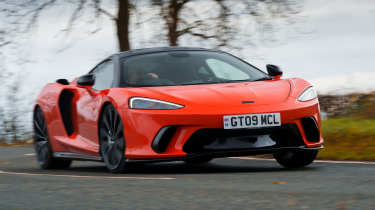
You forgot this existed, didn’t you? The McLaren GT, or GTS as it’s known today. Embarrassingly, we nearly did too. The GT has been around since 2019 as the softer-edged, most-useable entry-level McLaren, but when it was updated to become the GTS in late 2023, nobody seemed to notice. Not only because the updates were almost undetectable to the casual observer, but also because a year earlier the Artura had been launched to redefine what a baby McLaren could be. As an all-new product with a bespoke V6, hybrid drive and a new carbon structure, it left the GTS sitting awkwardly in the range, and seeming out of date before it even arrived.
Now, with McLaren’s new era fast approaching – bringing new hybrid supercars, an SUV and a new logo – the GTS is living on borrowed time. Order books are expected to close this year as McLaren phases out its current range, meaning if you want one, you need to act fast.
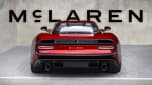
On paper there’s plenty to like. The GTS is a refreshingly pure supercar in the context of more modern rivals: mid-engined, rear-drive, with no batteries or electric motors in sight, all of its power coming from a 4-litre twin-turbo V8 alone – a rare thing in 2026. Having eight cylinders instead of six is a key point of difference to the Artura, so too the general approach of the car, says McLaren. It’s been engineered to have a more rounded, refined character, to fulfil the GT part of its name. This extends to the tuning of its suspension and electro-hydraulic steering, plus the trimming, insulation and packaging of the interior, which includes an expansive rear luggage area that extends from behind the seats, over the engine and to the tail.
More reviews
Compared to the GT, the GTS has a lightly tweaked exterior with new vents for better cooling and airflow to the V8, which is marginally more powerful than before. Changes to the combustion phasing and ignition timing tease out an extra 14bhp, bringing the total to 626, and at 1520kg it’s a hair lighter too (though the saving is from the standard fitment of carbon-ceramic brakes, which were optional on the GT). A new nose-lift system boosts usability, too, and it does work swiftly in practice – raising or lowering in as little as four seconds.
Though certainly more useable than other carbon-tubbed exotics, the previous GT didn’t lope along with the grace and refinement of a traditional grand tourer, and the GTS follows the same theme. It doesn’t hide its supercar core, from the drama of lifting the dihedral doors, swinging yourself over the tub and sinking into the seat, to the start-up theatrics. The V8 whaps into life with a hollow flat-plane blare and buzzes through the structure – not intrusively, but enough to have the wheel tingling in your hands at idle.
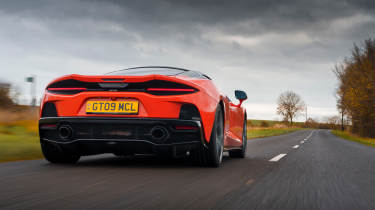
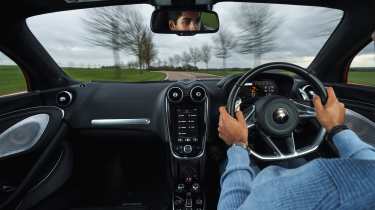
Not much has changed inside save for new upholstery options, and as a result the cabin does feel a bit last-gen – mainly in terms of the HMI, which doesn’t have Apple CarPlay or Android Auto capability, either via a cable or wirelessly. Plenty of glass area (helped by the electrochromic panoramic roof option) does give it an airy feel, however, and the materials are generally high quality. The metal speaker grilles of the optional Bowers & Wilkins hi-fi are a particular highlight, even if it feels like they could grate the skin from your knuckles.
It’s still no Continental GT rival inside, then, but once underway the GTS has its own virtues – those typical of most McLarens. Namely steering that’s measured and tactile, a fabulous driving position and a level of compliance that you don’t expect from a supercar. The body is free to move on its springs and that gives the GTS a relaxed feel as it flows over a smooth, undulating surface. That’s despite it using conventional springs, anti-roll bars and adaptive dampers, instead of the sophisticated hydraulically cross-linked setup you’ll find on a 750S, which does away with roll bars entirely. It feels compact as you thread it along too, somehow more like a sports car than a supercar or GT.
Its performance definitely falls within the latter two categories though. Under light loads the V8 is happy to fade into the background as the seven-speed dual-clutch transmission slips through the ratios, but take manual control via the tactile aluminium rocker paddles and it takes on a fierce edge. On a damp road the power is heavily reined in by the TC, but the delivery intensifies as you pick up speed and gain traction, building to an addictive rush. The GTS is not as rabid as a 750S, or even the older and similarly powerful 650S, but it feels revvy and sharp when fully lit. The only disappointment is that the V8 doesn’t sound any more exciting than an Artura’s V6, yet it lacks the snap and response of that car’s hybrid system.
When the road surface gets challenging, the GTS is less cohesive than its sibling too, and its sense of comfort and refinement comes undone slightly. It’s largely smooth and controlled, but sharp bumps and intrusions can thunk through the tub and kick back through the wheel, and the rush of the tyres filters in over rough tarmac. As a result you don’t feel totally cocooned and isolated from your surroundings, at least not as you would in a true GT.
But there’s a flip side, because the GTS is more alive and involving than, say, a Maserati GranTurismo when you aren’t cruising, and guiding it from corner to corner, riding the torque and enjoying its clear, measured responses, can be immensely satisfying. At speed the stiffer damper modes (usually Sport, sometimes Track) are needed to stop the body moving too freely, but even then it feels light on its feet and wieldy.
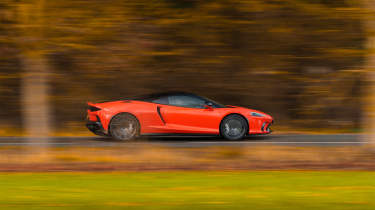
There’s fun to be had beyond the limit, too. In the wet the front end is strangely tricky to read and fully lean on, but the rear is totally transparent. With the ESC in Sport mode (or switched off) the GTS is fantastically controllable when it breaks away, and you can precisely meter out the power to tease out small, satisfying slides on the way out of corners. Given it has an open diff, it feels like sorcery.
If the GTS were the only car McLaren made we’d applaud it for its distinctive and compelling dynamics, and (infotainment aside) how useable it manages to be. You really could commute in it and cover long distances, because while it doesn’t fully lean into the GT role, it’s a supercar with impressive bandwidth. The trouble is, the Artura is more impressive again, in every sense: faster, more competent, more vividly exciting and just as easy and undemanding in normal driving.
Living with the McLaren GT
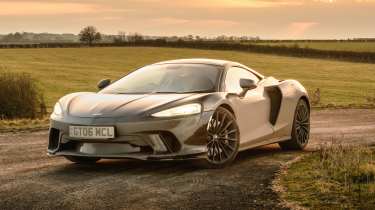
It looks like a supercar and sounds like a supercar; it probably even smells and tastes like a supercar. It’s only when you drive it that the GT’s GT side really makes itself felt, and it strikes you within just a few metres: few supercars have a ride that’s this relaxed, this absorbent, this comfortable. Is that enough to make it a car you’d want to go grand touring in, though, or at the very least one you might want to use every day, as McLaren suggests you could? That’s what we set out to discover by running a GT on our long-term test fleet for several months.
Editor-in-Chief Stuart Gallagher had the first stint with our GT and was quick to discover long journeys were indeed among this 612bhp, 203mph car’s fortes. He found he happily used it for trips where he’d leave a 720S at home and noted that he arrived at his destinations feeling ‘calmed rather than frazzled’. When Editor-at-Large John Barker took his turn, he praised the GT for the way it was happy to mooch and commented that he found it more everyday useable than he’d expected.
Inevitably, there was a trade-off for these abilities. While the GT was still astonishingly fast when you got the opportunity to wind it up – its detuned version of the 720’s 4-litre twin-turbocharged V8 saw to that – when really pushing on its chassis wasn’t quite as crisp and reassuring in its feedback as those of other McLarens. For this reason, Barker admitted he had no inclination to wind back the stability control. As a counterpoint to that, my own time with the GT coincided with some particularly foul weather and I found its relatively relaxed demeanour made it far more enjoyable to use in such conditions than a more conventional, more highly strung supercar would have been.
Helping the GT’s wet-weather appeal was its feelsome hydraulically assisted steering – something we all agreed was a genuine treat to experience. Something else that we were all in agreement on was that our car’s full Batmobile colour scheme, both outside and in, was far too dour. A switch to some diamond-cut alloys for the last few weeks of our loan took the edge off the unremitting blackness, and prior to this we went with the cheaper option of leaving the car covered in a layer of wintry grime. (OK, we also did this because nothing looks cooler than a properly filthy supercar. I mean grand tourer.)
Reliability-wise, our GT didn’t miss a beat. Its fuel calculator was rather optimistic, though, sometimes claiming mpg averages well into the 30s when around 20mpg was closer to the truth. In practical terms it had an OK-sized front boot – on a par with a rear-drive 911’s – and in theory offered nearly three times as much capacity again in the rear. However, whatever you placed in the long, narrow and shallow space above the engine and beneath the hatchback – an area that Barker nicknamed ‘the trouser press’ – was visible through the rear glass, and if you had lots of bags you’d lose your rearwards view too.
But as long as you didn’t want to take the kitchen sink with you, you could conceivably use the McLaren GT for grand touring, and you could absolutely use one every day, all year round, if you felt so inclined. The question is, would you? It’s much easier to imagine someone having a Range Rover or RS6 or Bentley for such duties, with a more focused 750S or similar on standby for when the conditions and journey suit. But if you really crave that supercar-style buzz more of the time, but without all the compromises usually associated with doing big miles in a supercar, McLaren’s grand tourer has you covered.