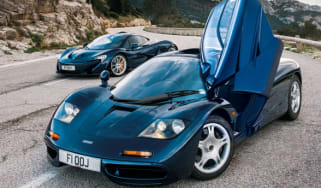
McLaren P1 (2013 - 2015) review – the F1's hybrid successor is what the W1 must beat
It was the model that established McLaren Automotive as a contemporary supercar powerhouse. Its legacy now looms large over its successor, the incoming W1 hypercar
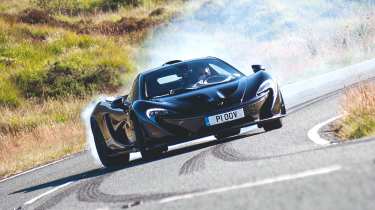
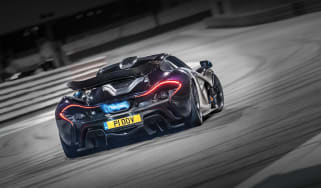
McLaren’s rapid churn of new models means it feels like it was much longer ago than 2013 that the mighty P1 hybrid hypercar hit the road. Visually though, it’s still pretty contemporary – very obviously a product of the McLaren brand. And to drive, it’s somewhere in the middle, utterly up to date in its performance, but less outrageous and incisive than some of the cars McLaren has launched since.
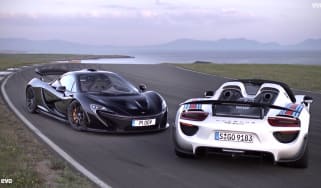
However old or new the P1 feels to you though, it remains one of the brand’s most iconic vehicles, sitting at the peak of hypercar performance in the mid-2010s along with the Ferrari LaFerrari and Porsche 918 Spyder that arrived almost simultaneously. It’s still an experience to drive, and continues to attract collectors as much as enthusiasts on account of its relative rarity – McLaren made only 375 examples over two years.
History
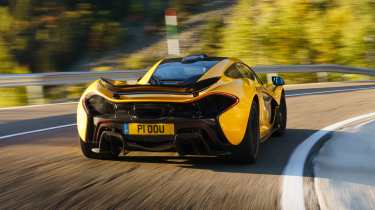
The P1 arrived as McLaren's first hypercar since the F1 in 2013. The same year that the Ferrari LaFerrari and Porsche 918 Spyder hit the road, leading the hybrid hypercar trio to be dubbed the “Holy Trinity”, each a technological showcase of its respective brand but going about their missions in tantalisingly different ways. The £870k McLaren split its two rivals for price; the Porsche started at £780k, while the Ferrari was a genuine £1 million car. They were pretty closely matched on performance though – when evo got the P1 and 918 together for a track battle at Anglesey in 2014, just two tenths separated their lap times, in the 918’s favour.
More reviews
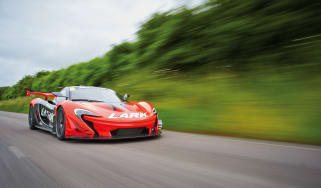
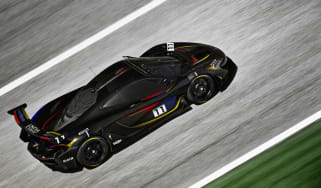
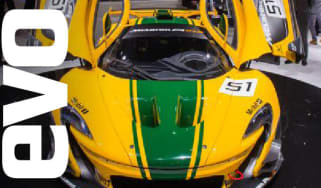
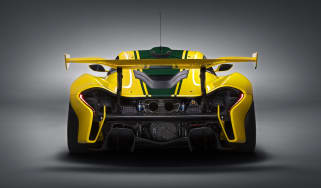
Those wanting more track focus would wait for the P1 GTR, which was unveiled in 2014 and launched in 2015, to coincide with twenty years since McLaren’s victory at the Le Mans 24 Hours. The GTR was designed for track use alone (even if customer team Lanzante quickly adapted some for road use), and made more power (986bhp), shed 50kg, and through a combination of slick tyres and extra aero, had even higher cornering capabilities.
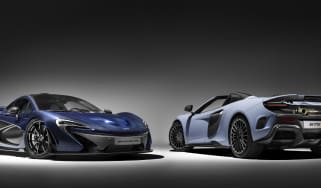
Production of the P1 ended in December 2015, with 375 units produced since the first cars rolled out of McLaren Automotive in October 2013. The car was retroactively added to McLaren’s “Ultimate Series” in 2015, when the company’s brand strategy was split into Ultimate, Super and Sports series models, highlighting a quickly expanding range. It has since been joined in the Ultimate Series by the Senna, Elva, Speedtail, and the limited-production Solus GT, while the McLaren W1, announced in 2025, is the P1’s direct successor.
Engine, gearbox and technical highlights

- McLaren's first hybrid
- 903bhp and 664lb ft
- 'Race Mode' drops, stiffens and transforms the P1's aero
The automotive world was already moving in the direction of electrification in 2010 when McLaren Automotive emerged, and while environmental credentials were perhaps not at the top of the list for a new performance car capable of scalping the Ferrari and Porsche also in development, it was clear that hybrid technology, just as it would in the LaFerrari and 918 Spyder, could contribute much to the car’s performance.

That hybrid technology had recently been adopted in the World Endurance Championship (and with Audi, won at Le Mans in 2012) was no doubt a factor too, but the interesting aspect was how differently each manufacturer’s application of hybrid tech would end up. Where Ferrari chased simple assistance and Porsche went down the plug-in route with a usable electric range, the P1 had a short EV range (around six miles) but without the plug, predominantly using its 131kW motor for torque fill to help the engine at low revs while its twin turbos spooled up.
The basic architecture of the P1’s 3.8-litre V8 was not dissimilar to that of the McLaren 650S, but the block was strengthened to handle the extra strain of a higher output, and there was a new casting to incorporate the electric motor. The engine alone was capable of 727bhp and 531lb ft, but peak combined power, with engine and motor working in unison, rose to 903bhp, with 664lb ft of torque. The P1 could cruise around on electric power alone and for up to six miles before the V8 fired back up.
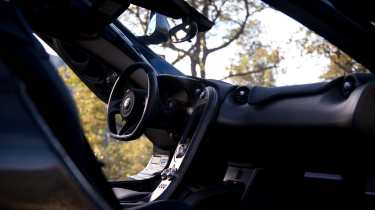
Transmission to the rear wheels (incidentally, there was no front e-motor; the P1 was solely rear-wheel drive) was through a seven-speed dual-clutch gearbox, and while the fast-shifting DCT didn’t need any gaps filling in, the e-motor had the ability to torque-fill for when the engine was off-boost.
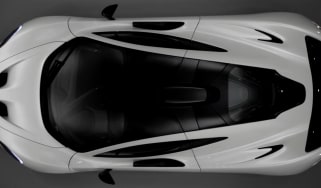
The car’s dramatic shape was the work of Robert Melville, current Design Director at McLaren, and Frank Stephenson, best known at the time for his work on the original BMW X5, BMW Mini, and perhaps most relevant to the P1 project, the Ferrari 430 and Maserati MC12. It was sculpted by the air too though, with active aerodynamics including an enormous air-brake spoiler that could stand to attention, increasing drag under braking.
The aerodynamics were enhanced further by an active chassis setup whose ride height could drop by up to 50mm in race mode. With the now-familiar interlinked hydropneumatic damping system first debuted in the 12C the electronics could exercise huge control over each corner of the car, and, if necessary, stiffen it (by up to 300 per cent, once again in race mode) for incredible control on track.
Driving the McLaren P1
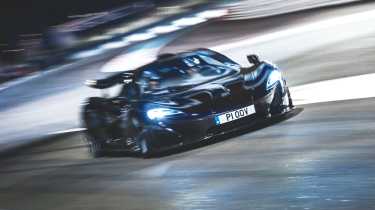
- Gamechanging grip, performance and downforce
- ... but the P1 was bidable, enjoyable and organic
- As at home flat-out on track as tackling a great road at six-tenths
What stood out most on evo’s original drive was the contrast of a car that felt surprisingly liveable on the road thanks to the clever damping (albeit loud, with little sound deadening and plenty of tyre roar), yet astonishingly fast on a track, with relatively light steering that has since become something of a McLaren trademark, huge grip, and benign balance despite an unsurprising appetite for oversteer.

The P1 is a searingly quick car on road, race circuit or in a straight line: McLaren claimed 0-62mph in 2.8 seconds, 0-124mph in 6.8 seconds and a top speed of 217mph. On the road that translates to surreal performance that’s way beyond what can realistically be deployed on a regular basis. What’s most impressive though, is that the rear-drive P1 feels for the most part hooked-up and secure. Of course it can light up its tyres should you so wish but the level of mechanical grip and traction is mighty. In the wet? Just leave the traction control well alone, okay?
The P1’s ride and handling changes between distinct modes – one of them so extreme that it’s not actually road legal. In the road modes – Normal, Sport or Track (ironically) – the P1 feels supple, lithe and very, very light. The steering requires very little effort, the ride is simultaneously locked-down in terms of control and loose-limbed in the way it deals with nasty surfaces.
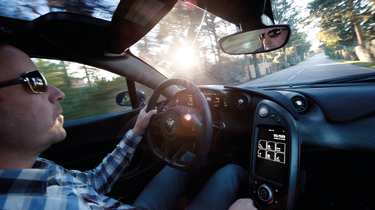
It’s an incredible sensation and it breeds real confidence because there’s such excellent wheel control and instant response to steering inputs. You seem isolated from the worst of the road but completely in tune with it at the same time. The clever Brake Steer system isn’t really tangible on the road but the P1 seems to have unnatural levels of agility and the all-pervading sense of lightness infects everything – the steering weight (sometimes it feels spookily weightless), the way the front end snaps onto line and the sheer body control.
Really start to drive hard and the P1 becomes surreally manic, though. The gliding sensation disappears to be replaced by massive front end grip, some tramlining under braking and fantastic traction. Here the Bake Steer effectively mimics an active torque-vectoring limited slip differential and the result feels completely natural.
In Race mode the steering remains light but has more heft, the suppleness is replaced by an incredibly stiff set-up that rattles and rocks over kerbs but the bizarrely benign balance and the appetite for oversteer remains. It’s simply wild: Explosive power, black-out brakes, neck-straining grip and total immersion as you hustle the thing like an old M3.
'Part of me thinks this is the car McLaren should have built first, but as chief test driver Chris Goodwin is quick to acknowledge, it simply wouldn’t have been possible to create the P1 without learning from the process of developing the MP4-12C. There’s certainly a family resemblance in the way the two cars feel and perform, but the P1 is a mature and more completely resolved machine.
'It has an aura of assurance and natural confidence that leaves the pathfinding 12C feeling a bit try-hard. Its feel, performance and dynamism are quite simply on another level. Goodwin says he wanted to create a road car that mimicked the raw, ballistic thrills of a Can Am racer and gave a strong hint of the precision, sophistication and extraordinary downforce of a contemporary F1 car. The fact that some three hours after our track session is over I’m still wide awake, buzzing with a rush of adrenalin that simply won’t subside, suggests he’s been successful.
'With meaningful wheeltime in everything from a Ferrari F40 to a Porsche 918 Spyder, I thought I knew my way round the supercar landscape pretty well, but after driving the P1 I honestly feel a bit lost. Its breadth of ability is truly freakish, the fusion of petrol and electric propulsion totally seamless, the ferocity of its performance utterly corrupting. Like watching David Blaine skewer his arm and trying to work out whether what he’s just done is real or magic, I’m still struggling to wrap my brain around what the P1 does and how it does it. What I do know is that McLaren has delivered on that extraordinary promise.' – Richard Meaden, evo editor-at-large, who first tested the P1 around Abu Dhabi circuit.
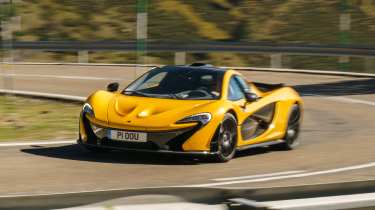
'The engine really is mighty once you start to use all of the available revs, and the seven-speed dual-clutch ’box, whilst not as savagely quick as the best Ferrari offering nor as magically precise as the latest PDK, is exciting to use because every upshift seems to grant access to even more power. It’s an illusion of course, but the fact the P1 pulls just as hard in fifth as in second or third leaves you in no doubt that you’re strapped into something with performance you could never grow fully used to exploiting. The chassis copes, just. And it needs plenty of help from the driver.
'In quicker corners the P1’s balance shifts. Suddenly the front end is nailed down and it’s the rear struggling to keep up. More than once I roll into a turn at the top end of third and sense the tail starting to come around sharply. It’s a wicked surprise and sends a flush of heat down my neck. This thing is serious. I’d love to say I learnt to trust the car and use the pointiness to glide it through quicker turns with minimal steering lock, but I’d be lying.
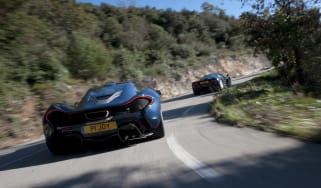
> Dream drive: McLaren P1 in the Pyrenees
'Sliding a P1 out of slower turns is one thing, letting it dance on the edge at high speed is something else and best left to the racetrack. Even so, it’s a trait that befits this car’s wild character. Remember when Formula 1 switched to the new hybrid era and for just a couple of races the drivers and teams couldn’t get to grips with the cars? The raw energy contained within was tangible, almost spilling over. That’s the P1. I can’t think of another supercar that feels quite so untamed.' – Jethro Bovingdon, who revisited the P1 in the Alps in evo 276
McLaren P1 values and buying guide
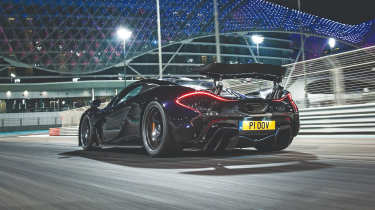
Like many of its ultra-high-end ilk, the P1 never really lost money after it went on sale at £866,000 in 2013. By 2020 the cars were touching the million mark and as of 2026, prices are still in this ballpark, though some have gone for more – the auction record for a standard P1 is nearly £2 million, while one sold at auction for $1.6 million in 2021, around £1.2 million at the time. P1 GTRs can go for a lot more, particularly if they’ve been converted for road use by Lanzante – the car launched at nearly £2 million in 2015, and while today’s figures start around £1.7 million, asking prices nearer £3 million aren’t unusual.
Mechanically speaking the P1’s V8 will need similar attention to that of other contemporary McLarens. There's now also a 4-litre upgrade available from Cosworth. It's the car’s electrical components however that need special attention. Some owners have reported battery failure, with replacement with an upgraded unit now an easy six-figure bill. Brake life is theoretically just about indefinite and pads last a long time too, but will need eventual replacement. Tyres have much shorter lives, especially on track; it’s not unusual for owners to switch to Michelin tyres from the Pirellis that McLaren originally recommended.
The P1’s body panels are replaceable, though you’ll probably want to avoid dinging one. Avoiding scraping the front splitter and rear diffuser is more difficult, with both referenced almost as running costs on owner forums, and each with substantial five-figure replacement bills.
Specs
| P1 | P1 GTR | |
|---|---|---|
| Engine | V8, 3799cc, twin-turbo, plus 131kW electric motor | V8, 3799cc, twin-turbo, plus 131kW electric motor |
| Power | 903bhp (combined) @ 7500rpm | 986bhp (combined) |
| Torque | 664lb ft (combined) @ 4000rpm | 664lb ft+ (combined) |
| Weight | 1490kg | 1440kg |
| 0-62mph | 2.8sec | <2.8sec |
| Top speed | 217mph (limited) | 200mph+ (estimated) |
| Price new | £866,000 (2013) | £1.98m (2015) |
| In today’s money | £1.23m | £2.77m |
| Value today | £1m+ | £1.7m+ |