Ferrari Amalfi review – Maranello’s 631bhp Aston Martin Vantage rival
The Ferrari Amalfi replaces the Roma as Maranello’s entry-level car – one with almost as much power as an Enzo…

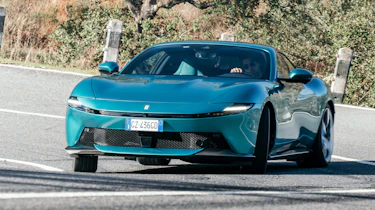
When the Roma arrived in 2019, it felt like Ferrari had finally produced an entry-level GT with a proper identity. Compared to the California-derived Portofino, it was fresher, fitter and more cohesive – every bit as exciting as a Ferrari should be while being rounded and usable enough to draw new customers in (around half of Roma buyers counted it as their first car from Maranello). But having occupied the sharp end of the sports GT field for five years or so, the Roma has now made way for a new coupe to serve as the entry point to Ferrari ownership: the Amalfi.
Designed to go up against the likes of Aston Martin’s Vantage and the Mercedes-AMG GT, the Amalfi is a refinement of a familiar formula, taking the Roma as a base and honing what was already good, and rethinking certain elements - such as the interior - in response to customer feedback. It remains a rear-drive V8 coupe with ‘+2’ seating and improving upon the Roma, the Amalfi must also comply with the latest legislation. Indeed Ferrari has worked hard to counteract the impact of European noise and emissions regulations.

Visually it’s very much an evolution of the Roma (no bad thing), with reworked surfacing and details. There’s a new bonnet and central power bulge, plus reshaped flanks, where three body creases meet like an arrowhead on the doors. The rear cuts off more sharply than the Roma’s rounded tail, and there’s a new nose graphic that - whisper it - you might say has a certain whiff of Toyota Prius about it... The net result, however, is an elegant, uncluttered grand tourer with classic proportions and more presence and understated muscle in person than the pictures might suggest.
More reviews
Beneath that new bonnet lies a development of the Roma’s 3.9-litre V8, with a power boost from 612bhp to 631bhp achieved through a new Bosch ECU (borrowed from the 296, Purosangue and 12 Cilindri) and revised management for its twin turbos. They spin up to 6000rpm faster than before, while the engine’s rev limit has been raised by 100rpm to 7600. It’s lighter than the old unit too, with new camshafts (-1.3kg) and a trimmed down block (-1kg), as well as cleaner thanks to new catalytic converters. While they’re more restrictive and add back pressure to the exhaust, sapping a little power, the engine modifications more than offset that.
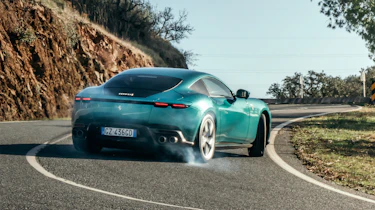
There’s also a new rear silencer to reduce volume to the required level for legislation, but Ferrari has tuned the system to supposedly sound as good as the Roma’s from inside the car. There’s a singular, flat-plane tone when the V8 fires up, but almost as important as the noise is how you wake it, because the trademark wheel-mounted start button has returned, replacing the touch panel used in Ferraris of late. It’s a small detail, but with a satin red anodised look and a tactile action, it makes the start-up ritual that bit more special. Elsewhere on the wheel you’ll find buttons for the HMI instead of touch pads too, a development taken from the F80 that makes navigating through the interface much more intuitive. A change we can get behind.
The Roma’s split cabin design with its high central tunnel has been swapped for an architecture resembling that of the Amalfi’s big brother, the 12Cilindri. There’s a landscape touchscreen instead of the Roma’s tacked-on portrait display and a more open, airy vibe. It does feel more generic somehow, without the cocooning feel that made the Roma so special to sit in. The seat itself doesn’t get low enough to nestle you into the car either, but that does mean an evocative view of the bonnet ahead, with the peaks of the wheelarches framing your vision.

Ferrari’s designated test route initially takes us through towns and villages in Portugal’s Algarve region, and the Amalfi is calm and docile as it slips through morning traffic. The engine’s hum is muted, the steering’s light and quick and there’s an intuitive feel from the brakes. These deserve a special mention, as they now use brake-by-wire with no physical link from pedal to master cylinder, yet there’s totally natural and consistent response. The brakes now incorporate the ABS Evo system found on other contemporary Ferraris, too, with a 6D sensor that measures grip levels more precisely to maximise the braking potential of each wheel.
The Amalfi has been developed to have more bandwidth than the Roma, with retuned chassis systems (including Ferrari’s Side Slip Control 6.1) and bigger step changes as you flick between the five Manettino modes – Wet, Comfort, Sport, Race and ESC Off. With the roads damp and the car warming up, the more relaxed damping and throttle mapping of Wet or Comfort are helpful, and allow the Amalfi to make effortless progress. It laps up bumps with clean, fluid movements and while there is some surface patter over the roughest sections, it’s supple and really well judged, no busier than a 911 Carrera. The engine doesn’t deliver a monster swell of low-down torque but there’s still real flexibility, just in a more measured way. Combine that with smooth auto shifts from the dual-clutch ‘box and you have the makings of a competent, satisfying tourer – one you could feasibly use every day.
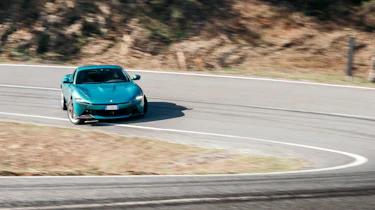
But there’s always a nagging sense that the Amalfi is itching for a bit more commitment. You feel it in the steering, and how quickly the nose responds to small nudges of the wheel, and in the sharpness of the engine as the revs build. Sink into the throttle and…oh. In Comfort or even Sport the traction control saves you from yourself and heavily limits the power in these conditions, but once up to speed the full might of the engine is released. Then the Amalfi explodes up the road with immense force, and the surge is sustained and amplified as the digital needle whips past 7500rpm on the tacho. It’s a more livewire delivery than the burly V8 you’ll find in a Vantage, and feels good for every one of its 631bhp – perhaps a few more. And then it dawns on you that this entry-level Ferrari has almost as much power as an Enzo…
And, believe it or not, a stack more torque. The Amalfi’s 561lb ft matches that of the Roma, so too the 3000-5750rpm window in which it's delivered, but Ferrari has manipulated the curve to deliver more at high revs, giving the impression of ever increasing thrust. Sadly, that rush isn’t accompanied by an especially rich soundtrack, even with the exhaust uncorked in the Amalfi’s racier modes. It sounds pretty good at high revs, but in the mid-range there’s some mechanical noise up front and not much music from behind, and it lacks the multi-layered tone and majesty you’d want from a GT. The V6-engined 296 solves the noise problem by using ducts to channel genuine engine sound into the cabin. Ferrari’s engineers say this solution wouldn’t suit the Amalfi’s brief as a more subdued GT, but a more soulful voice would do it no harm.
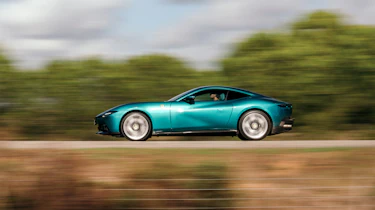
Still, it’s a lovely engine to use with an exciting delivery, and when fully lit its sharpness is a good match for the Amalfi’s character, which is lithe and responsive, and totally different to the more heavy-set feel of a Vantage. Rather than muscling it through corners you guide it with a delicate touch, and in the damp it’s easy to exploit in Sport mode as it gently meters out the torque to limit slip. You flick it from corner to corner and revel in the Amalfi’s wieldiness and agility, which feel much closer to that of a sports car than a traditional grand tourer.
There’s a definite sense of shared DNA between the Amalfi and the 12 Cilindri, which also reacts with a clarity and lack of inertia that belies its size. But if anything the quick-witted feel suits the Amalfi more, because it's lighter, more compact and better able to deal with fast inputs, and doesn’t have the savage delivery of a V12 to manage. But that’s not to say it won’t bite. With the stability control off the rear kicks wide easily out of slow corners, and given the quick steering and sharp engine responses, you need to be precise to catch it smoothly.
Through faster corners it's a little short on feel, too. It can be tricky to gauge just how much the front tyres are loading up against the greasy surface, particularly when applying the first few degrees of lock. There’s less feedback to draw from than in, say, a McLaren, which doesn’t allow you to commit with unwavering confidence.
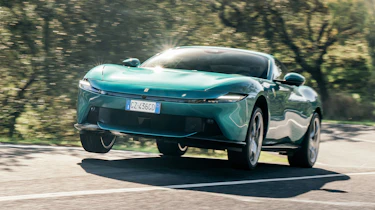
But on dry roads with the Goodyear Eagle F1s warmed through, the Amalfi is a bit of a revelation. So fast, so manageable, and huge fun once you’re in tune with its responses. Lean on it with more intent and you get stronger messages from the front end, which stays locked on all the way from apex to exit. When grip does ebb away it does so gently, and with the Manettino in Race the Amalfi feels alive and adjustable, letting you precisely dictate its attitude on corner exit. It’s not fool proof and will still light up the tyres if you’re greedy, but the electronics gently intervene to keep things neat and controlled, without awkwardly intruding.
In Race there’s more drama from the gearshifts too, the ratios popping home with a defined thump when you pull on the large carbon paddles. The changes are crisp, particularly on the way up, but the jolts can unsettle the car when it’s fully loaded up in a corner. The dampers default to their stiffest mode in Race, but on smooth Portuguese roads there’s no need to reach for the Bumpy Road button. The Amalfi is still precise and controlled if you do, but the body movements are a little more languid, and the extra support from the firmer mode is a better match for its sharp reactions. When pushing hard the brakes remain standout, with a firm progressive pedal and an impressive resistance to triggering the ABS.
The rewards in Race are more than enough for road driving, but to fully indulge in the Amalfi’s talents, it’s worth making the leap to ESC Off. There’s a greater sense of jeopardy and it demands respect, but there’s a wonderful sense of progression when the rear breaks loose, and there’s scope to scribe small angles - or larger ones - at will, leaning on the hard cut-off of the rev limiter. The Amalfi instills real confidence and encourages you to work the chassis hard, corner after corner, enjoying its adjustability and poise. It’s an impressive trick, even more so in the context of how subdued and calm it is in normal driving.
If the Amalfi was tasked with carrying the torch of the Roma, consider it job done. It’s no radical reinvention of the theme but it’s a car with superb bandwidth, as adept at calm cruising as it is scrambling up a mountain pass with fantastic speed and balance. The lack of a captivating sound - and a sense of intimate connection through the steering - make it less immersive than it could be, but as a sports GT to bring in new Ferrari customers and excite current ones, it’s hard to fault.
Price and rivals
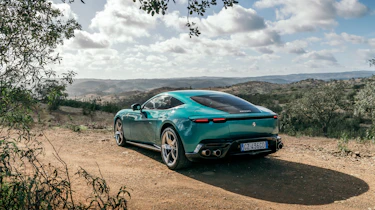
At £202,459 the Amalfi occupies a highly competitive space where pretty much any flavour of sports car, GT or junior supercar is available. In many ways the Amalfi combines all three genres, much like the £165k Aston Martin Vantage. The Aston is more of a brute than the delicate, lithe Ferrari, but makes a more characterful noise and is a match for its design and finish inside and out.
The Mercedes-AMG GT is a more conventional rival but no less capable, particularly in 805bhp E Performance guise. It’s a deeply impressive coupe with four-wheel drive all-weather pace, but it’s more remote and far less exciting than the Amalfi, coming in at £186,290.
Porsche’s 911 Turbo S, meanwhile, continues to punch above its weight in its latest hybrid-assisted 992.2 guise, and with over 700bhp and four-wheel drive, has the Ferrari easily covered in raw performance terms. It is heavier and more complex, however, and from our initial impressions, not as pure to drive as the Amalfi.
If you’re willing to sacrifice some practicality for outright drama, there’s also the Maserati MCPura and McLaren Artura to consider. The Artura is technically superb and one of the most richly rewarding entry-level supercars on sale, while the MCPura has the purity of its rabid, non-hybrid turbocharged V6 and a stunning design on its side.