McLaren W1 review – the Ferrari F80's wild, 1258bhp nemesis
The P1’s successor has arrived, with 1258bhp and surprising manners

Chimera was obviously taken TVR some time ago, but I think Manticore is still available. A fearsome triple hybrid from Persian mythology with a name that means man-eater, it possesses the body of a lion with a human-like face endowed with multiple rows of teeth, and a tail that either resembles a scorpion’s or is covered in venomous spines that can be fired like arrows. In other words the stuff of nightmares. Apologies if you’re reading this at bedtime.
Why delve into such folklore? Well, I think McLaren should take a leaf out of Ford’s book and start naming its powertrains. It’s not really been McLaren’s style, with an assignation of letters and numbers more the Woking way, but the company put a toe in the water with Artura and I think they should continue down that avenue by calling the W1’s hybrid of internal combustion and electric motor... The Manticore Powertrain.

Sure, it might need slightly more workshopping than my caffeine addled mind is currently capable of, but my point is that the notion of a hybrid doesn’t generally inspire awe where the modern motor car is concerned. And in the case of the W1 it really should.
Second gear on a deserted Italian strada provinciale. Warm tarmac, warm fluids, ice in the veins; nail the throttle with as much conviction as possible and try not to lift for a couple of seconds. BAM! You’re hit with an instant shot of electric response that turns straight into a monumental slug of turbocharged midrange, and if you steel yourself not to change up then you’ll find yourself consumed by a savage, rabid, crazy 9000rpm top end that feels naturally aspirated. Add in a plethora of chuffs and whooshes in the midrange, cracks from every upshift, with a superbike doing unspeakable things to a buzzsaw when you reach for the limiter, and you have a soundtrack to match the performance. It’s not S70/2 baleful and beautiful, but it’s acoustically very entertaining.
All of which was a bit unexpected. When McLaren unveiled the car that would follow in the illustrious tyre tracks of the F1 and P1, it said that the W1 would come with a brand new engine, but the trouble was that the basic architecture of that engine was also going to be identical to what had gone before. Here was another 4-litre, twin-turbo, 90-degree, flat-plane-crank V8. So, despite the fact that this new MHP-8 engine is 13kg lighter, 40mm shorter, with new turbos, plasma coating on the cylinders, DLC-coated sliding finger followers and both port and direct injection, I couldn’t imagine it being very different in character to the old M840T. Then you drive it and realise that this has a whole new ferocious character to it. There are similarities, sure, but that hard, aggressive top end in particular is something that feels very distinct.
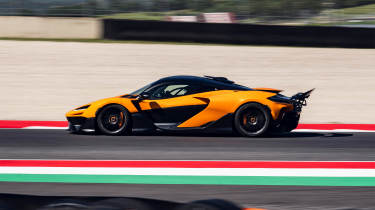
It’s certainly got the performance to back up the character as well. On its own the new V8 produces 916bhp and 664lb ft of torque. For reference, that’s an identical torque figure and 12bhp more than the sum of the hybrid outputs for the P1. The W1 then adds in another 342bhp and 324lb ft from a radial flux e-motor that sits to the side of the gearbox for grand totals of 1258bhp and 988lb ft. The end result is that the W1 goes from a standstill to 186mph (300kph) in less than 12.7sec, which is 30 per cent faster than its predecessor and identical to the similarly rear-wheel-drive Aston Martin Valkyrie.
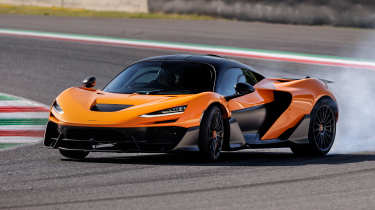
If that still just seems like a bunch of big numbers that are hard to relate to then settle yourself into the firm, fixed bucket driver’s seat as you pour the car into the downhill left-hander at the end of a lap of the Mugello circuit (yes, the Mugello circuit that is owned by Ferrari – I like to think Benedetto Vigna in his office in Maranello had one eye on the CCTV while McLaren was there). As the corner opens out and you squeeze on the throttle in third gear, running the W1 out to the red, white and green exit kerb, you push the Boost button on the right-hand spar of the new, slightly square steering wheel. All 1258bhp fires you down the straight with a level of acceleration that never seems to diminish over the next kilometre. There is no sense of the air getting harder to push through and the speed just keeps climbing on the digital dash, the numbers flicking over like the digits on a free-flowing petrol pump. The 1.1km straight isn’t actually straight, either, nor is it flat, so you need to pay attention to where you’re going, steering gently with the throttle pinned as the track meanders past the bright white pit wall on your right.
And although experience tells you to look as far ahead as possible, the braking zone for the big hairpin at the end is hidden over a blind crest. You take the rise at well over 190mph, feeling yourself go light in the harness, and then 200mph shows up on the dash just before you hit the brakes hard as the 200m board flashes past.
Two hundred miles per hour. With me driving. In a road car. Braking a bit early. Not on a long runway, but a circuit. For reference, when Lando Norris and Carlos Sainz Jr raced around Mugello for the 2020 Tuscan Grand Prix, their MCL35 F1 cars were clocked at less than 10mph faster by the end of the same straight. That’s how astonishingly fast the W1 is.
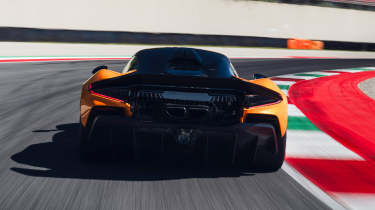
Of course, the next questions are about whether a car with this much performance and this much power going solely to the rear wheels is actually useable and fun in anything other than a straight line. Well, let’s start off slow – because the W1 can. Back in the pit lane, rock the rocker switches on the instrument binnacle to select Comfort mode for both handling and powertrain and you have a car that is very easy to drive at low speeds as you head out through the paddock for the public roads beyond.
Some of this ease comes down to the beautiful hydraulically assisted power steering that immediately makes you feel connected to the car and happy threading it along a road. Squeezing it down a couple of narrow streets in a nearby town just minutes after leaving the wide expanses of the circuit there is no sense of panic as I pass a Punto that is pressing on.
You sit low, but the seating position doesn’t feel extreme and you still have that trademark McLaren visibility, with the front arches in sight and decent-sized mirrors. The company actually claims that the A-pillars are the thinnest it’s ever done, and because the seats are fixed it should be that the sight lines are pretty much the same for all. The immovable buckets mean the pedal box and steering column have a really good range of adjustment, and I found it a breeze to get a really good setup, with the wheel nice and close but the aluminium, floor-hinged pedals also at a comfortable distance – not something that’s always possible as a lanky person. You’re not rubbing shoulders with your passenger like you are in the P1 either.
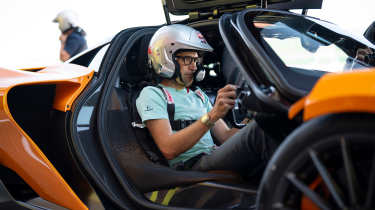
The ride is definitely not some sort of magic carpet like an early MP4‐12C’s or long legged like an F1’s, but the firmness feels appropriate and it’s by no means unyielding or uncomfortable. The directness of the damping actually adds to the sense of connection and therefore the confidence the car gives you in negotiating normality. There is also a button for the nose lift, which acts quickly should you need it, and there is even a bit of luggage space behind the flip-down headrests. You’d have to pack with a certain amount of thought, but you could manage a few days away in it and there’s enough room for a crash helmet if you’re travelling to a trackday.
It’s not taxing in terms of noise, either, because McLaren has placed the chain drive on the back of the engine, which helps with NVH, and the V8 only really starts to get a voice once the turbos are working hard. With the typically tactile McLaren metal stalks sprouting from the steering column, the fun buttons in the roof and the new InnoKnit material that is lit from behind with LEDs, the overall feeling in the cabin is definitely that of a purposeful but very accommodating road car rather than a stripped-out track toy.
There is an Electric mode for the powertrain if you want to travel entirely silently, but as the battery is a mere 1.4kWh you’re limited to just 2km of continuous stealth. Enough to crawl through a small village or soothe past any jittery-looking horses, but not much more. In Comfort, the electric motor is actually used mostly for torque infill during gearshifts, and it’s only when you move up to Sport that you get any real electrical assistance with the acceleration.
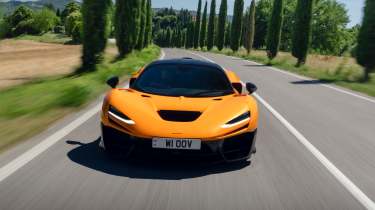
Switch the chassis into Sport as well, however, and you have a seriously addictive driving experience. All the steering, seating and sightline attributes that made it a doddle in town turn it into a fabulous car down a sinuous piece of road. The W1 has a 70mm shorter wheelbase than a P1 and it feels like a smaller, more agile car. In some ways it has the attitude of a sports car rather than a supercar in the way that you can hustle it down a narrower road with confidence. The fabulous steering obviously gives you wonderful feedback through the thin, Alcantara rim as to how hard you’re pushing the 265-section front tyres, but there is also a direct sense of connection through the seat to the huge 335-section rears.
We were told not to turn off any of the ESC on the road but I confess I did, simply because the car feels so transparently underneath you that it almost feels wrong to have electronics nipping at the edges. I thought all the turbocharged torque and electrified power might feel unmanageable, but there is a predictability and linearity to the delivery that means you can happily have the rear end scrabbling a little and helping you pivot through the corners. I’m quite sure it could all get out of hand, but I don’t think you’d be able to say it was unexpected if it did.
The controlled suspension keeps the guesswork out of any weight transfers too, yet doesn’t have you wincing over bigger bumps. You can feel the stiffness inherent in the carbon monocoque, but that in turn lets you really feel how each of the front wheels in particular is moving over lumps and cambers in the road.
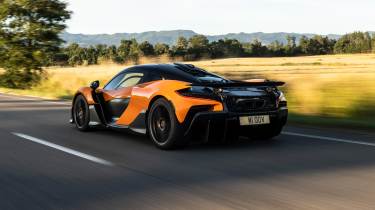
Braking is unaffected by any battery regen requirements, so again there is crystal clear feeling through the pedal as it’s a purely hydraulic system underneath the ball of whichever foot you choose to use. The carbon-ceramic discs are 390mm at the front, clamped by six-piston calipers, and McLaren says they have an extra layer of ceramic coating compared to previous iterations, which has given them both more durability and also allowed a more aggressive brake pad to be used. Again, the fear is that extra bite might mean less modulation, but you can just brush the pedal for some reassurance or push deep into the travel and feel the tyres dig into the asphalt with equal confidence.
Although not a lightweight at 1399kg dry (an almost identical figure to the P1), the W1 is also not a heavyweight in hybrid terms, and that’s reflected in the driving experience. The W1 doesn’t feel virtuously light, but neither does it have those moments where you feel more mass than you’d like on the brakes or in tighter corners.
Add in the crazy way the powertrain delivers instant yet characterful ha makers of performance throughout its rev range and you have a genuinely intoxicating machine. Whether you’re living in the more familiar McLaren mid-range world of tschhhh, choooffff and pewph sounds that echo behind you like loud synthetic waves crashing on a shingle beach, or you’re seeking out the new heady, hard upper reaches of the revs where it seems to spin with an unhinged anger, there is no doubt this new (Manticore!) powertrain is a bit special.
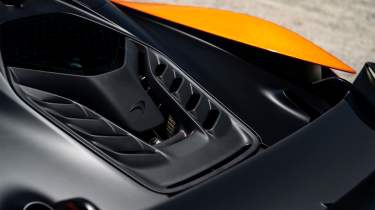
Clearly you don’t need so much muscle on the road, but to discover that on the right stretch of tarmac such a chunk of the performance is both accessible and enjoyable on the road is a lovely surprise. Of course, when you do get to a track it unlocks even more performance...
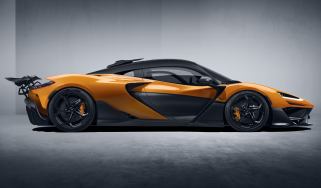
Pull back into the pitlane and it’s time for Race mode again, which is activated by reaching up to the roof and pressing the blue glass button a couple of times. This not only drops the front by 37mm and the rear by 17mm, giving the car more rake, but also locks out the big cross damper at the front and the Z bar at the rear to control the car’s heave. The reason it needs to do this is that the rear wing also extends backwards by a whopping 300mm to effectively extend the diffuser under the car and work with the active front wing to generate up to 1000kg of downforce at 174mph (350kg at the front 650kg at the rear).
There are two suspension settings even when you’ve done all this, with Race for bumpier circuits and Race+ for smoother ones like Mugello. Two powertrain modes are also unlocked for track use: GP manages the battery power over longer stints, like a cautious partygoer nursing their drinks over the course of a whole night, while Sprint strawpedos every available bottle upon arrival, giving you full power (without needing to press the Boost button) for a lap or so until the battery is depleted.
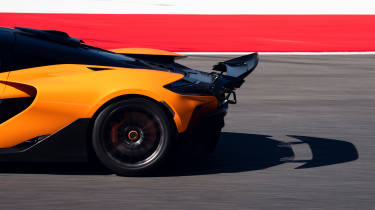
Whichever mode you’re in, and even on a big, wide track like Mugello, the performance is vivid, shrinking the distances between corners to such an extent that there’s almost no time to relax around a lap. If you jump on the power too early, you’ll run wide onto the exit kerb in an instant. Hold the throttle a moment too long and you can miss a braking point by a chunk.
Yet the chassis is friendly enough to allow you the mistakes. There is a touch of understeer to lean on initially, but if you trail brake with a bit more commitment then you can really load up the front tyres and loosen the rear end in a progressive, almost kart-like way that will be familiar to anyone who’s driven a 600LT on track. Add in the downforce that manifests in tremendous stability and a sense of security at higher speeds and you have a surprisingly driveable hypercar. Corners like the famous, fast, cresting Arrabbiata 2 are reassuringly calm despite the speed you’re carrying. The balance through the chicanes is natural and intuitive.
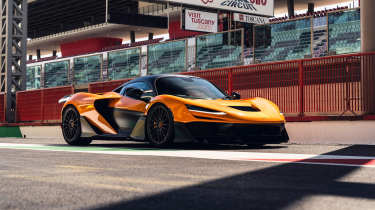
And if, even for a moment, you lift your eyes above the Armco to look at the backdrop of hills in the surrounding countryside, you’ll remember that this is a car that can also quite happily tackle a town or bumpy B-road. Which is perhaps the most extraordinary thing about the W1; the sheer breadth of its ability. With so much power and torque the performance was perhaps a given (even if it is still shocking to experience), but the expectation when boundaries are being pushed, when you dip into hypercar territory, is that the cars have to be uncompromising and therefore compromised in some areas. But the W1 really doesn’t feel like that.
If you were going to level a criticism at the W1 (apart from the small matter of it only being available to 399 people at a starting price of £2million), I think you could say that it feels like a next-generation P1 in terms of its philosophy rather than a whole new concept. You look at Ferrari’s lineage of F cars and each one looks like it has emerged from a clean sheet of paper with no real carry-over from what has gone before except the badge on the bonnet. By comparison the W1 looks like evolution rather than revolution, but the benefit of that approach is that, although the car might lack some of the shock of the new, it has also stubbornly retained all the vital ‘old’ things we loved about the previous generation, such as the steering and braking. And by improving as much as innovating, McLaren has made a fundamentally better car than what’s gone before, not just a different one.
McLaren W1 specs
| Engine | Engine V8, 3988cc, twin-turbo, plus e-motor |
| Power | 1258bhp |
| Torque | 988lb ft @ 4500-5000rpm |
| Weight | 1399kg (dry) (914bhp/ton) |
| Tyres | Pirelli P Zero R |
| 0-60mph | 2.7sec |
| Top speed | 217mph |
| Basic price | £2million |