Mercedes-Benz SLR McLaren (2003 - 2007) review – one of the weirdest supercars of the 2000s
A mashup between Mercedes-Benz and McLaren produced a radical but flawed supercar at the turn of the millenium. We revisit the mighty SLR
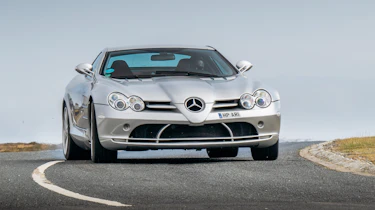
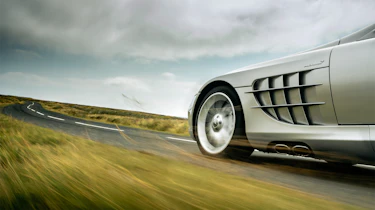
The Mercedes SLR McLaren is a quite extraordinary car in many ways. For instance, there have been other cars with side-exit exhausts but usually they exit just ahead of the rear wheels. The SLR’s exit in front of the doors. Why? So that the underfloor aerodynamics can be as tidy and effective as possible. Yet, like the legendary 300 SLR that inspired it, the SLR also has a crude flip-up air brake at the back…
It was in 1997 that Mercedes-Benz presented the Vision SLR Concept, a very striking show car to preview a new flagship Merc. It had chainmail-trimmed seats and looked spectacular. Back then it had a V12, but once the deal had been struck for McLaren to develop and build the production SLR – with the project being led by Gordon Murray – it was redesigned and became a V8.
It was still stunning when it was revealed in 2001 as the Mercedes-Benz SLR McLaren and it’s no different today. The SLR looks amazing in pictures, but in reality it looks truly incredible, partly because its proportions are even wilder than expected; it’s not just long, it’s also massively wide. But the Mercedes/McLaren partnership meant that beneath that skin, the SLR was confused in what it wanted to be. Was it a supercar or a super GT? The engineering and components were a mix of the two, and that came across in how it drove in period.
More reviews
Does the SLR still feel like an awkward mishmash, or is it a more cohesive supercar in the context of today? We revisited the SLR in our evo Eras: 2000s supercar test. Read on to find out.
Engine and performance
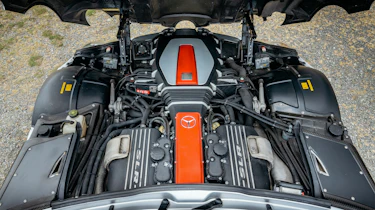
- 5.4-litre supercharged V8 with 617bhp
- Five-speed automatic gearbox
- Fabulous soundtrack from the side-exit pipes
The SLR’s engine was one of the sticking points between Mercedes and McLaren. Mercedes initially promised exclusive use of the 5.4-litre, supercharged V8 (a development of the SL55’s engine with 617bhp and 575lb ft of torque), but subsequently launched a CLK DTM AMG road car with a 574bhp version.
Flip the tiny cover on top of the gearshifter, push the start button and the V8 booms into life. If you’ve left the door open the gargle through the side-exit exhausts is wonderful, even at idle. On the move, it takes just a gentle prod to realise the engine is a monster. The SLR feels like a powerhouse and it takes some time to get the confidence to pin the throttle. When you do the V8 thunders, the supercharger shrieks, and you’re left wrapping your head round the astonishing pace.
It’s by no means as dramatic as, say, a V12 Lamborghini, but there’s an addictive muscularity to the SLR – feeling it sit on its rear axle and haul up the road must have felt otherworldly in 2003, because it still does today. Sadly the five-speed automatic gearbox is less instantaneous than the shove. Too slow in manual mode, it’s actually better to leave it in auto and let the torque of the engine do the work. When you need the full force of the V8 all it takes is a boot of throttle, which engages the kickdown and rockets the SLR forwards.
Driver’s note
‘It sounds terrific, goes like stink. Calm your inputs and it starts to gel a little bit, but it’s more a case of compensating for the way it drives rather than becoming at one with the car.’ – Richard Meaden, evo Editor-at-Large
Ride and handling
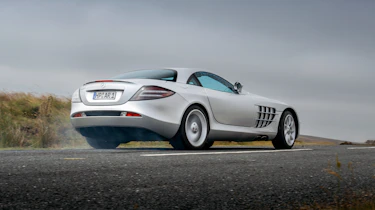
- Weirdly sharp steering and springy brake feel
- Rear end lacks control over bumps
- Much sweeter when you calm your inputs down
One of McLaren’s biggest contributions to the SLR project was its carbonfibre chassis, as well as the aerodynamics, which included an active air brake. Add in the fact the V8 was mounted well behind the front axle line and you’ve the ingredients of a serious front-engined supercar rather than a grand tourer, but other elements betray that. Take the braking system: the SLR used an adaptive system developed for the Maybach, which included automatic braking in traffic jams. Mercedes pushed for this, and by the time McLaren realised it wasn’t the right solution for the car, it was too late.
Even at modest speeds the steering is bright and the brake feel is… weird. Both seem designed to thwart your efforts to drive smoothly and confidently, leaving you reluctant to deploy the mighty performance of the engine. Something else that stops you is the lack of control at the rear. The ride feels comfortable, compliant initially, but through dips the rear can bottom out without warning.
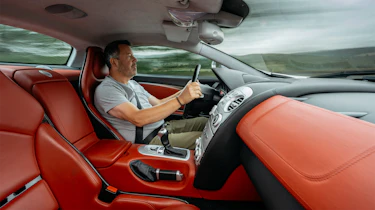
You do eventually get more in tune with it, though. It works much better with single, measured inputs to the ultra-responsive steering and springy brake, but the latter seems to have been designed to give the wrong response to any input. Get beyond these mere details and if you want to carry any sort of speed then you’ve got to scan the road for bumps that might test the suspension travel. It helps if you imagine you’re the throttle man in an offshore powerboat crew (appropriate given the length of the snout), easing off as required.
All told, the SLR is as strange as we remember it to be in period. It feels like it’s trying to be three different cars at once, which is a reflection of the McLaren-Mercedes marriage – they shouldn’t really go together. But once you’ve accepted the foibles it’s undeniably special; the looks, the sound, the presence are still spectacular.
Driver’s note
‘The noise, power and speed. The relative civility and genuine usability. The build quality. The overly sensitive steering and dead-pedal brakes. The derivative interior and disjointed styling. I’m still perplexed by what the SLR is trying to be.’ – Richard Meaden, evo Editor-at-Large
Values today
Part of the SLR’s problem at launch was that it cost a mammoth £313,465, over double the price of an SL65. It certainly didn’t offer double the experience. Something that has suppressed values over the years is what it costs to look after an SLR. Parts availability, prices, the expertise, man-hours and ultimately the labour costs needed are more on the side of McLaren than Mercedes. There’s also the fact that McLaren built over 2000 of the things and even that was well below the 3500-unit target first set for the model.
With time the SLR has become appreciated as a moment of madness from Mercedes-Benz, and values have started to rise beyond the c£200k doldrums they lingered in for a while. You’ll pay somewhere in the region of £350,000 for a sub-20,000-mile SLR today, with ultra-low mileage examples being beyond £400k.