Aston Martin Vanquish (2001-2007) review – Ferrari 550 Maranello rival for a third of the price
The original V12 Vanquish defined what Aston Martin was to become and looks like great value given its rarity
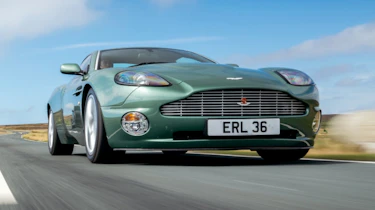
It’s difficult to understate the impact the V12 Vanquish had at Aston Martin when it launched in 2001. Ian Callum’s styling set the template for a generation of Aston Martins to follow, and you can still trace its bloodline in the current models, not just because the Vanquish name still exists, but conceptually and visually too. It’s almost like someone flipped a switch at the turn of the millennium: the Aston Martin story can now be written pre-Vanquish and post-Vanquish.
Fast-forward over a quarter of a century and the Vanquish still has the power to stop you in your tracks. Its specification still looks modern today, with a Lotus-style extruded and bonded aluminium structure with carbonfibre reinforcement, aluminium panels, a paddleshift transmission (albeit an automated manual) and a Cosworth-fettled V12. It also features not a single grain of wood in its cabin. Although the early Aston ‘waterfall’ dashboard is not one of the Vanquish’s stronger features.
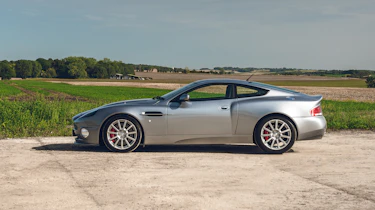
What the Vanquish has always had is presence. The contemporary DB9 and Vantage are both gorgeous shapes, but by comparison they look smoothed over, a touch more homogeneous, whereas the Vanquish looks and feels more exotic. Its lines have a bit more aggression, more attitude – more muscle definition. Comparative rarity adds to the exoticism. Across all versions, the total built was 2578. A sizeable number compared with previous Newport Pagnell-built cars – but not compared with around 16,000 DB9s and even more ‘VH’ Vantages.
History – from Project Vantage to Vanquish
November 1997 and a cold, grey morning at the Millbrook proving ground. A secret Aston Martin concept is parked at the base of the famous Hill Route. It’s here for a photo op with Ford president and CEO Jac Nasser, Aston being part of the Blue Oval’s much-vaunted Premier Automotive Group. Also in attendance are Aston CEO Bob Dover and designer Ian Callum, both keen to hear Nasser’s verdict.
Hard-nosed businessman though ‘Jac the Knife’ was, he was also famously a car guy, and he responded to Project Vantage in a purely instinctive way. He knew this was how an Aston Martin should look and feel, that this was a template for the future of the marque. And, of course, he was proved absolutely right.
More reviews
In-depth reviews
Reviews
- Aston Martin Vanquish Volante 2025 review – Ferrari 12 Cilindri Spider rival impresses
- Aston Martin Vanquish (2012 - 2018, Mk2): a V12 super GT great
- Aston Martin Callum Vanquish 25 by R-Reforged 2022 review
- 2019 Aston Martin Vanquish Zagato Shooting Brake review
- Aston Martin Vanquish Zagato review
- Aston Martin Vanquish S review - should you buy one over a DB11?
Named V12 Vanquish, the new flagship would be a hit with both press and customers alike. Moreover, it would establish a new design language for the Gaydon era of Astons that followed – cars like the DB9 and V8 Vantage – and its innovative construction would lead directly to the VH platform that would underpin the next 20 years of production. It was nothing less than the start of Aston Martin’s modern era.
Engine, gearbox and performance
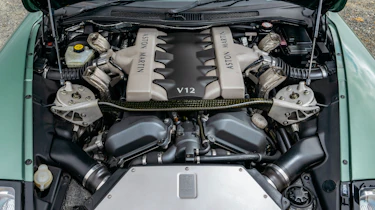
The engine was a development of the V12 that had latterly been installed in the DB7 Vantage, an all-alloy 5.9-litre, 60-degree unit making 460bhp at 6500rpm in its earliest form.
With the launch of the V12 Vanquish S in 2004, peak power jumped to 520bhp thanks to the attentions of Cosworth, and while the 0-60mph time was practically unchanged (evo recorded 4.9sec, against AM’s claimed 4.6), the official top speed was up from 190 to a headline-grabbing 201mph. Whether anyone other than a factory test driver on a closed, banked circuit ever achieved that was a moot point then and certainly is now. But it all added to the Vanquish legend.

You’ll care even less the instant the 5.9-litre V12 catches. There are plenty of other applications of this magnificent engine, but it had unique intake and exhaust manifolding for the Vanquish, and while it sounds great in a DB9 or a V12 Vantage, it’s somehow more visceral, more vocal, more vital in the Vanquish. Aston Martin went to considerable lengths to get the sonics they wanted. As Bob Dover later revealed: ‘We recorded V12 sounds from a Ferrari and a Lamborghini on a cassette machine and made it sound like that!’
With a kerb weight of 1875kg and a power-to-weight ratio of 282bhp per ton, outright performance is, unsurprisingly, little to write home about in today’s super-tourer landscape. But it’s strong and urgent enough to be engaging, the power swells pleasingly, and that soundtrack is very special indeed. For the full orchestral effect you need to sustain the throttle past 5000rpm, which is when the full string and brass sections join in. No V8 can match that.
The Vanquish was famously the first Aston with an automated manual transmission and paddles, the system dubbed ASM (standing for Auto Shift Manual). Essentially it was a six-speed manual Tremec transaxle with electro-hydraulic clutch actuation, thus doing away with the clutch pedal. The ratio-swapping in early cars left plenty to be desired in terms of both speed and smoothness, though by the time the S came out there had been tweaks to both hardware (magnetic rather than analogue gear position sensors) and software to make it more acceptable.
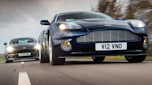
Pull back on both paddles to select neutral, then pull the right-hand paddle to select first and you’re away. You can put the car in full auto mode, but it feels happier being manually shifted. Happier, but not completely chuffed. Early road tests highlighted how it was possible to smooth the shifts by backing out of the throttle just a touch on upchanges, and that still applies, even in a late Vanquish S.
The gearbox remains its weakest aspect. The changes can be smoothed, through finessing the timing and degree to which you feather the throttle, but it’s still a touch more ponderous than you’d ideally like. I reckon I could learn to live with it; there’s a kind of satisfaction to be derived from executing smooth changes, both up and down the ’box – approaching T-junctions and roundabouts it’s much slicker if you paddle through the downchanges yourself.
But there is another option (two in fact) if you’ve set your heart on a Mk1 Vanquish. At least one specialist has offered a conversion to a fully automatic gearbox. Better yet, shortly after production ended at Newport Pagnell, the renamed Aston Martin Works developed a conversion to a traditional manual with a stick shift and three pedals.
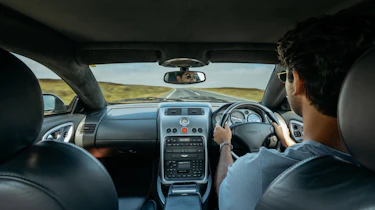
The gearbox was physically the same Tremec unit but with all the electronics and actuators stripped away and some minor internal changes. The engineers then created an aperture in the central carbonfibre tunnel to allow a lever to be pushed through, while the driver’s footwell was reconfigured to include a clutch pedal, the whole thing beautifully trimmed so that it blended seamlessly.
Around 100 cars have had the conversion over the years, at a cost of around £20,000. Which is a substantial sum, but the whole thing is very well executed – as you’d expect for what is, in effect, a factory conversion, developed by some of the engineers who built the car originally.
The clutch is quite stiffly sprung and the initial shift into first is slightly gristly, but once everything’s warmed through and you’re focusing on the road rather than the mechanism, the stick can be palmed around the gate with pleasing ease. What’s more, you immediately feel more connected, more in control, more involved.
It subtly changes your perception of the Vanquish. For a fleeting second, you can almost kid yourself you’re driving a sports car – especially since the pedals are well positioned to pivot your braking foot and give the throttle a squeeze on downchanges.
Ride and handling
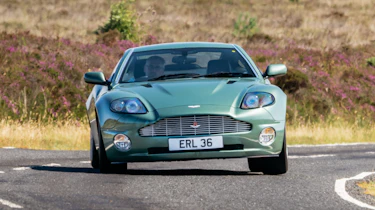
Get too carried away and the Vanquish’s weight and slightly cushioned responses are there to remind you that, while it is many things, a sports car it ain’t. The Vanquish does things its own way – and it’s all the better for it. It is an immensely enjoyable car.
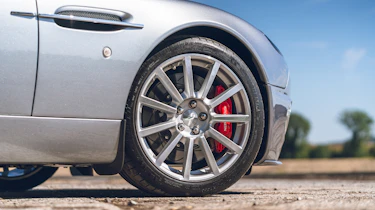
The Vanquish rides well, in a loose-limbed way where more recent Astons feel more tightly tied-down. Sitting on relatively modest (by current standards) 19-inch wheels and wearing tyres that actually have a discernible sidewall (Michelin Pilot Super Sports on this car, 255/40s at the front, 285/40s on the back) certainly helps the secondary ride, too…
Even in the more tightly suspended S, there’s quite a bit of initial give in the suspension as you load it up – considerably more than in a contemporary Vantage or DB9. So it rolls a touch more and doesn’t quite have the same sharpness of response. But this calmness in the ride and the steering is true to its GT nature. And you soon discover that when you push it a little harder you uncover a real depth of composure. Even better, it feels entirely natural as it shimmies its hips at the exit of a corner – everything relayed back to the driver in a rich stream of feedback from both ends of the car.
Among the changes for the S – improved ASM gearshift, that power boost, uprated suspension and quicker steering – were bigger Brembo brakes. Those of the early car were a little marginal, given the weight and performance, but these were a marked improvement.
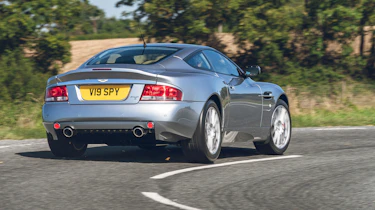
The pedal has a slightly soft initial response that’s somehow in keeping with the rest of the dynamic package – everything slightly cushioned – but again they deliver when needed. This is on the road, of course – if you want an Aston for trackdays, it’s probably fair to say there are better alternatives.
And that’s mainly because despite its largely aluminium construction, the Vanquish was and is a heavy car. Bob Dover later admitted it was built primarily for strength – the same example was used for front, side and rear impact tests – and they didn’t have time to reduce the weight as much as they would have liked. The carbonfibre windscreen frame was there to pass the convertible roll-over test, though Aston didn’t build a convertible in the end. Zagato did, and it looked terrific, but it remained a one-off.
There’s something very noble about the Vanquish. It’s the blue-blooded supercar, a machine that could only have been made in England. There’s just enough of the hand-crafted about it to connect with its Newport Pagnell roots, but at the same time it’s tangibly a giant stride on from the DB7 and the old Virage-based monsters that came before it.
It is the consummate GT. Every time you slip in behind the wheel, you start thinking about road trips: Le Mans, perhaps, or even further afield. And whatever your destination, you’d always take one last lingering look back.
What’s the Aston Martin Vanquish like inside?
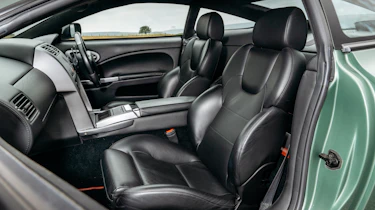
The impression of something hand-tailored continues inside. By the 2006 model year, Aston had banished some of the more jarring details of the early cars – the more obviously borrowed switchgear, for example, now swapped for Vantage/DB9 items – but retained some of the more endearing features, such as the polished aluminium door spars with their AM script.
It all feels a little more bespoke than the Gaydon cars – a reminder that it was the last model largely hand-built in the old factory at Newport Pagnell. Among the details, the pale cream instrument faces are noticeably easier to read than the Gaydon cars’ chronograph-style dials, the revs reading to 7000, the speedo to 200mph…
You do feel like you’re sitting a touch too high though, partly because the instrument binnacle itself is set relatively low to the rest of the fascia. It feels odd at first, but it dissipates the further you drive, helped enormously by the fact that you feel so connected to the car, both through the steering and through your backside.
Aston Martin Vanquish evo Eras test – John Barker
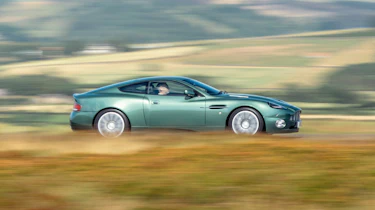
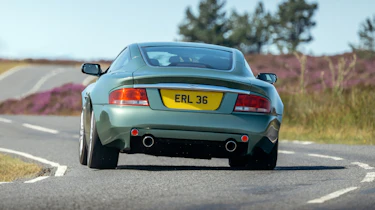
‘It seems amazing that the Vanquish is now 25 years old. It still looks contemporary and I’d argue there hasn’t been a better-looking big Aston since, and while most examples are finished in one of the many shades of silver, this one, belonging to Eric Clark and first owned by Lord Rothermere, is reckoned to be one of only three finished in the DuPont shade of Sage Green.
‘Press the big red start button and the V12 comes to life with a surprisingly gravelly edge. The engine went into lots of models subsequently but sounds rawest in the Vanquish, delivering a rich brogue as it works through the mid-range, en route to a surprisingly keen, wailing 7000rpm top end.
‘Initially, though, the relatively soft edge to the Aston’s responses together with the automated manual temper your enthusiasm. As ever, these gearboxes are great on downshifts but you have to help smooth the upshifts with a lift of the throttle. This soon becomes instinct, and when you pick up the pace the Vanquish shows that it’s a very capable and engaging GT, stringing sequences of bends together with an easy, natural agility and encouraging you to use all the revs.
‘Senior staff writer Yousuf Ashraf and the Vanquish are the same age. ”It’s much calmer than other supercars of its era,” he observes, “so you need to adjust your driving accordingly, but it’s a really rounded package. The engine sounds lovely and is really flexible, but the gearbox dates it. The interior looks and feels pretty old too, like it’s from a decade earlier.”
‘“I lurch between thinking these are a bit unresolved and magnificent,’ says Dickie Meaden, who is twice as old as the Vanquish. “It would have been anachronistic and limiting if Aston had stuck with a manual when Ferrari and others were going to single-clutch paddleshifts. They’re immature tech but I think we can judge them a little more kindly today. As an overall experience I love the Vanquish.”’
Aston Martin Vanquish values and buying guide
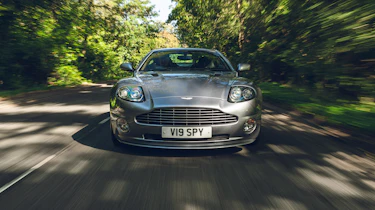
In spite of its relative rarity compared to the more numerous VH cars that followed it, Vanquish prices have been far from buoyant. Some got as low as £30,000 at one point but most are closer to £40,000 now. Examples of the later S – cars with the lowest miles and with works manual conversions – are £70,000-90,000.
A really worthwhile option was the Sports Dynamic Pack, available from 2003, which added uprated suspension and brakes. The general consensus is that upkeep of the Mk1 Vanquish requires a little more effort and expense than the more mainstream cars that followed in its wheeltracks. This shouldn’t come as a surprise, but a comprehensive service history from either a marque specialist or AM itself is essential with the Vanquish, as far back as you can go – owners picking up what they see as a bargain may be less inclined to embark upon money-no-object maintenance.
The Vanquish S, introduced in 2004 (from chassis 1506), incorporated the handling upgrades, along with a new aero package, an improved gearshift and a power increase to 520bhp. ‘The S is a better car,’ says Aston Martin Works boss Paul Spires, ‘but it’s worth noting that an early car can be uprated to what is effectively S specification.’ Works has also converted a number of Vanquishes to manual transmission, using the six-speed Tremec unit from the DB7 GT.
Ideally Vanquishes should be serviced every six months or 7500 miles; if a car’s had anything less than an annual service it should certainly put you on your guard. If in doubt, have your potential purchase inspected. AM Works offers an inspection and road test report. Several of the other Heritage specialists such as Nicholas Mee offer a similar service. It’s possible to buy a warranty, too.
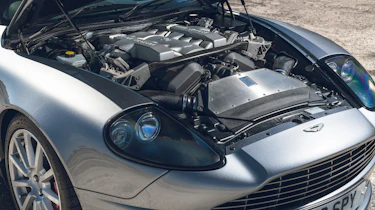
The V12 engine is very strong, and serious faults are rare. The most common problem is with the coil packs, which suffer both from heat damage and occasionally from water ingress causing shorting. It’s an expensive job to replace them, and always best to do a bank at a time. So check the engine pulls cleanly and smoothly. Any misfiring points to problems.
Potentially the most serious issue is oil consumption caused by the engine ingesting its own oil vapour because the reed-type valves in the breather system have stuck open. A low oil level could eventually lead to starved big-end bearings at the back of the engine. So look inside the air filter for a heavy oil deposit; anything more than a light misting could spell trouble.
Don’t be put off by the automated manual – properly set up and driven with a little sensitivity, it’s a decent system. ‘Early cars had analogue gear position sensors, which can wear, which is when you can get problems,’ Spires says. Later cars (chassis 600 onwards) had magnetic sensors, which are much more robust. Most early cars will have had them retrofitted when the clutch has been replaced. The shift has benefited from software updates over the years, too.
Unsurprisingly, clutch wear varies hugely depending on driving style. Clutches can last as few as 15,000 miles or as many as 40,000. On the test drive you’re looking for a nice crisp pull-away and a crisp change, with no slip, no untoward noises and no serious vibrations. A whistling sound as you pull away suggests spigot shaft bearing wear, which is upwards of £2000 to repair; upwards of £5000 if the shaft needs replacing too. A new clutch is upwards of £4000.
The standard brakes aren’t up to track work but are fine for anything but the most extreme road driving. Cross drillings should be cleaned as part of a service; if they’re blocked it can lead to corrosion, particularly on the inner face.
Thanks to the car’s aluminium construction you’re unlikely to find any holes, but minor corrosion can still leave the Vanquish looking untidy, and the one major component that is steel, the front subframe, can succumb to rust.
Aston Martin V12 Vanquish specs
| 2001 V12 Vanquish | 2004 V12 Vanquish S | |
|---|---|---|
| Engine | V12, 5935cc | V12, 5935cc |
| Max power | 460bhp @ 6500rpm | 520bhp @ 7000rpm |
| Max torque | 400lb ft @ 5000rpm | 425lb ft @ 5800rpm |
| Weight | 1835kg (255bhp/ton) | 1875kg (282bhp/ton) |
| 0-60mph | 5sec (claimed) | 4.8sec (claimed) |
| Top speed | 190mph | 201mph |
| Price new | £160,000 in 2001 | £174,000 in 2005 |
| Price today | From £40,000 | From £40,000 |