Lamborghini Murciélago SV (2009-2010) review – Lambo's original V12 went out with a bang
Faster, leaner and more striking than the regular Murciélago, rarity has elevated prices into hypercar territory
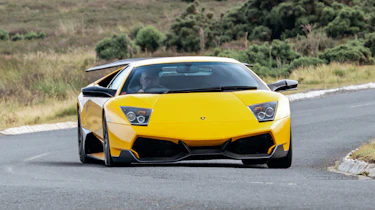
If the styling of the Murciélago of 2001 hinted at a more considered, less outgoing take on Lamborghini under Audi ownership, the LP670-4 SuperVeloce of 2009 (SV for short) showed that not only was Audi giving Lamborghini plenty of control of its own affairs, but that the devil was in the Murciélago all along.
Testing the SV again as part of the evo Eras series was a reminder of just how polished the finished product was, despite its slightly intimidating demeanour. Rarity, meanwhile – under 300 are thought to exist – means that as values of regular Murciélagos have risen, the SV has climbed even higher, some now commanding seven-figure sums. It’s not an accessible Lamborghini then, but it’s become one of the most coveted.
Lamborghini Murciélago SV in detail
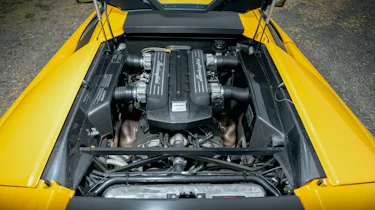
- More power and torque from a 6.5-litre version of the Bizzarrini V12
- Lower weight and greater downforce
- Instantly identifiable from the distinctive SV graphics
Successor to the decade-old Diablo, which had matured nicely under Audi’s patronage, the Murciélago arrived in late 2001 with a neater, smoother but still very Lamborghini look courtesy of designer Luc Donckerwolke. Like the Diablo, the Murciélago was built around a traditional spaceframe chassis but with an enlarged, 6.2-litre, 572bhp evolution of the V12. However, it wasn’t the uplifted outputs that moved the Murciélago on so much as the fact that the engine was now mounted a full 5cm lower, thus lowering the centre of gravity and significantly enhancing the big Lamborghini’s agility.
More reviews
> Best supercars 2026 – The latest dream cars rated and ranked
The V12 started the decade with 572bhp and got stronger, the capacity growing to 6.5 litres to stay one step ahead of the equivalent Ferrari, culminating with the LP670‑4 SV, one of the last cars to use the Giotto Bizzarrini-designed V12. As a 3.5-litre it had powered the first Lamborghini, the 350 GT, in 1964, and it powered every flagship model that followed, from Miura to Countach, Diablo to Murciélago. Over five decades it grew in capacity from 3464cc to 6496cc and power went up from 280bhp to a 661bhp peak. Quite the legacy.
Lamborghini Murciélago SV 2009 review – David Vivian
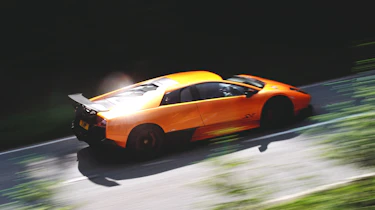
Attending the first drive of the LP670‑4 SV, seasoned road tester David Vivian arrived slightly sceptical, writing that he’d hoped the SV would be rear- rather than four-wheel drive, even lighter, and have a nice, round 700bhp. But after driving it he reckoned it wouldn’t matter if you’d just stepped from an LP640‑4 or a Ferrari 599 because ‘what the SV serves up is altogether more extraordinary, relentless and all-consuming. When it comes to sheer, epic supercar sensation, the Murciélago might be the best there’s ever been':

'Attacking an empty stretch of mountain road in the SV hammers so much immediacy and raw excitement into the usual supercar mix, your heart nearly leaps out of your chest. The noise, the bite, the response, the grip and braking power – all require rapid mental recalibration to make much sense of. Not because they in any way defy the physics of what’s possible given the basic hardware but because they’re delivered with such unfiltered honesty and intensity.
'Both against the clock and subjectively, the SV is a savagely, intimidatingly fast car. Although the shift speed of its e-gear transmission is less slovenly than before, it’s still very far from seamless. Yet, in a strange way that seems entirely in keeping with the SV’s physical, bull-necked character – a double-clutcher would be altogether too smooth and suave for this car, though there’s little doubt the optional (but heavier) six-speed manual gearbox would suit it best of all.
'Below 4700 revs the engine is merely brutal, from there to the 8500rpm red line it’s insane – an electrifying ball of energy that screams the hairs off the back of your neck and thumps the lightened LP to three-figure speeds quicker than you can decide if that’s where you really want to go. If it isn’t, the enormous carbon-ceramic discs can wipe off the speed even more rapidly.
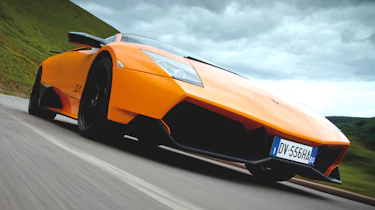
'Corners do little to blunt its charge. What’s perhaps most remarkable about the SV’s chassis is its eagerness to translate even the most fleeting and subtle helm input into meaningful action. You can nuance a cornering line with steering or throttle. And with so much width to place on the road, it’s a revelation that it can be done so accurately. This is the other side to the SV’s character – it feels focused and intimate. The colossal output from the engine is met without contrivance or nerves from the chassis. Just grip, conviction and precision.
> Lamborghini Aventador (2011 - 2022) review: the V12 supercar you can use everyday
'The ride is remarkable, too: ultra firm and biased heavily towards body control over comfort, but it still manages to round-off edges without jinking or jarring. It’s completely oblivious to mid-bend bumps as well. Power oversteer? With the torque split rear-biased it isn’t off the agenda, especially if you stay on the brakes while turning in, but you’d better be quick with the opposite lock. Let it get too out of shape and there’s no way back.'
evo Car of the Year 2009 result – John Barker
‘Fourth goes to the LP670-4 SV, a damned exciting and accomplished supercar that comes with a heavy does of drama in all the important areas – styling, ambience, performance and noise. “What a glorious, unreconstructed, old-school supercar,” says [Ollie] Marriage. And what an effective one, too, inspiring confidence to revel in the sound and fury of the sensational V12.
“Yes, the Noble made it feel clumsy in a couple of areas - you could tell it was a much heavier car, for instance – but what I loved about the SV was its attitude, its sheer OTT-ness. And for me, natural V12 beats turbo V8 every time. At least when it’s done this well.”’
Lamborghini Murciélago SV revisited – John Barker
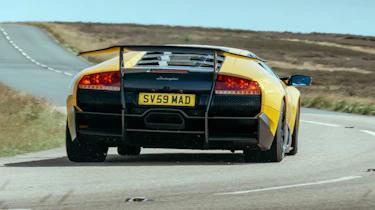
- Grit, menace, and dizzying pace from the highly-strung V12
- Never lets you forget there’s a big V12 dominating the weight balance
- Fixed-back seats are like instruments of torture for most drivers
The Murciélago’s V12 is a proper old-school engine, rich in character. Coming to you on the breeze, the Ferrari’s V12 sounds fabulous, urgent, but the wail of the Lamborghini’s V12 is in a different league, carrying even further with an angrier, grittier edge to it that perfectly complements the SV’s looks. Yet for all its menace and thunder, in terms of fuelling and ignition it’s beautifully mannered, surprisingly polished. It delivers cleanly and mightily whatever the revs, with a mid-range gutsiness to challenge the supercharged V8s in the Ford and Mercedes, and a manic, dizzying, 8500rpm top end like the Ferrari, just a bit stronger. It’s a truly epic engine.
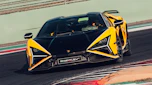
All of this might be enough for you to forgive it for not being that settled on these difficult roads, but you soon discover that the SV rides really well too, so you can carry speed where some others start to feel a bit jostled. Pick up a bit of pace, waggle the steering wheel and it’s pretty obvious where the mass is. (Pantomime style, it’s behind you!) Go for a turn at speed and the SV needs a moment to change tack, for the rear to respond, but it’s very planted on those 330/35 R18 Pirellis. I’ve no doubt that it helps that this car has been through a ground-up rebuild and feels box-fresh, possibly better than new.
The downsides of the SV, for they exist, are two-fold. Number one, its fixed-back carbon seats, which are torturous for 99 out of 100 drivers. If you’re in the remaining one per cent, you’re probably exactly the same size and shape as their designer. Number two is, admittedly, only a downside if you don’t own one, because it’s the ever-escalating sums SVs are fetching.
Driver’s note
‘In terms of dynamics, I don’t know whether the Countach ever really rewards you for the effort you put in. The Diablo from the last test felt weirdly wieldy after the Countaches, and it’s very analogue compared to the Murciélago, but there’s a little bit more delicacy in the way the Murciélago goes down the road, and its paddleshift gearbox also moves things on. I think you can roll your sleeves up and actually explore the Murciélago, feel its balance and work towards its limits and with its weight distribution, and you’re more a part of the process, which I find satisfying.’ – Richard Meaden, editor-at-large.
Values and buying checkpoints
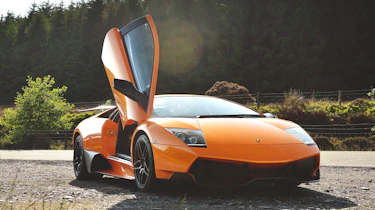
It’s tricky to put a value on an SV. They don’t come up for sale often, and the Murciélago itself has gone stratospheric in recent years, with examples listed for sale in the high £300,000, and upwards of half a million pounds for some cars.
Recent auction results though suggest a car that collectors value on par with some of the 2000s hypercars. An SV sold in Monterey in August 2026 for more than $3.1 million, around £2.4 million, though its sub-1000 mile tally and rare low-wing specification might have contributed. Previous to this the most recent result was $770k with Barrett-Jackson in January 2025, which still isn’t pocket change, at nearly £600k. It’s safe to assume you need seven figures in your back pocket though – four times what an SV was worth a decade ago.
Given their rarity and value it’s safe to assume that most SVs will be in fairly fine fettle, any problems stemming more from them being left to sit in collections of tens or hundreds of other cars. The spectacular Bizzarrini V12 is generally considered very solid, with ancillaries, and the clutch and automated manual transmission more likely to throw up issues. The V12 does consume a little oil though, so regular checks, and top-ups, are recommended.
Specs
| Engine | V12, 6496cc |
|---|---|
| Displacement | 6496cc |
| Max power | 661bhp @ 8000rpm |
| Max torque | 487lb ft @ 6500rpm |
| Weight (kerb) | 1565kg (429bhp/ton) |
| 0-62mph | 3.2sec (claimed) |
| Top speed | 212mph (claimed) |
| Price new (2009) | £221,335 |
| Value now | £1million-plus |