Lamborghini Diablo SV (1995 - 1999) review – the last pure untamed V12 Lambo
Before Audi took over, Lamborghini took the Diablo back to its untamed analogue roots. The SV is an icon of the era
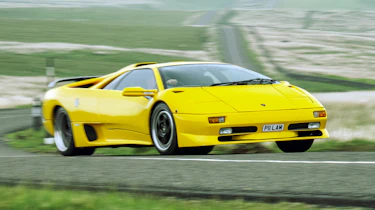
Arriving five years on from the original’s introduction, the Lamborghini Diablo SV of 1995 wound Sant Agata’s flagship supercar back to the analogue, unforgiving roots from which its predecessors grew. With hindsight, it's the perfect middle point between Lamborghini's mad early years – the Miura and Countach – and the polished (but still thrilling) Audi years, from the Murciélago onwards.
Bringing back the Super Veloce badge that was first and last used on the Miura, the SV is arguably the daddy of Diablos. Fewer than 3000 Diablos were produced between 1990 and 2001, of which fewer than 350 were the SV, which was only in production between 1995 and 1999.
Oddly, the SV was actually priced lower than the standard Diablo when new, owing to its reduced complexity and refinement. In recent years, its rarity and specialness has shot it into the collectability stratosphere.
Lamborghini Diablo SV in detail
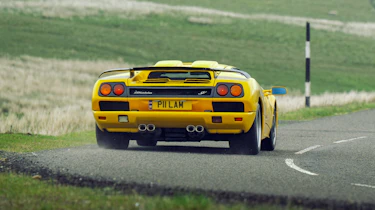
With its roof scoops, split-rim OZ wheels and three-section rear wing above the extended bumper on its curiously squidgy mounts (for US crash regs), the SV looks every inch a poster-worthy supercar.
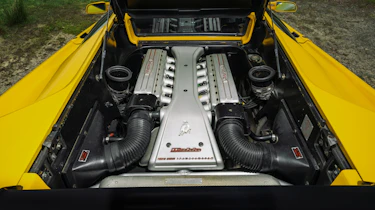
It was purely rear-wheel drive and ditched the VT’s adaptive dampers, helping to cut kerb weight by around 100kg. The 5.7-litre V12’s power was lifted from the VT’s 485bhp to 503bhp, while lower gearing pegged the top speed back to 186mph but made for more in-gear urge.
Approaching it for the first time, the intimidation factor is huge. Limboing under the scissor door and dropping into the Alcantara-trimmed driver’s seat, your hip point couldn’t possibly be lower. Ahead is a gigantic expanse of dashboard, also trimmed entirely in Alcantara, and a long expanse of flat-angled windscreen beyond. Your arms reach upwards for the comparatively high steering column and your feet are slightly shunted over to the left, meeting the closely stacked pedals. This is not a car in which to wear chunky ’90s-era Air Max trainers.
More reviews
Group tests
- Ravage Alpine A110: France's perfect sports car made even more perfect
- Alpine A390 v Hyundai Ioniq 5 N – are these EV crossovers fun as well as fast?
- Ariel Atom 4R v Ariel Nomad 2 – is grip more fun than slip?
- Ariel Atom 4R v Caterham Seven ‘evo25’: power-to-weight heroes go head-to-head
- Audi Quattro, RS2 and RS3: five-cylinder icons head-to-head
- Who makes the best GT car? Aston Martin v Bentley v Maserati
- BMW 230i M Sport v Volkswagen Golf GTI Clubsport
- Caterham Super Seven 600 v Super Seven 2000
- Ferrari Enzo v LaFerrari – analogue hypercar meets its digital successor
- Great Ferrari hypercars driven: 288 GTO, F40, F50 and Enzo head-to-head
In-depth reviews
- Abarth 600e review – electric hot hatch with surprising character
- Alfa Romeo Junior review – small Italian crossover to rival Ford's Puma
- Alpine A110 R (2023 - 2026) review – the flawed but fantastic Porsche Cayman GT4 alternative
- Alpine A390 review – France's flawed rival to the Porsche Macan
- Alpine A110 review – the sports car Lotus should be building
Long term tests
- How lowering the roof on the Abarth 695C is a threat to my driving licence
- Alpina B10: Alpina B10: end of term report
- Alpina B10
- I lived with the 697bhp Aston Martin DBX707, and used values are puzzling me
- The subtle trick that makes Audi’s old interior better than a touch screen
- My Audi S8 can’t make me hate it, even if its safety systems are often terrible
- Living with this £40k Caterham Seven even makes the KFC drive-thru memorable
- Caterham Seven evo Edition revealed – bespoke 420R joins the Fast Fleet
- It has a VW Golf R engine, but the Cupra Leon is quietly old-school
- Cupra Ateca VZN Fast Fleet test – four months with Cupra's hot crossover
Reviews
- Abarth 695 (2012-2024) review – why we’ll miss Italy’s Mini Cooper S rival
- Abarth 500e 2023 review
- AC Cobra 289 review – British sports car with an American V8 heart built to fight Ferrari
- AC Cobra 378 Superblower MkIV 2021 review – another V8 Cobra, but with a GM heart this time
- Acura Integra Type S 2024 review – a Honda Civic Type R with added restraint
- Alfa Romeo 33 Stradale 2025 review – a rare Italian jewel beyond compare
- Alfa Romeo Tonale 2023 review – 276bhp Speciale version tested
Seeing anything behind you is a challenge. Beyond the letterbox rear screen there’s mesh, as if the V12 engine is a dangerous creature in a cage, and the view is further obscured by the ducting from the roof-scoops swooping down into the bay.
Driving the Lamborghini Diablo SV
But here’s the plot twist. Snicking the gearlever through its open gate into first is light, easy. The clutch likewise. The steering wheel has a similarly tiny diameter to the Countach’s but power steering makes the Diablo a doddle to manoeuvre. Three-point turns in earlier Lambos were to be avoided at all costs, but that’s not the case here (though reversing without a spotter is, admittedly, challenging).
Once you’re underway, the Lamborghini’s steering remains light, but it’s positive, measured and accurate, while the gearchange is a baulk-free, tactile joy. The V12 is joyful too. Albeit bored and stroked, the block is essentially the same as in the Countach (and the Miura and 400 GT before that) and it has some of the same sonorous qualities. It’s a smooth, mellow bellow. As the revs build in second and third gear, it feels like catching the swell of a wave and riding it, propelled by a small ocean’s worth of torque.
The front end responds keenly without being darty, and the rear follows faithfully. There’s a lot of grip, partly because there’s so much rubber on the ground (the rear tyres are 335mm wide). I’m sure if you were being gung-ho, the weight of the engine behind you could get you into trouble, and you need to bear in mind there’s no ABS, but nonetheless the Diablo SV is a car that’s on your side. You can really get into a flow with it. On the open, sweetly cambered roads skirting a Scottish loch as we near our final photography spot, I don’t want to stop driving.
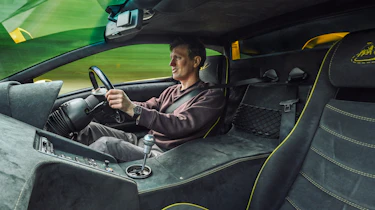
There are downsides, of course. You’re conscious of the Diablo’s width, and aware that you’re at the pointy end of a widening wedge. The mirrors are way outboard on their double stalks, a bit like the extensions a caravan tow-car might wear. The side windows’ unusual shape, plunging downwards at their leading edge, gives a good view of those mirrors, and initially I set the passenger-side one to keep an eye on the distance between the Diablo’s flank and the kerb, until I’ve acclimatised to the width. Eventually you stop breathing in every time there’s a lorry coming the other way and just get stuck in and enjoy it – and get stuck in you can.
I adore driving the SV and it’s undeniably a better car than the Countach in every objective way, though I can’t help but feel some of the older car’s indefinable magic isn’t quite there; for me, the Diablo doesn’t fizz down the road with the same energy, and my heart isn’t beating through my ribcage in quite the same way as it was in the LP400 and QV – though maybe that’s not such a bad thing.
‘It’s the car I wanted the Countach to be, but it never quite was,’ evo editor-at-large Richard Meaden says. ‘I know people revel in that car’s physicality, and I get it, but it diminishes the driving experience, I would say, whereas the Diablo is much wieldier but still has the drama and enough heft and intimidation factor to fulfil the role.’ Yousuf also feels that a pinch of the Countach’s otherworldly presence is missing but agrees: ‘It’s so much easier to drive but still has a lot of the drama. It’s moved the game on in the right way: a lot easier to drive without taking away the good bits.’
Part of the Diablo’s appeal is that there’s a literal and spiritual DNA strand going back to its ancestors. It has been described as the last of the dinosaurs, but the surprise is that it’s a truly adept, rewarding drive. The Diablo SV isn’t always mentioned in the pantheon of great driver’s cars, but maybe it should be.
Values and buying guide
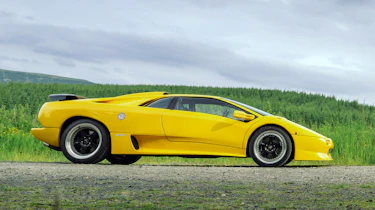
Lamborghini Diablo values languished for a long time but in recent years have taken a jump upwards. As well they should, given how special and comparatively rare these cars are – there are more than four Gallardos and three Aventadors for every Diablo made. It’s also the last ‘pure’ Lamborghini, before Audi took over and in the eyes of some, tamed the raging bull.
The Super Veloce is high up in the pantheon of Diablos, only secondary in value to slightly rarer models like the iconic SE30, the ultra-rare GT that succeeded the SV and the run-out 6-litre version. You’ll struggle to pay less than £400,000 for any Diablo SV example in today’s market, with most priced well over £500,000. It won’t be long before some reach a £1million valuation.
The Diablo isn’t such a four-wheeled blue-chip stock that they’re all perfect. Not yet, at least. These are still old Italian cars that for some time, were at risk of neglect. So you’ll want your chosen car to come with a comprehensive history of maintenance and remedial work.
The Bizzarrini V12 is a hardy thing but can burn oil for a variety of reasons that then require rebuild work, so a car with a recent clean bill of health is best to ease the nerves. As per any old Italian car, electrical gremlins and even rust aren’t out of the question. Needless to say, you’ll want a crystal-clear accident history too…
Specs
| Engine | V12, 5707cc |
|---|---|
| Power | 503bhp @ 6800rpm |
| Torque | 427lb ft @ 5200rpm |
| Weight | 1530kg (334bhp/ton) |
| 0-60mph | 3.9sec |
| Top speed | 186mph |
| Price new | £153,000 (1995), £323,613 (in today's money) |
| Value now | £450,000-plus |