Lamborghini Miura: How the original supercar was willed into existence
Innovative, exotic, motorsport-inspired, impossibly aspirational. There can be almost no doubt, the Miura is the original supercar

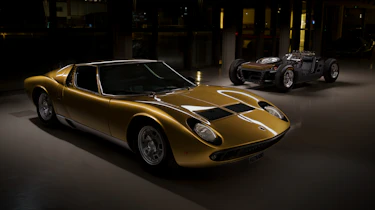
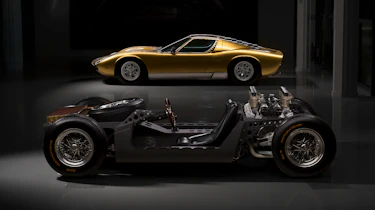
There will always be some debate over who made the first supercar, what the precise definition of a supercar is, and even who coined the term, but it could be reasonably argued that the Turin motor show, November 1965, marked the birth of the supercar as we know it. What appeared on the stand of Automobili Ferruccio Lamborghini SpA wasn’t even a complete car, just a rolling chassis, but it caught everyone’s attention.
Lamborghini was just a couple of years old and had launched just one car, the 350 GT, a high-performance, front-engined V12 tourer designed to compete with Ferrari, but that rolling chassis was so radical and exciting that it quickly became the star of the show, featuring as it did race-car-like construction and a big-capacity V12 engine that was not only mid-mounted but also transversely installed with an integrated gearbox.
The chassis had sprung from the imagination of three remarkably young but key members of the Lamborghini team: technical director Giampaolo Dallara (29), engineering director Paolo Stanzani (29) and chief test driver Bob Wallace (27). They were candid about their motive – they were trying to persuade their boss, Ferruccio, to go racing.
They were also candid about their inspirations, citing the Ford GT40 and the Issigonis Mini, two cars that they considered excelled in their field; the Ford for its general packaging and low height, the Mini for its innovative drivetrain. They couldn’t get their hands on a GT40, but Ferruccio’s wife, Annita, had a Mini that they borrowed and studied extensively.

Despite their youth, Dallara, Stanzani and Wallace already had experience as development engineers, having cut their teeth on the 350 GT. Ferruccio had wanted a high-quality, capable GT, but the tubular chassis of the prototype, the 350 GTV, was too race-car-like. It had been designed by Giotto Bizzarrini, as was its 3.5-litre V12, originally conceived as a 1.5-litre Formula 1 engine.
The young trio set about reconfiguring the car’s Superleggera (Superlight) construction – a skeleton of small tubes clad with panels – to make the 350 GT more accessible, habitable and refined, and reworked the V12 for better tractability and durability.
It’s ironic then, that their next project, the now famous Turin rolling chassis, was very much motorsport-led. Internally known as project L105, the folded steel chassis, peppered with lightweighting holes and weighing in at just 125kg, echoed the tub of the GT40.
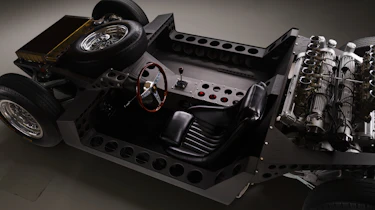
Meanwhile, for this application the V12, already uprated to 3.9 litres for the upcoming 400 GT 2+2, incorporated the five-speed manual gearbox in its main casting with a shared wet sump, the whole unit sitting transversely behind the seats, ensuring that all the major masses were within the wheelbase for a low polar moment of inertia.
In the ’60s, the Emilia-Romagna region was home to a whole host of carrozzeria – coachbuilders – and at the Turin show many of them dropped by the Lamborghini stand, keen to be involved. Legend has it (that’s to say it’s unproven but makes a good story) that Nuccio Bertone appeared towards the end of the show, the last coachbuilder to stop by.
He examined the chassis and told Ferruccio that his studio would design ‘the perfect shoe for this wonderful foot’. An odd turn of phrase, though after a long day wandering the show seeking out new business in a suit and dress shoes, maybe feet was all Nuccio Bertone could think about. That phrase would have sounded better in Italian too, because everything does. Example: ‘quattroporte’ dances on the tongue, whereas ‘four doors’ thuds to the floor like two sacks of spuds.
The most beautiful shoe Bertone did, of course, deliver, via yet another very talented twentysomething Italian destined for great things, the brilliant Marcello Gandini, then just 27. Remarkably, Gandini took what would later be named the Miura from first sketch to finished design in just three months, and when he presented his design to the young team at Lamborghini they saw nothing they wanted to change. When the boss, Ferruccio, saw it he said: ‘With this we enter legendary status.’ And he was so right.
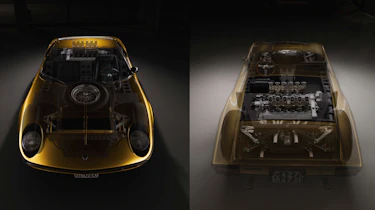
Bertone put in a huge effort and the prototype Miura was completed in time to be displayed on the Bertone stand at the Geneva show in March 1966. It was billed as the Miura P400: P for posteriore, ‘rear’, referencing the V12’s innovative location, and 400 to reflect its near-4‑litre capacity.

The tub, roof, door frames and doors were in steel while the front and rear clamshells were aluminium. Finished in orange, it looked sensational: beautifully proportioned, flowing, dynamic, and rolling on handsome, centre-lock, Campagnolo magnesium alloy wheels.
Ferruccio’s passion for bullfighting, already there in Lamborghini’s raging bull bonnet badge, went further with the Miura. Its name referenced the legendary breeder, Don Eduardo Miura Fernandez, while details such as the pop-up headlamps’ ‘eyelashes’ reflected characteristics of his fighting bulls. Also, when the car is viewed head-on and the frameless doors are wide open, they look like a bull’s horns.
Thanks to Wallace, the 350 GT had gained a reputation for fine handling, and the Miura used the same formula of double wishbones all round and front and rear anti-roll bars, but its weight distribution was naturally more rear-biased, the 1295kg kerb weight of the P400 divided 45:55, front to rear. As you’d expect, with the Miura, Lamborghini claimed the title of the world’s fastest production car, stating that the 350bhp P400 would get to 60mph in 6.7sec and top out at 172mph, bolstering its claim to the title of first supercar.
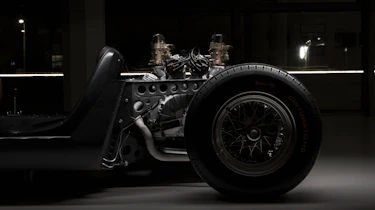
By the mid-’60s, mid-engined competition cars were increasingly common but mid-engined road cars were very rare. Just two preceded the Miura and neither was especially potent. The first was the 1962 René Bonnet Djet, powered by a Renault 8 Gordini engine, the second the 1964 De Tomaso Vallelunga, also powered by an in-line four, this time a pushrod Ford. Neither boasted much more than 100bhp, while the third, the Miura, boasted a 350bhp V12, fully six years before the next 12-cylinder, mid-engined car came along – the flat-12-engined Ferrari 365 GT4 BB (Berlinetta Boxer).
‘The Miura changed the company; everybody was talking about Lamborghini,’ says Walter Rinaldi, who began working in Sant’Agata Bolognese in 1966 and was employee number 120. ‘Everybody came here; they all wanted to see. All the soccer players, all the famous people… Rod Stewart; Little Tony, the Italian singer…’
When he’d been asked at the Geneva show how many Miuras he’d sell, Ferruccio had no idea. Neither did Nuccio Bertone, whose firm would be supplying painted and fully trimmed Miura bodies to Sant’Agata. Independently, both said 50. In fact Lamborghini’s first, rather tentative order was for 15 bodies from Bertone, and orders continued in multiples of 15 for the life of the Miura. A consequence of this small-batch approach was that there was a lot of hand finishing, so the bodywork of two Miuras of the same colour will not be interchangeable.
The whole Miura project had been executed at breakneck speed, from initial thoughts in 1964 to delivering the first customer car on December 29, 1966. As such, early customers became unwitting development drivers, but it’s an illustration of how much people loved the Miura and how much goodwill there was towards the company that very many owners were happy to keep bringing their cars back for reworks and updates. Ferruccio ensured that his customers were well looked after, giving credence to the story that it was the poor service he’d received from Ferrari as a customer that spurred him into becoming a car maker.
‘Out of a workforce of around 175 people, 70 were in customer care and spare parts, and the service workshop had eight ramps,’ recalls Walter, who was responsible for Spare Parts and Purchasing right through until 2009. ‘Customer care was so well made that people queued outside with their cars. They came and then they stayed for holidays, waiting for their car to be ready. All the mechanics were good but the connection you had as a customer with the people that reworked your car was incredible; rich owners, maybe millionaires, would ask for a specific worker.’
Development carried on post-launch, one of the most significant changes being to the chassis. After about 125 cars, the sheet steel was upgraded from 0.9mm to 1.0mm gauge, to the benefit of structural integrity and torsional stiffness, though these days in adverts for the earliest P400 cars you can see this spun as a positive because they’re the lightest models.
There were many detail changes – for instance, you’ll find many fewer lightening holes in the chassis on the later SVs – yet the fundamentals of the car changed little over its lifetime. For the P400 S, power went up to 365bhp, for the SV it went up again, to a claimed 385bhp, with separate engine and gearbox sumps, while the rear wheels and arches were wider and there were no ‘eyelashes’ but, finally, there was air conditioning.
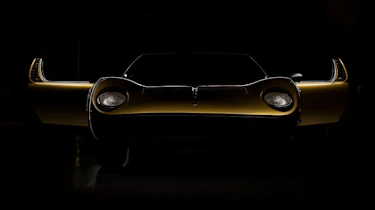
Production ended in 1973 with just 764 made: 256 P400s, 338 P400 Ss and 150 SVs, plus a few specials, most notably Bob Wallace’s pet project, the Jota, the Miura evolved into the race car that the rolling chassis had suggested it could be.
The Jota had a much breathed-on V12 with 440bhp, much bigger wheels and tyres, and its fuel tanks in its broad sills, after the fashion of the GT40. It also had aero, including faired-in fixed headlamps and a roof-mounted aerofoil, but most notably a front air dam that swept up the sides of the nose.
The phrase ‘if it looks right, it probably is right’ doesn’t apply to aerodynamics, and the original Miura, though slippery, had a reputation for nose lift at speed, which the Jota addressed. Although it was created to meet the racing regulations of the day, Ferruccio could not be persuaded and, sadly, the Jota no longer exists; it was destroyed in a road crash soon after being sold in the early ’70s.
Sixty years on, the Miura still causes some enthusiasts to go weak at the knees. It has a strong claim to the title of the most beautiful supercar ever created, yet its designer, Gandini, said his ambition was to break with the tradition of curvy cars. ‘Nobody rejected the Miura,’ he recalled. ‘There was immediate consensus. Even more than it deserved. I was at the beginning of my career and I didn’t have enough autonomy to be able to do exactly what I wanted.’
We found out exactly what he wanted to do in 1973 when the extraordinary Countach was revealed. It was a car that couldn’t be any more different to the Miura, visually, in its layout or in its manner of construction. It was a car that shocked and thrilled. But that’s a story for another issue.
Was the Miura the first supercar, then? The term had been used decades earlier, and elsewhere in this issue you can read – or may already have read – about the cars that preceded the Miura and which might also lay claim to the title. However, what’s undeniable is that after the Miura the term became increasingly commonplace, and when you consider the current definition – low, mid-engined, typically eight cylinders or more – the Miura surely fits the bill better than any other.
Driving the Lamborghini Miura
I’ve never driven a Miura before today. About 15 years ago I had the opportunity but I declined for the reason that I didn’t want to discover that one of the most beautiful cars of all time was awful to drive. You know, don’t meet your heroes, feet of clay and all that.
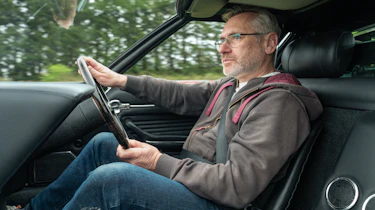
I’d heard tell of its very Italian driving position – the long arms, short legs standard that was still in evidence in some Alfas of the ’80s – and of the tendency for the steering to go worryingly light at speed, and so I’d talked myself out of it. But today’s the day.
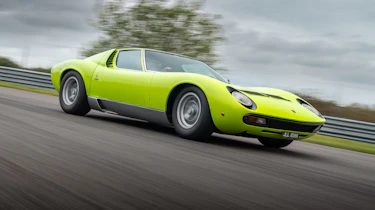
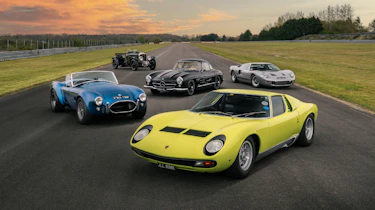
I couldn’t have chosen a more perfect car than Graham Robertson’s lime-green SV. Dropping into the simple, bucket-shaped driver’s seat, the thin rim of the steering wheel is a bit of a stretch, so I ask Graham if the seat adjusts. I ask because the headrests are stuck to the screen between us and the engine.
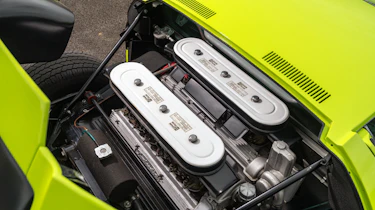
About that; it looks rather like a terrarium, and you can see the top of the exotic creature it houses: the pancake air filter of the V12’s forward bank, almost touching the glass. Seat budged an inch forward, the driving position is spot on, and it’s quite the view in front with the gentle swell of the front arches, and rearward over the engine and through the louvres.
Crack open the throttle a fraction, turn the key, and the V12 comes to life quickly and idles smoothly. Having studied the rolling chassis, one of my concerns is the gearshift: lever and gearbox couldn’t be further apart, the ’box being on the far side of the engine. ‘How’s the gearshift?’ I ask.
‘Not bad,’ says Graham, ‘I was told to treat it like a tractor.’ It’s a little stiff getting into first but once I’ve got the measure of the clutch and heel and toeing, the lever moves around the open gate sweetly. The non-assisted steering quickly sheds its parking speed weightiness too, and the Miura’s nose tacks into turns cleanly and accurately.
It may have 350bhp and weigh the same as a Toyota GR86, but when you squeeze the throttle the Miura doesn’t so much snap forward as gather speed, partly as if there’s an inertia in the complex throttle mechanism that synchronises the opening of the 12 butterfly valves in the four, triple-barrel, downdraft carbs beneath the huge pancake air filters.
It’s a complex, beguiling note from an engine that must be naturally well balanced and refined because it appears to be solidly mounted – it doesn’t seem to move in the mirror – yet there’s no harshness coming through the chassis. It does leave you frazzled after a long motorway journey though, says Graham.
My short ‘taster’ has put to bed most of my fears and left me wanting more. Returning to the muster point, the Ford GT40 is there so I draw alongside it. In profile the similarities are clear, especially the shape of the windscreen, but, surprisingly, the road-going Ford is a much narrower car than the Lamborghini.
It’s also workmanlike where the Miura is polished, the Ford looking like a car designed and detailed by race car engineers, so there are simple pressed vents where needed, and a slightly awkward revised front wheelarch profile where the wing-line has been raised to set the headlamps at the legal height. There’s also none of the fancy trim and, of course, a much simpler interior. It’s an inch lower than the Miura, though, hence the cutaway doors. Overall, the GT40 looks like the development prototype for the Miura, which, in a way, it was.