I lived with the 697bhp Aston Martin DBX707, and used values are puzzling me
We’ve lived with the ‘regular’ DBX, now it’s the turn of the 697bhp range-topper to spend time on our fleet. Will this super-SUV impress as much in daily use at it did on its launch?

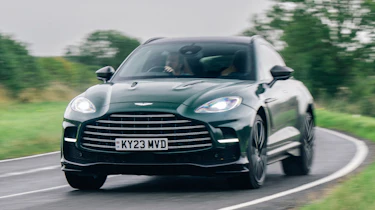
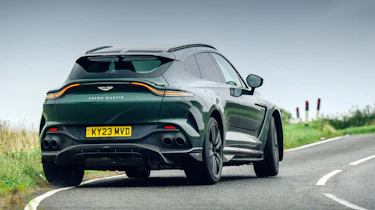
Nearly 10,000 miles in and, while the 707 has become a norm in evo’s life, it still remains a conversation starter for those meeting it for the first time. Primarily this is because it remains a rare sight, although in my small(ish) town ‘mine’ makes up a quartet of DBXs, one of which is also a 707 (satin gold paint, black wheels). But like all new cars in a sector a brand hasn’t been active in before, market penetration still takes time. In the first half of 2023 the DBX accounted for 43 per cent of Aston Martin’s total 2954 vehicles sold; Ferrari expected to sell in the region of 3000 Purosangues each year. Today you can find early 707s for half their original price, which is something that can't be said for its Italian alternative.
As I file this (late) copy our very own Dickie Meaden is discovering just how close, or not, the Ferrari and Aston Martin are in terms of ultra-luxury, high-performance SUVs. While he downs several hundred litres of superunleaded I’ve a few bits of housekeeping to attend to, specifically the not-so-glossy bits of 707 ownership.
> Aston Martin DBX S review – beating the Ferrari Purosangue to the top of the class
More reviews
The front and rear splitters, flicks and wings form an integrated flow of body-meeting add-ons, but the gaps between the trim pieces that make up the extended side sills are ‘sizeable’. It can be attributed to the DBX’s early years: conceived under Andy Palmer, the 707 was created under his replacement Tobias Moers, but delivered to the first customers after he had departed, which meant design, engineering and suppliers probably didn’t know which way the project was going from one day to the next. That the 707 is such a well-rounded, immensely capable and deeply desirable machine is testament to those who brought it to market.
The other required fix concerns something we’ve discussed previously about the DBX: its HMI system. While more recent cars have rectified this, even with familiarity and regular use the unit in our car frustrates. Apple CarPlay becomes your default connection (there’s no Android Auto, sorry) but the Mercedes-supplied system is still too antiquated to get the best from the smartphone-mirroring tech. From the top down, all at AML are aware of this shortcoming, and the fix will provide the DBX’s interior with not only a design uplift but an all-important kick into the 21st century. Until this happens, I’m happy to continue to rely on 700bhp and dynamics to match for entertainment. – evo issue 316
Report four: our super-SUV squares up to a rival in the form of Porsche’s Cayenne Turbo GT
A visitor from Stuttgart for the DBX this month in the shape of the Cayenne Turbo GT, the super-SUV that Porsche sent to its Weissach GT department for a workout in order to show the Brit upstart who produces the best performance SUV. It’s a sector that remains a mystery to many of us, in terms of why manufacturers invest so much to chase performance figures with cars you would never start the process with in the first place. But bills need to be paid, investors rewarded with dividends, high-margin specials funded and, for some, EV ramp-up costs bankrolled.
Yet regardless of how well such machines drive and fulfil their remit – and some of them do so surprisingly well and considerably beyond expectations – they still feel like trying to train a spin bowler to throw down 90mph howitzers, or turning a central defender into a flighty winger. A remarkable achievement if you pull it off but still the answer to a question few asked. I will always struggle with the appeal of an RS Q8 for as long as Audi produces the more practical, quicker, better driving and less ostentatious RS6.
Alongside the DBX707 in evo’s car park, the Porsche certainly doesn’t have the same visual aggression. Closely resembling the regular Cayenne Coupé on which it’s based, it forgoes the aggressive aerodynamic battledress that adorns the Aston. With no jutting diffusers or front-end dive planes, it’s all very subtle by comparison. Better? I’ll let you decide. However, during their time together the DBX started more conversations but only the Cayenne resulted in someone following me and actually asking to buy it. This was when I stopped to try to squeeze in all the flatpack components required to fit-out a utility room – and for those What Car? readers who have picked up evo by accident this month, I can reveal that the DBX swallows considerably more than the Cayenne Coupé.
The Turbo GT’s recent disappearance from Porsche’s configurator following the introduction of the midlife model facelift no doubt had something to do with the purchase offer, so too the struggle to see where the additional £42,000 goes on the Aston – and that’s before options. The Porsche carried an RRP of £147,510 whereas a 707 starts at £190,000 and our car tops out above £200,000.
You don’t need to be using any of the Turbo GT’s 631bhp to understand this Porsche was developed with pure performance in mind. Alcantara smothers every surface, and while the seats aren’t GT3 buckets they are pretty close to them in how they grip and hold you, which all highlights the broader remit the 707 works to as it blends its luxury agenda with its ultimate performance objective. Step from one to the other and the DBX feels like a car you sit on, not in.
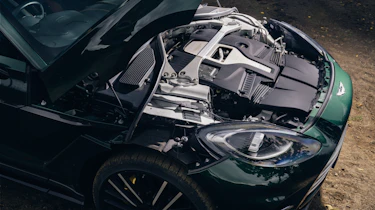
Yet the DBX is the more vocal when you wake its twin-turbo V8, its exhaust note raucous to match its dress code, whereas the Cayenne burbles and prefers to hit you when you’re on the move rather than irritate the neighbours when you’re not.
Despite the DBX707’s 66bhp power advantage over the Cayenne it’s the latter that feels the more highly strung and switched on from the outset. If anything, it never feels switched off. Everything about the Turbo GT has a sharpness about it, from the first moments of the throttle and steering responses, via the solidity that permeates through the chassis regardless of your speed, to an eagerness that tells you that even in its mildest setting it’s a match for the 707 when the Aston is in its higher Sport configuration.
There’s a smoothness and calm in the Aston. Its soothing stride masks the nastiness of poor roads and dull drives, whereas the Porsche feels unable to settle, always engaged and ready to go. This is where the DBX shines, donning its loafers while the Cayenne is unable to ditch its running spikes; the Porsche’s eight-speed auto is always a gear lower regardless of how you’re driving.
Yet when you want to experience all rather than nothing of the Turbo GT’s performance, the pedigree that’s been engineered throughout rises to the top in an instant. It may look like a Cayenne, but the way it drives feels totally bespoke, like no other Cayenne, not even the impressive GTS.
There’s not a millimetre of slack in anything it does. Where the 707 can feel slow to respond, the Turbo GT is already primed. Its engine punches harder, the shifts drive home harder still, and the revs are more than a match for a Black Series AMG V8, never mind the regular M177 that Aston Martin has calibrated for its models. Even in its most extreme Sport+ setting the Aston doesn’t have the responses, directness or togetherness of the Porsche.
What the Cayenne Turbo GT doesn’t have is the DBX707’s suppleness and comfort on longer treks. Ideally you’d want the Turbo GT’s precision injected into the 707’s DNA. A DBX707 AMR would probably do it, and would certainly add to Aston’s bottom line. – evo issue 314
Report three: our DBX laps Silverstone alongside rare and expensive company at the British Grand Prix weekend
Bond was cautious after the camera cars had peeled off the circuit. At the front of the field the pair of Valkyries – a road car and a track-only Pro – had bolted, their vulnerable V12s in need of some fast cooling air after a 40mph lap of filming. Yet for all their downforce and searing speed they couldn’t compete with the riotous pair behind them: a DB3S and DB4 GT Zagato. The former’s disdain for rear tyres could put Jethro’s antics to shame, the latter’s soundtrack was, I’d wager, the best the Silverstone crowd heard throughout the Grand Prix weekend.
But BMT 216A was playing it safe. Along the Hamilton Straight its straight-six was stretched, yet through turn one and the fiddly sequence that follows it took it easy, as you would if you found yourself behind the wheel of a £3.3m asset.
Into Luffield the 2023 Formula 1 Vantage Safety Car was anxty. Its eight-speed ZF was in second, its twin-turbo V8 hovering around the red line. As it entered the old pit straight the revs dropped as third was selected. Now a decision had to be made: stick behind Bond or pass? He went for it, giving the Silver Birch DB5 enough room to avoid its body-tearing wheel spinners, and bolted for Copse. I did the same in the evo DBX707 that had found itself at the pointy end of Aston Martin’s 110th anniversary parade lap.
The Vantage pulled only a small gap on the 707, MVD’s torrent of grunt from its more powerful AMG-sourced V8 not prepared to embarrass itself in front of the Friday-evening crowd. Although I nearly did when forgetting the Safety Car runs a set of sticky Michelin Cup 2 tyres and our Fast Fleeter doesn’t. It meant the entry to Copse was a little brisk, the middle a bit of a mess and the clean(ish) exit a welcome relief. No amount of bribery was going to stop my daughter telling her mother how much fun that was. I’m glad someone enjoyed that particular moment.
Maggotts is fierce from an SUV’s perch, Becketts another opportunity for embarrassment, but with a little more self-control the 707 completed the task before thundering along the Hangar Straight at 130-plus mph.
Stowe is a brake-eater, Vale ready to catch out those who consider it a simple 90-left, and the long right onto the start-finish straight feels the most important corner of the circuit if you want a good lap time. Aston Martin, and certainly not Silverstone, didn’t want any lap records setting though, and before the fun became an insurance claim MVD was heaving for breath and trying to keep cool in the 30-degree ambient temperatures back at AM’s new F1 team campus (not a factory). I think it enjoyed it more than the lap of the M25 it had completed the day before.
Embarrassingly, that lap and a bit of Silverstone was the most exciting thing the DBX and I have done this month. The miles pile on, the glances – the vast majority admiring/positive – continue, and fuel continues to be drunk at a near-unacceptable rate. – evo issue 313
Report two: the 707 is settling in nicely, although its drive modes appear to be missing the obvious targets
Less running in and getting to know you with the DBX707 this month, more hitting the ground running and we’ll come back to the pleasantries at a later date. From within a week or so of collecting our Buckinghamshire Green machine from Gaydon, KY23 MVD hasn’t stopped, but unfortunately they’ve been miles restricted to motorways – and not even ones that lead to anywhere interesting. Monotonous and repetitive at best, utterly forgettable the norm. There are only so many alternative routes you can seek out when confronted with another late-night M25 closure.
Anyway, it has meant that rather than spending time experimenting with the drive modes to find my preferred engine, suspension and gearbox settings to program the individual mode with, I’ve spent it setting up the infotainment system. Which didn’t take long due to the fact the Mercedes-Benz system used by Aston Martin is nearly as old as the company itself.
This won’t be news to anyone, as it’s well-documented how poor the HMI is in Aston’s rather expensive products and further evidence of the challenge faced by those who build as many cars in a year as Mercedes does before the first tea break of each day. Manufacturers are investing huge sums into in-car tech, both the hardware and software, and also the budget to talk endlessly about it. And yet after nearly 4000 miles I haven’t given it a second thought until I came to write this update. The only change I would advocate is a stronger DAB receiver and a wireless CarPlay function, which by all accounts are coming sooner than we might think.
In between squeezing between the kerbs at Heathrow car parks and getting RSI clasping fuel pumps (25mpg on a good run, 19 not unusual), MVD continues to demonstrate the benefits AM’s engineers seized upon in developing a performance SUV built on bespoke platform rather than one supplied by a group and expected to be all things to all brands that use it.
That said, when the 707’s dampers are left in Comfort it feels at its least special, a little normal for a car the team sweated over to elevate from the 542bhp standard example. There’s more movement across the body and it feels too close to an SUV in that it lacks the body control that marks the 707 out when you tighten up the chassis. Select Sport and that tightness is immediate, injecting poise and removing the fidget in the air springs that’s noticeable at low speeds in Comfort. And in Sport there’s no apparent trade-off in ride comfort; if anything I personally think it’s better.
Like our previous DBX, the 707 is sensitive to tyre pressures when it comes to ride quality. The book suggests 41 psi front, 45 psi rear for light loads, but a single psi drop of the 23-inch Pirellis settles the low-speed manners across the board. The factory-recommended pressures I get; Aston needs them as high as possible to help reach emissions targets (although at 323g/km I’m not convinced sacrificing ride quality is making a huge difference). But having the default suspension setting too soft is an odd one to me; I think the majority of customers would prefer the taut Sport setting as the car’s default, to deliver a more settled, reactive and composed experience from the off.
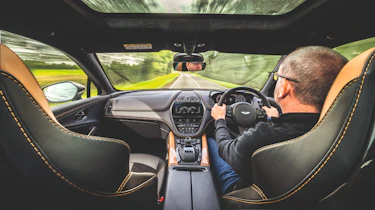
Other observations: I’d like the whole steering wheel to be trimmed in Alcantara rather than part of it (or at least for this to be an option) and the electric tailgate release is inconsistent, sometimes opening at the press of the button on the fob, in the car or on the tailgate, and sometimes merely delatching and requiring human intervention. The former is a genuine First World problem, the latter a problem I need to have looked at. Along with the magazine’s fuel budget. – evo issue 312
Report one: worth the 11 month wait?
It’s fitting that in the issue in which we introduce the first all-new Aston Martin road car to be conceived and developed under the watch of current chairman Lawrence Stroll, we also introduce to evo’s Fast Fleet a model that was originally conceived by his predecessor, Andy Palmer: a DBX, specifically a DBX707.
A recap on the DBX and the 707, should you need one: the DBX is the volume seller designed and developed at the sort of huge expense that Aston could barely afford at the time, but then neither could it afford not to do so. And the 707 is the hyper-luxury, mad-performance model for a market that is still a licence to print money.
In the DBX, Aston Martin created one of the few, if not the only bespoke performance SUV, so it is unencumbered by the limitations of group platforms, while also not being held back by having to live up to a legacy of rock climbing and river wading. And it’s really rather good, a match for contemporary performance estate cars and an ostrich-sized feather in the brand’s cap, highlighting that front-engined GT cars aren’t its only party piece.
However, unlike the ranges of its rivals, the DBX line-up was for some time a rather shallow pool for customers to fish in, the only options being the ‘standard’ 542bhp V8 model and, if you lived in China, a six-cylinder mild-hybrid. For those wanting to trade-in their Lamborghini Urus, Range Rover Sport SVR or even AMG G63, Aston Martin was lacking a comparable ultra-performance SUV offering.
I say ‘was’ because 12 months ago (evo 297) we drove the 697bhp DBX707 and discovered an SUV with a heavyweight punch to make the competition wince. On the sun-drenched launch route around Sardinia, it demonstrated that its bespoke platform was more than up to the task of handling much more of everything. And now we have the opportunity to find out how that translates over six months in the UK, with its dreary weather and appalling roads.
When you’re given the opportunity to spec a new car you don’t have to pay for, there’s a moment – longer actually – that’s tricky to navigate. Do you go crazy and test the PR department’s sense of humour and patience? Do you play it safe and kick yourself come delivery day for being predictable? Or do you go with what you’d select if you had the resources to actually pay for the car yourself? Having played it safe with evo’s original DBX (grey with black – I know, so imaginative…) this time I went with the third option: what would I do were it mine?
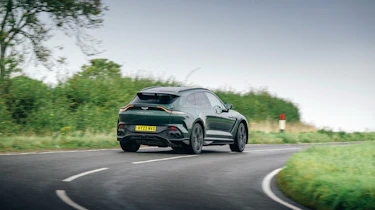
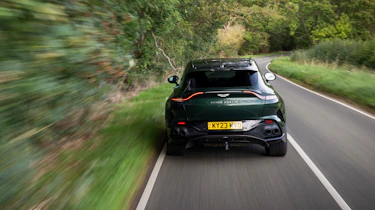
The answer is Buckinghamshire Green paintwork by Q, with a bright satin grille finish as opposed to the dark chrome alternative. Complementing this is an upper and lower body package in gloss 2x2 twill carbonfibre that includes the (sizable) diffuser, side sills, front splitter and side gills. The chrome brightwork is also replaced with black trim.
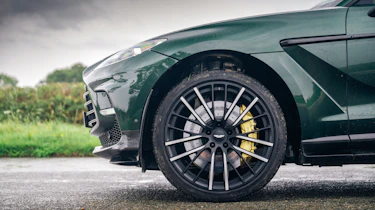
I stuck with the 707’s bespoke 23-inch forged wheel design, which will test the steering damper that was absent from the original 542bhp models at launch and isolates some of the vibration induced by the increased mass of these largest-sized wheels. Bronze-painted brake calipers were to stop the groans of disappointment that red alternatives would elicit from those in the office. Clear glass, black badges and red tail lights completed my ideal specification for the exterior, although someone high-up in Aston vetoed the clear glass and black badges.
Inside is as extroverted as I get. Aston Martin offers a vast array of ‘environments’ in terms of materials and colours; I stuck with the suggested ‘Accelerate – Duotone’ option, with black Alcantara for the seat centres and a combination of black and Oxford Tan leather for the bolsters. And then out went the piano black wood and in came the gloss bronze mesh trim to accompany the carbonfibre and dark chrome for the interior ‘jewellery’, with the stitching matched to the tan leather. After a couple of days of agonising over the details it became apparent that a) I’d be a hopeless new-car collector if I had to spec them and b) too much choice can be a bewildering thing to have.
The wait – 11 months, such is the demand the 707 has created – became increasingly agonising as the collection date approached. But when it finally arrived, even though it coincided with being shown the stunning DB12 at the same time, it was worth every one of those long days. Parked in the sun, green paint glistening, the details pinging, it looked stunning. And the key was finally in my hand. Never has the 150-mile drive home from Gaydon been more rewarding, even if 145 miles of that were on motorways and dual carriageways.
Those first impressions confirmed that away from the launch razzmatazz the DBX707 doesn’t disappoint. Despite the increased performance it is as discreet as its lesser-powered brother. Yet when you call upon it, all the shock and awe that the twin-turbocharged 4-litre V8 forces through the nine-speed auto and to all four corners is all-encompassing. In many of the Aston’s rivals this sensation comes because they feel too big and cumbersome to deal with what is being dealt to them, but the 707 retains the polish and detailed sophistication that made the original DBX such an unexpected and impressive device.
Whether it continues to impress as a performance car, and one wearing an Aston Martin badge at that, we’ll find out over the coming months and (quick) miles. – evo issue 311
| Total mileage | 10,085 |
|---|---|
| Overall mpg | 21.7 |
| Total costs | £0 |
| Purchase price | £223,000 |
| Value today | c£115,000 |