McLaren 570S (2015-2021) review – one of the best-value supercars of the moment
The McLaren 570S was a supercar its maker called a sports car, that set a dynamic benchmark for rivals in its segment
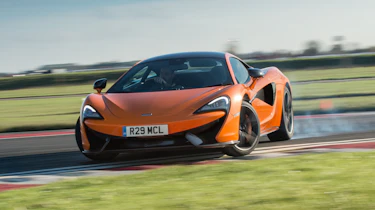
The McLaren 570S was the first model released in the brand’s now-defunct entry-level Sports Series range, which grew out in all directions from the entry-level 540C to the 570S Spider, 570GT and eCoty-winning 600LT. The 570S was the core foundational model and a foil for other junior supercars like the Audi R8, Honda NSX and Lamborghini Huracan, as well as senior sports cars like the Porsche 911 Turbo S and Aston Martin Vantage.
The Sport Series was tasked with more than doubling McLaren’s overall road car output to more than 4300 units per year. That goal with hindsight was a folly because even though it was way off achieving those numbers, McLaren still managed to spook the market with surplus supply to requirements. Quality and reliability concerns have hamstrung used values still further.
There’s no reason to associate the model’s struggles with its technical capability though, as dynamically speaking, the 570S was nothing short of a benchmark, while also being more everyday usable than McLaren’s supercars had been up to that point. If you buy carefully and develop a good relationship with a specialist, a Sports Series McLaren can offer a top-tier supercar experience for BMW M2 money. That sounds mighty appealing in a world where some Ferrari F430s are now clearing the £100,000 mark…
Engine, gearbox and performance
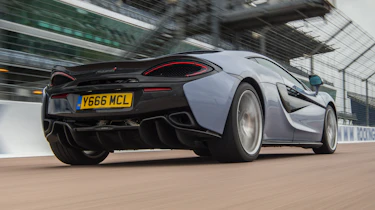
- Basic V8 shared with other McLarens
- Predictably it lacks quite the same eye-widening surge as more powerful applications, or the personality of rivals
- Twin-clutch box is fast and responsive enough, if not class-leading
More reviews
Reviews
- McLaren 620R (2018 – 2020) review – McLaren's ultimate road racer made the 600LT look soft
- McLaren 570S (2012-2022) review - alert, engaging, better than an Audi R8?
- Litchfield McLaren 570GT review – UK tuner lifts output to 720bhp
- McLaren 570GT Sport Pack review – the best of both worlds
- McLaren 570S Spider 2017 review - has the roadster got the Sports Series sparkle? (video)
The 570S used the same Ricardo-sourced twin-turbo V8 that served throughout the McLaren line-up – right up to the P1 GTR. Compared to the V8 in its big brother at the time, the 650S, the engine featured 30 percent different components with new internals and valve gear.

In this application, it’s rated at 562bhp at 7500rpm and 443lb ft from 5000rpm – some way down on the old 650S’s (641bhp and 500lb ft), but keeps the same high 8000rpm redline and linear torque curve. The flat-plane crank V8 uses a dry sump lubrication system.
The gearbox is the familiar seven-speed twin clutch unit, or Seamless Shift Gearbox in McLaren speak, driving the rear wheels through an open differential. The engine and gearbox can be switched from Normal mode into Sport or Track to improve response and cut shift times. The 570S manages 0-62mph in 3.2 seconds and has a top speed of 204mph.
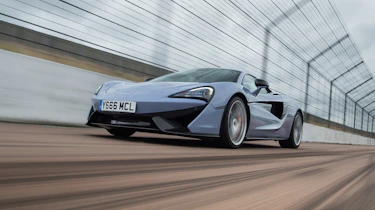
That 562bhp has a very predictable effect on 1400kg of McLaren. The 570S is still a very fast car but perhaps predictably never quite manages to deliver the breathtaking hit of a 650S or 720S. It also doesn’t quite match the industrial slingshot effect of the much torquier 911 Turbo S, but few things do. The 8500rpm red line gives the engine a crescendo that was mostly alien to turbocharged cars until it came along, which seems like reasonable payback for the slightly dull throttle response below 3500rpm.

That’s only really an issue when exiting very tight corners – it’s frustrating to feel that lag when you want to balance the car under power at corner exit – because from halfway around the rev-counter onwards, throttle response is very sharp. Fitted with the optional sports exhaust, the 570S does sound pretty potent from the outside, but from within the cabin the note is rather uninspiring.
The familiar Seamless Shift Gearbox, meanwhile, wasn’t the leader of the pack for outright for shift-times at the time, but there’s plenty enough response and immediacy between the ratios to be getting on with.
Ride and handling
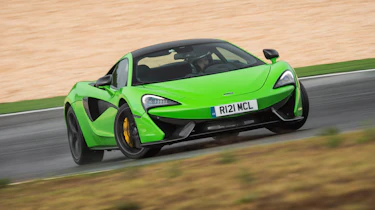
- The 570S was a class-leader in terms of ride and body control
- The brakes require getting used to and are only at their best when being pushed
- Likewise the steering, while feelsome, is at its best when properly loaded
Like all McLarens, the 570S is built around a very light, stiff carbon fibre tub. Called MonoCell II, the chassis is similar to that of the 650S but adapted to improve access to the cabin with 80mm trimmed out of the sill height. It was billed as an everyday sports car rather than an occasional-use supercar, after all. The tub was also 5kg lighter, weighing just 75kg. McLaren claimed a 25 per cent higher stiffness to an equivalent aluminium structure. Front and rear subframes, made from aluminium, carry the drivetrain and suspension components.
The 570S’s dry weight, with certain lightweight options, was quoted at 1313kg – add another 100kg or so for a kerb weight. That figure undercut the 991 Porsche 911 Turbo S by some 227kg and the Audi R8 Performance by 282kg.
That’s a seriously impressive figure for the class, thanks in large part to its carbon construction and the omission of the hydraulic systems of its Super Series siblings. Indeed the 570S used conventional anti-roll bars rather than the complex ProActive Chassis Control system that defined high-end McLarens. The simpler, cheaper anti-roll bar solution differentiated the 570S as the entry-level model and aided its competitive price positioning.
The 570S uses double wishbones all round with three-way adaptive dampers, offering Normal, Sport and Track modes to reflect the powertrain options. In 2017, McLaren released an optional track pack for the 570S which combined a selection of lightweight options and the 570GT's rear lip spoiler together. The 570 family also went without the hydraulic active aero of the super series cars.
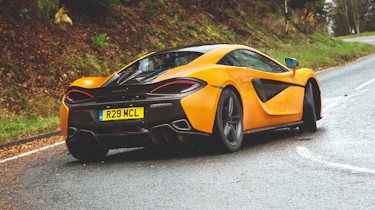
What first stands out on the road is the impressively pliant and relaxed ride quality. In Normal mode the 570S is hugely comfortable, both around town and on the motorway, with none of the crashiness that you might expect of a car with such dynamic ability.
The 570S has the sweetest chassis of any car in this class. Ramp the handling and powertrain modes up to Sport and the 570S becomes a responsive, agile and rewarding car. That impressive ride quality translates into suppleness when you push a little harder, so the car rides over bumps without being thrown off course and lands with real control into compressions.

The clever bit is that the body always remains tautly controlled, never feeling as though that pliant setup has been achieved simply by winding off the spring rates. The 570S is never anything less than alert and agile. On turn in the front axle grips hard and the car resists roll, so it feels urgent and precise into a corner. The steering is also crisp and direct, with a strong sense of connection to the front axle once the chassis has been loaded up. At corner exit, the car finds good traction despite the lack of a limited slip differential.
With the ESC system knocked back to its Dynamic setting you can also revel in the chassis’ natural balance, applying the throttle confidently and early to provoke the rear axle into swinging around progressively. The 570S was the most playful McLaren yet at its launch – by design a much more playful car than a 650S – and that makes it more fun on a twisting road. Much of that is down to its more progressive, less critical transition from grip to slip.
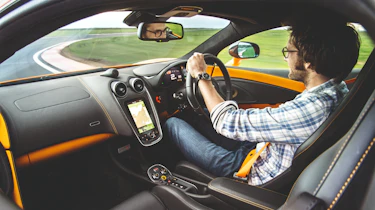
Darren Goddard, head of vehicle engineering for McLaren at the time, told us that ‘the whole dynamics brief for this car was around making it more engaging at lower speeds. So it’s not all about lots of downforce on the track; it’s not all about how fast a lap time can be. It’s about making the car more useable and more fun.’

The standard-fit carbon ceramic brakes – with 394mm discs and six-piston calipers across the front axle – return very forceful retardation, though the brake pedal itself remains defiantly lifeless until you apply full pressure.
The Track Pack saves a further 25kg, thanks to the lightweight seats and trim, as well as the attractive wheels. McLaren quotes a dry weight of 1313kg. The rear wing, still integrated into the bodywork and unique to the Track Pack, rises 12mm higher than the item on the standard 570S. It adds 29kg of downforce at 150mph, says McLaren.
Dynamically, the Track Pack feels exactly like the 570S, which is to say a class leader of the day. The seating position is just about perfect and the fixed back buckets seats give supreme support in cornering. Far from being a focused, one-trick pony the Track Pack is actually very approachable in regular use with good long distance refinement and plenty of cabin and stowage space. It’s also enjoyable to drive at moderate speeds with its evocative seating position and tactile steering.
evo Car of the Year 2016 result – Dan Prosser
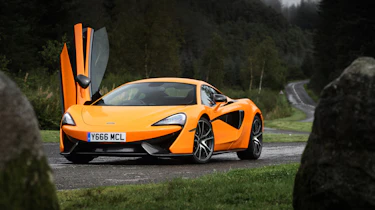
‘The first step on the podium goes to the McLaren. Towler and I both rank the agile supercar in the runner-up position, while Gallagher and Trott each score it third.
‘“The 570S feels entirely like a McLaren, nothing else, and given the short history of McLaren Automotive I think that's a real achievement,” says Towler. “It rides really well and the sensation of it pivoting somewhere underneath the driver's seat is exquisite.

‘“Four mid-engined supercars entered evo Car of the Year,” adds Gallagher, “but one had lapped the rest of the field by the end of the first day. The McLaren is the benchmark in this sector for me.”
‘The McLaren wasn't universally adored, though, with Henry ranking it just eighth in his list. “I love the pace that I can carry into corners with it and how late the 570S gives me the confidence to brake,” he notes, “but without a truly involving engine it leaves me just a bit cold.”'
evo Track car of the Year 2018 test – Richard Meaden
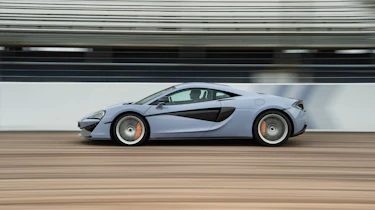
‘The McLaren is defined by its torquey, turbocharged engine and hugely grippy and somewhat prescriptive dynamics. It feels gobsmackingly quick out of the corners and carries tremendous speed into and through them. It’s ultra-precise and asks for modest steering inputs, thanks to its nailed-down nose and fine balance.
‘You can sense the electronics keeping it poised, even in Track mode, when you feel the ESC nibbling away. The lack of a limited-slip differential helps keep the nose pointy, but it does mean the Brake Steer and ESC are kept busy. Disabling ESC remains far too fiddly – McLaren, please address this in your next-generation cars.
‘There’s no question the 570S encourages commitment, and its composure is truly breathtaking, but there’s something about the way it delivers its best and demands to be driven that leaves all of us feeling like we’re still missing out on a fine but vital layer of engagement and excitement.’
What’s the interior like and is the tech any good?
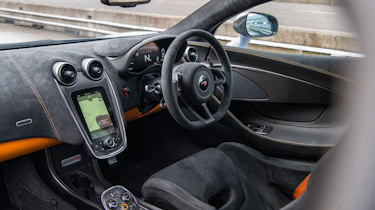
This car would be no more taxing in daily use than an Audi R8 or Porsche 911 Turbo apart from the fact that, despite the reprofiled carbon tub, it’s still a slightly tricky car to get into and out of.
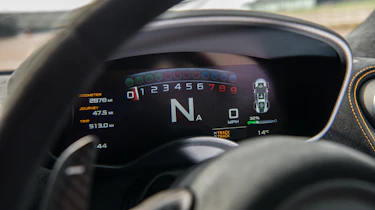
There’s an airier feel than in a 650S or 12C owing to the lack of that tunnel that flows down between drive and passenger in the more senior supercars. In the 570S, the infotainment binnacle drops more sharply. It was also the first McLaren after the P1 to adopt a fully digital instrument display, with differing display settings, including a P1-style width-spanning tacho, depending on the mode you’re in.
The cabin quality is good for the most part – although the satellite navigation did frequently confuse itself. The 570S didn’t escape McLaren’s infotainment issues and its history of glitchiness.
McLaren offered Sport and Luxury trim levels for the cabin. The optional sports seats offer superb support in hard driving, but they’re also perfectly comfortable over a long journey. The track pack made the P1-style fixed bucket seats standard and they’re fantastic – comfortable and supportive in equal measure. The only downside is they do make ingress to the cabin a little awkward. Drivers with larger thighs might find them too tight too.
MPG and running costs
The 570S, like all McLarens, is a mixed bag when it comes to running costs. We’ll get to reliability in the buying guide and cover the day-to-day stuff here. The good is that the 570S, like almost all McLarens, is capable of surprising frugality, able to return upwards of 30mpg on long motorway runs.
That, along with a reduced rate of tyre use if you’re sympathetic by comparison to say, a 911 Turbo S, can in part be attributed to its low weight. Buy an example registered after April 2017 and it won’t cost the Earth to tax, either.
Now the bad. Beware of those brakes. All 570s came with carbon discs, which will be pricey to replace. Being a proper supercar means supercar servicing costs, in terms of parts and hourly rates. Happily, specialists like V-Engineering and Thorney Motorsport are every bit as capable with these cars (if not more) as a main dealer, and more affordable too.
Values and buying guide

As above, you won’t want for expertise when it comes to looking after a 570S. In fact, we’d advise buying a car via one of these specialists, that’s been able to inspect the car first, as they can have more than their fair share of issues.
The Sports Series cars specifically are especially prone to cracked door hinges and alloy bodywork electrolysis leading to bubbling paint. Avoid tuned cars and listen for a ticking sound that lingers for more than a few seconds after the car is started. A top-end rebuild for the V8 engine can cost between £8000 and £15,000, while the gearboxes, which can exhibit fluid leaks indicating a worn input shaft bearing, cost around £10,000 to rebuild.
In our comprehensive McLaren buying guide the main piece of advice is thus: don’t scrape the bottom of the barrel where price is concerned. The bottom of the barrel for Sports Series McLarens is now below £60,000 and you’re far better off getting a verifiably healthier, inspected car at above £70,000. That’s still less than what you’ll pay for a new BMW M2.
Carbonfibre addenda increases resale appeal, with individually specified options and packages. One example is the Carbon Fibre Exterior Pack 2, which includes aero blades, side skirts and a diffuser, all made from carbonfibre, which added almost £10k to the bottom line. Likewise the carbonfibre interior pack, which was £5000 at the time. We wouldn’t be without the sports seats in a 570S either.
The security pack is a nice thing to have, costing £4000 when new, it included vehicle lift, front and rear parking sensors and a rear-view camera, making the 570S easier to live with, especially in urban environments.
The alternatives are similarly priced, admittedly. Porsche 911 Turbos and Audi R8s from the same era are in the £50,000-£100,000 range, while a Lamborghini Huracán can’t be had for much less than £130,000 at the time of writing. As a driver’s car, the McLaren clears them all with ease, even if the V8 isn’t a patch on the Lambo and Audi’s V10 for personality and panache. That 600LTs have finally taken a leap upwards in price also highlights the value proposition in a 570.
Specs
| Engine | V8, 3799cc, twin-turbo |
|---|---|
| Power | 562bhp @ 7500rpm |
| Torque | 443lb ft @ 5000-6500rpm |
| Weight | 1313kg (dry, 435bhp/ton) |
| 0-62mph | 3.2sec (claimed) |
| Top speed | 204mph (claimed) |
| Price new | £143,250 (2015) |
| Value now | From £60,000 |