New Porsche Boxster EV prototype review – impressive, but will it sell?
A drive in the electric Boxster reveals Porsche has made an impressive electric sports car
You may recall a decade or so ago, one of the hottest conversation topics in the food industry was the then-new Impossible Burger. Its aim – like its Beyond Burger rival – was to convince carnivorous foodies to swap beef for plant-based patties so close in taste and character to the real thing that they would brown in cooking and ‘bleed’ when rare.
Could this be the Impossible Sports Car? The new Porsche 718 Boxster – to be officially revealed in early 2027 – is a purely battery-powered successor to the Boxster we know and love. As it enters its final development stage, we’re joining prototype testing in Mallorca, in the passenger seat on the road and behind the wheel on track. It’s a single-motor, rear-wheel-drive car and we’re about to discover it has its own equivalents to faux blood and real-meat texture: a facsimile of a flat-six engine noise, artificial gearchanges and a handling balance as close as possible to the previous petrol Boxster’s.
Porsche Boxster EV prototype in detail
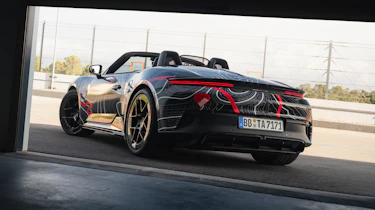
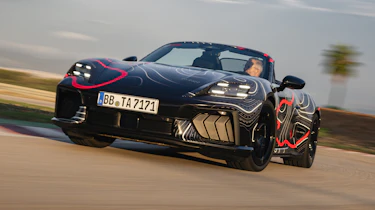
Our first glimpse of the new, 983-generation Boxster is underground, in a private car park in Palma. There’s a bevy of Boxster prototypes here, kept away from prying eyes. Our driver will be Frank Moser, vice president for the 718 and 911 model lines at Porsche. This car no doubt occupies rather a lot of his time and his thoughts.
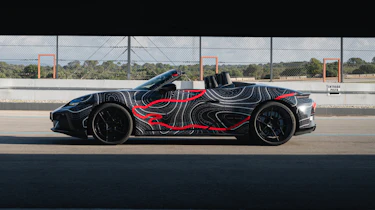
Graphic decals and black paint disguise the new car’s lines, and the Porsche badges are blanked off, but it’s instantly recognisable as a Boxster. Overall the shape is similar to its predecessor, with sharper, more modern details. Moser isn’t disclosing any numbers relating to the 983 just yet, including dimensions, but it is ‘a little bit wider’ than the old 982, with a longer wheelbase.
More reviews
So far, prototypes have covered nearly 2.5 million miles of testing in more than 20 countries. The hardware is finalised and the remaining work is mostly on software. Final fine-tuning touches will likely be signed off following ice testing in Sweden in the new year.
As we climb aboard, another prototype drives past. It emits not a whir but a sound very much like a traditional Porsche flat-six, light ‘exhaust’ crackles on the overrun and all. Interesting. It’s quite a drop into the low-set passenger seat, just like in the 982. In fact, it feels very much like we’re sitting in the old car. Some of the interior is covered by shrouds but the seating position and general architecture feel very similar, with decent space for two tall-ish occupants.
Immediately behind the seats there’s a slight bulge in the bulkhead. Moser explains that’s where the 800V battery is positioned. It’s roughly where the engine was in the ICE Boxster, for a traditional mid-engined balance – weight distribution is 40:60 front-to-rear – and that low seating position. Porsche calls the layout E-Core, with the battery a partially stressed chassis component. The 983 is the company’s stiffest ever convertible road car.
The platform is a redevelopment of the previous 718’s, now sharing more components with the 911. The front structure is similar to the old car’s, with MacPherson strut suspension, while the rear is all new, using elements from the current 911 Carrera GTS, including its rear-wheel-steering system – a first for the Boxster. The power steering is also from the 911 GTS, while the e-motor is related to the Macan’s.
Riding the Porsche Boxster EV prototype
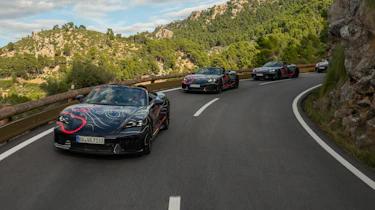
We get underway in comparative silence, barring the natural whir of the motor and muted tyre noise. The 983 can be driven with this natural accompaniment or with selectable propulsion sounds. The first is the sci-fi-esque E‑Sound – toggled by a switch on the dash where you’d find the sport exhaust button in older Porsches – with two settings: Sport, or bassier Sport Plus.

Moser mentions finalising the sound was a long process, blending elements from the Taycan and electric Macan. The party piece, however, is the separate E‑Shift mode, with artificial gearchanges as recently applied in the Taycan E-Shift. When it’s selected, what sounds an awful lot like a petrol flat-six comes to life. The sound is based on that of the 4-litre naturally aspirated engine in the previous 718 GTS. There are speakers front and rear, with around 80 per cent of the sound from the rear speaker outside the car, for an experience as similar as possible to a conventional mid-engined car.
It’s the product of countless recordings of the 4-litre in all manner of other scenarios, but it’s not an audio playback; the sound is generated in real time, linked to the load upon the motor and the level of acceleration, deceleration and regenerative braking. It’s infinitely more realistic than the similar tool in Hyundai’s Ioniq 5 N and 6 N models, though it still has an inescapably synthetic character.
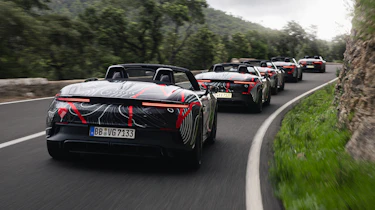
It reminds me a little of the sound you’d hear in a high-level computer game or simulator, but it does correspond exactly to what the car is doing, and feels very natural as a result. The sound changes with the driving modes too, emitting more of an ‘exhaust’ burble in Sport mode, as the 4-litre did in real life.
E-Shift’s virtual gears emulate a seven-speed PDK transmission, but the ‘ratios’ are shorter than in the old car, so the perennial criticism of the Boxster being overgeared no longer applies. The real, physical transmission is single-speed rather than the two-speed gearbox in the Taycan, to save weight and space, and because the Boxster is not chasing headline acceleration figures. Nonetheless, it feels pretty seriously quick. Now out in the hills, on sparsely trafficked, winding roads, Moser demonstrates a little of the performance. Acceleration is impressive, and lateral grip likewise, the 983 appearing responsive yet stable and composed.
Out of E-Shift mode, the paddles are instead used to toggle three stages of energy recuperation. As the 983 is more powerful than its predecessor, the brakes (also shared with the 911) are bigger than before. Carbon-ceramics are an option. Initial deceleration is always by motor regen; only when its limit is exceeded do the ‘real’ brakes come into play, with the handover seamless.
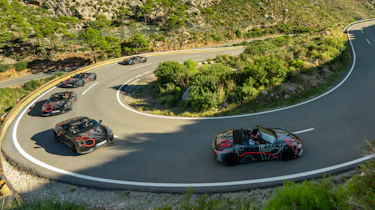
There have been rumours and conjecture the 983 would be a hybrid but Moser says the all-electric route was decided upon early on: ‘Plug-in hybrid [powertrain] would be very heavy; we decided to go for an EV. At that time, transformation to EV was a little ahead,’ he smiles. Would Porsche have still made the decision to go fully electric had it known how market conditions would be today? The supply/demand ratio for EVs, though growing, doesn’t make for encouraging reading currently, and market conditions around the world are as volatile as they are unpredictable. Another wry smile: ‘Perhaps we would have done something different.’
He adds, however, that it was the right decision at the time. The transition to electric was approaching at apparent full pace when the car was signed off, and Porsche had to commit. Would there have been a market for an ICE-powered successor instead? ‘Yes, I think there would,’ he replies. The electric Boxster will launch into, essentially, a market of one in 2027, though it will be joined later by Alpine’s electric A110. MG’s Cyberster is the only electric roadster out there currently but it’s a different kind of product, its modest sales secondary to its brand-building mission.
We pull into the entrance of the twisty Llucmajor circuit, south of Palma. Porsche is not quoting figures for the 983’s battery capacity or range; however, the battery has dropped from around 100 per cent at departure to 73 on arrival. Given we’ve been travelling for around two and a half hours, on everything from urban streets to mountain roads to dual carriageways, that suggests a reasonably usable range. ‘We had to find the sweet spot between acceptable range and low weight,’ Moser says. ‘We don’t want to be the world champions in range for this car. It has to be agile – it’s a Boxster.’
Driving the Porsche Boxster EV prototype on track
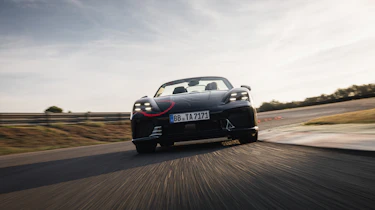
Now I’ll have the chance to find out myself for four laps, following Le Mans winner Timo Bernhard in a 911 GTS pace car. Acceleration feels closer to that of a supercar than a sports car. Porsche will not disclose power figures, sufficing to say it is ‘the most powerful 718 of all time’, so it exceeds the GT4 RS’s 493bhp. For top variants, 0-62mph will be achievable ‘in under three seconds’ and top speed will be ‘more than 155mph’.
Kerb weight too is ‘in line with’ the current 911 range, so we can assume between 1500 and 1800kg; a source close to the project suggests 1700kg. Though it does feel heavier than the old car, agility is thoroughly impressive. The 983 has very good front-end response, changes direction smartly, is stable under braking, and faithful in its responses. Brake feel is excellent too, especially given the car is blending motor deceleration with conventional brakes. Deliberately varying the amount of pressure on the pedal at different stages to see how it responds, it always feels natural.
I’m in Sport Plus mode, with the adaptive dampers in their stiffest setting. It feels like there’s more ultimate grip than evo’s old Boxster GTS 4.0 long-term test car (the 983’s newly developed Pirelli P Zero R tyres are wider than its predecessor’s), both laterally and longitudinally, however it still has very similar handling characteristics. That’s with everything switched on; after a couple of laps, I switch the ESC to its partway-off Sport mode, which allows a good deal of freedom. With so much torque on tap, it wags its tail more readily than the 982, and when on the next lap I switch everything off, it needs much faster hands to catch a slide before it develops than in the older car. Still, the 983 prototype is a controllable car you can quickly build trust and rapport with.
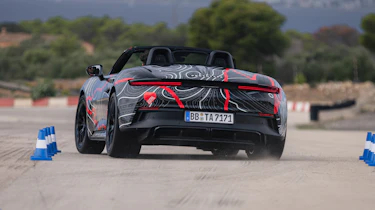
I began the laps with the E-Shift switched on, and the ‘gears’ in auto mode. The shifts are exactly where and when you want them, with downshifts accompanied by an incongruous blip of ‘revs.’ In manual it feels uncannily similar to a real PDK ’box, including a false limiter if you hit the redline. An Impossible Burger gimmick? Perhaps, but it does make driving at the limit feel easier and more natural. Where the engine sound felt synthetic on the road, on track at higher speed it feels more natural and really is helpful for context to gauge speed and braking distances.
I switch to the E-Sound too, which is also helpful for context but a much more unusual sound than the placebo-effect engine. The sustained rush of acceleration is actually slightly more dramatic without the punctuation marks of the simulated gearshifts. I also try half a lap of so with no sound at all save the natural sounds of the motor and tyre rush, which is curiously dramatic too and actually rather fun, but also does make the acceleration more disorienting. The extra context of the propulsion sound when driving towards the limit is useful.
Perhaps the most important question: am I having fun? Yes, I really am. Having a ball, in fact. With a caveat: I think I’d be having even more fun in the old 4.0 GTS but that’s a high bar, and this 983 is a great entertainer in its own right. All too soon, the session and our time with the prototype is over.
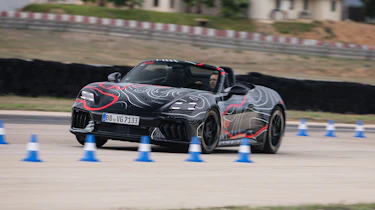
First impressions crystalise on the cool-down lap back to the pits. It definitely does feel heavier than the old Boxster but it doesn’t feel like a huge increase. Handling balance is intuitive and similar in feel to the old car. With everything switched off, you do need to be mindful of the extra hit of torque – the old car would take bigger throttle inputs before it would break away, whereas this does it more readily.
With the stability control switched on, it’s so stable, and so unobtrusive in its operation, that it almost lulls you into a false sense of security. With the systems on, I went flat out through a long right-hander which followed a hairpin and felt the car’s attitude being subtly trimmed by the brakes and the power being gently quelled; on another lap, with everything switched off, it very much was not possible to take it flat without a slide. I’m glad the Boxster has remained rear-wheel-drive rather than becoming all-wheel-drive; I think the latter would have changed its essential character, whereas the 983 really does retain a lot of the dynamic personality of the 982.
‘Two-door sports cars are the heart of Porsche; they are very important,’ Frank Moser says, acknowledging that both existing customers and potential new ones may be sceptical. ‘I think they need to drive the car [to decide].’ It’s been a brief spell in the driver’s seat but on this first taste, this all-electric sports car is a genuinely appetising recipe.