Red Bull RB17 – the 15,000rpm track hypercar that will beat F1 cars… sometimes
Red Bull’s rival to the Aston Martin Valkyrie AMR Pro, Pagani Huayra R and GMA T.50S Niki Lauda goes to the ultimate extreme
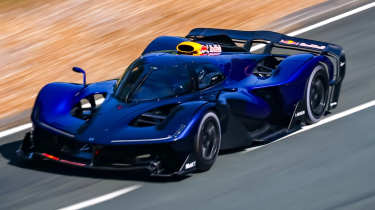
We’ve heard it before, haven’t we? A hypercar that puts ‘Formula 1 performance’ in the hands of mere mortals (albeit very wealthy ones). The last car with this brief was the Aston Martin Valkyrie, and a staggering technical achievement though it is, a fraught development process meant it fell short of its stratospheric initial targets. Now though, the Red Bull RB17 is said to make it all a reality.
This car is the true full expression of Adrian Newey’s and Red Bull Advanced Technologies’ engineering and design vision, unrestricted by road or race regulations. The Aston Martin Valkyrie AMR Pro, Pagani Huayra R and GMA T.50S have a serious rival on their hands. Here’s everything you need to know about the Red Bull RB17, including insights from Red Bull technical director Rob Grey.
Red Bull RB17 – engine and gearbox
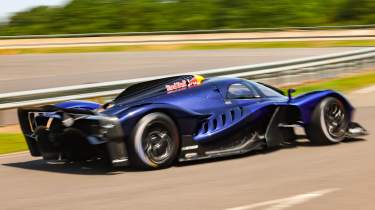
At its core, bolted directly to its carbonfibre chassis, behind its two-seat cockpit is the 15,000rpm Cosworth-developed 4.5-litre V10 serving as a semi-stressed part of the structure. With the aid of a 197bhp electric motor, peak power is rated at more than 1184bhp, with drive sent to the rear through a six-speed sequential gearbox (the e-motor takes care of reverse), with new software to manage the transmission and reduce gear teeth wear. The top speed is over 217mph.
> Cosworth's secret: behind the scenes at the firm behind Bugatti, Aston Martin and F1 engines
It’s also durable enough to run a 24 hour race without servicing. The engine could be good for a higher redline, however Red Bull deemed the extra 5000rpm that would have it matching old F1 V10s not worth the sacrifice in reliability and ease of use. This engine has been designed to avoid the need for numerous personnel in a pit garage just to get it fired up and last 20- to 30-times longer than the Silverstone Grand Prix’s 300km race distance, or more than the record race distance for a Le Mans 24 Hours, between major services, let alone rebuilds. Scheduled maintenance will be carried out at the Red Bull Advanced Technologies HQ (major services are every 5000 miles). It can even run on 98RON pump fuel.
Rob Grey on the Red Bull RB17’s powertrain
Why V10?
‘The general feeling, led by Adrian [Newey], was that our favourite F1 car noise is a V10 from the early 2000s. It’s funny, when you’re at an F1 race and they take an old V10 out, everyone rushes to the pit wall. No other cars get that. That’s why we’ve got a ten-into-one exhaust coming out on the spine of the engine cover, to make sure you can really hear it. There’s room under the engine cover for a silencer that will get it to the 105dB limit for ‘noisy day’ trackdays.’
Is the engine based on the F1 Cosworth V10?
'No, but this engine is closer to an old F1 engine than it is to any of the current-generation hypercar engines that Cosworth have done recently. This doesn’t bear any resemblance. There’s no commonality.'
Will you need an F1 team to start the car and run it?
'From day one, we’ve not had engine pre-heaters, we’ve not had tyre warmers. The aim is that it’s something you could keep at home, fire up, drive onto a trailer, go to the track, have some fun.'
How long did the engine project take?
'The engine project kicked off properly in April ’23. The project itself started in ’21 and we did a lot of scheming. We had lots of engine options. The whole project’s been done in simulation using the same tools we use on the F1 car, so when you’re looking at ‘Is a smaller engine with turbocharging and the extra drag from the intercoolers better than a bigger engine, natural aspirated?’ or ‘What’s best for lap time?’ it all goes into the simulation model, and you get the answer out.'
What’s the top speed?
'I think it’s 370kph [230mph].'
Red Bull RB17 – chassis, handling and aerodynamics
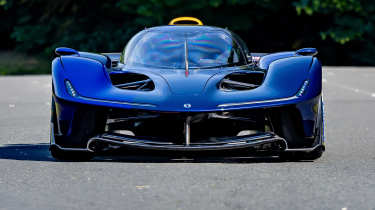
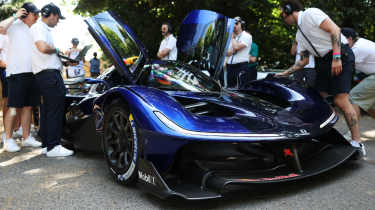
An initial concept of the car was first revealed at the Goodwood Festival of Speed in 2024 but even by this time, aero refinement and packaging were well under development. Now almost two years on, Red Bull is testing the car, with its public debut at Goodwood now complete.
The final design shows just how much the RB17 has evolved since that initial styling buck we first saw at its 2024 debut. What you won’t tell straight away from the images is that it’s shrunk too, although it is still comparable with a last-generation F1 car in terms of footprint.
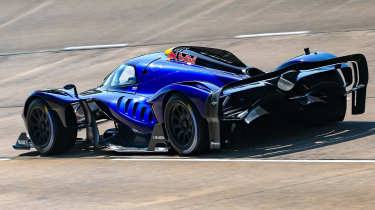
The fin above the engine cover, designed to aid high-speed stability, the double-deck front splitter and the rear wing and diffuser - now cut and multi-layered - have all been refined.
There are more vents scythed into that bodywork too, including into the top of the front and rear wings, side pods and on the more prominent central snorkel intake. The exhaust exit is also positioned further up the car’s spine at the base of that snorkel element. It also now has lights, wipers and rear-view mirrors – underrated features indeed.
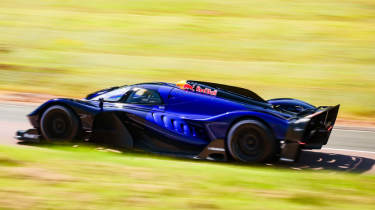
Despite the otherworldly performance, the RB17 has been designed to be accessible for a range of driver skill levels thanks to active suspension and aerodynamics. The ride height can adjust to change the car’s mechanical balance and roll as well as control how much ground effect-powered downforce it generates.
There are also movable elements in the front and rear wings to adapt to different circuit conditions and driving styles. Peak downforce is 1700kg – almost twice the weight of the car itself (sub-900kg was the target with no final figure given yet).
There’s also hydraulic power steering, traction control and ABS for the carbon-carbon braking system, and a choice of 18-inch carbonfibre wheels with custom Michelin slick tyres or 20-inch items wearing treaded tyres.
The RB17 has also been designed to be more habitable than all-out race cars, with a relatively roomy and highly adjustable cockpit with space for helmets and race suits. Controls will be physical, tactile items, with touch and haptic interfaces being swerved entirely.
Rob Grey on how the RB17 will drive
How good a driver will you need to be?
‘We’re not talking putting L-plates on it, but a decent amateur should be able to get in and enjoy it. That’s the aim. On the dash you’ll have a global balance adjuster, so you can dial it towards understeer or oversteer. On the steering wheel you’ll have high-speed balance and low-speed balance for corner entry, mid and exit, so if you’re a better driver, you can then really tune the car to your liking. The idea is that somebody who’s done a decent amount of trackdays, maybe in a GT3, should have no problems putting it in a sensible mode, driving it, and then learning with it and enjoying it.’
Tyres are a crucial part of the car. Where are you at with them?
‘I’d say we’re at a really good mid-development point. There are different specs of tyres. We’ve got a standard slick, but there will also be a ‘confidential’ tyre. They call it confidential because customers can run it but Michelin will turn up, fit them to the car, let you run the car, and then take them away. That’s how you get the ultimate lap time.’
Presumably you can tailor the aero to the circuit as well, as you go around the lap?
‘You can do anything. We’ve got a lot more freedom, which is a good thing and a bad thing. The development process is a lot longer because we have to sign off all of these different modes. We’re offering different engine modes and we’ve got a hydraulically locking diff, so we can control the locking, but everything has to be tried and tested and proven out. So it’s great from a point of view of being able to tune the car, but it also makes the development a lot longer.’
Will the Red Bull RB17 be faster than an F1 car?
‘Probably not any track because it achieves its lap time in a very different way. It’s got an awful lot of downforce at low speed, which then bleeds off at high speed. Normally aerodynamic downforce goes up with the speed squared. With this, we have an active front wing, active rear wing and active diffuser. Also, varying the ride height changes the downforce a lot and we have active suspension, so we can do that. Once we get to about 150kph [93mph], our aero drops away and that’s to give the tyre a sensible life.
‘So, Spa is a good example. I always have to emphasise: this is in the virtual world. On the simulator it is faster than the outright lap record at Spa. But it’s a virtual lap, so we’re trying not to shout about it too much.’
Red Bull will sell 50 RB17s, with customers invited to take part in exclusive track days around the world with driver coaching and car setup support. Simulator sessions will also be offered to get a taste of the RB17’s performance and driving characteristics before strapping into the real car. The cost? Still nothing announced as yet, though Red Bull revealed an estimate of £5 million (plus taxes) in 2022, making the RB17 twice the price of a Valkyrie. And that’s before you’ve taken it to Lanzante to make it road legal.