Jensen Interceptor is back as a £850k 960bhp track car
Clean-sheet successor to the British classic will be a 960bhp track car with road-going four-seater to follow. But it comes at a price...
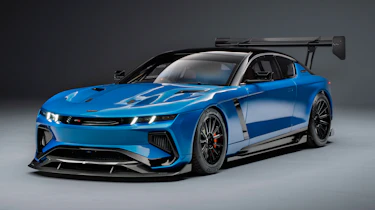
The Jensen Interceptor is back. Possibly. But not as we know it. This is the Jensen Interceptor GTX, the first prototype, demonstrator and proof of concept for a modern successor to the original Interceptor, by Jensen International.
Jensen International Automotive (JIA) has been developing and building restomod evolutions of the original 1960s and ’70s Interceptor since 2010, and its associated Jensen International group has since acquired the intellectual property and naming rights to the Interceptor. The GTX is the template for a brand-new, clean-sheet Interceptor for the modern era.
New Jensen Interceptor – track car first, road car later

The company’s ultimate aim is to create a road-going, four-seater Interceptor for low-volume production in the coming years. The wild-winged blue car pictured here is the Interceptor GTX: a track-only, non-road-legal creation described as an ‘enhanced prototype.’

It’s powered by a 960bhp supercharged V8, features purposeful and functional aerodynamic surfaces and is aimed at a small market of ‘gentleman drivers’ and casual trackday enthusiasts, who also happen to be well-heeled collectors with a passion for the Jensen brand. It won’t be FIA homologated for racing, and is intended purely for recreational track use, though it is fitted with race-spec safety equipment including an FIA-approved rollcage and fire extinguisher system.
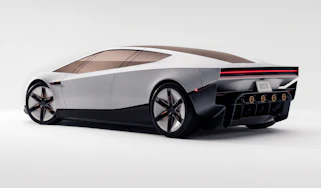
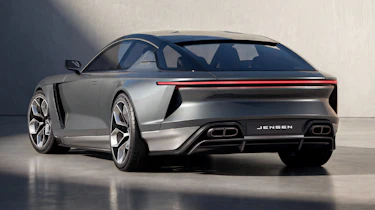
Of wider interest is the car the GTX is intended to lead to, the new Interceptor GT road car. If you squint, everything in blue on the GTX is as it would be on the road-going GT. Or, to save squinting, the GT is virtually rendered in silver in Jensen International’s illustrations in this story’s accompanying gallery.
A three-tier model range is proposed, as shown in the illustration. The extreme, track-only GTX sits at the top, a GTR variant in the middle (a less wild development of the GTX, still track-focused but likely to be road-legal) and the Interceptor GT, a traditional road-going luxury grand tourer, at its base.
Why has the wild GTX been created first? Aside from there being an established interest in non-road-legal track cars among wealthy individuals and potential customers, the decision to debut the new Interceptor as a track car is a pragmatic one, explains Jensen International managing director David Duerden. Time-consuming and expensive elements such as heating and ventilation, motive windows and production-level glazing for example, are not required for a trackday car.
It enables the car to be both an engineering template and test car for R&D, to prove the concept and also offer built-to-order versions of the GTX for sale to customers. ‘It’s the most efficient way of showing people “we’re going to do this” rather than “we want to do this,”’ says Duerden.
‘We chose to begin with the track-focused GTX because it is the clearest first expression of the new Jensen programme,’ he adds. ‘It allows us to prove the engineering, design direction and specialist supplier base behind the car, while giving prospective customers something tangible and fully functional to experience. The road-going models that will follow have been conceived as part of the same development path. The GTX is the first physical variant of that programme, not a separate exercise. Around 80 per cent of its exterior form, including key body panels and associated tooling, is intended to carry through to the eventual road-going car range.’
He continues: ‘We've kind of built this back to front, insomuch as we've started at the end: we started with a design for a production road car and worked back from it to produce the track version. It shows what we can actually do: it's not another render that pops out and then we've [still] got to go and build a car. It's a reality, and that's what we want to show.’
New Jensen Interceptor: Engine and tech
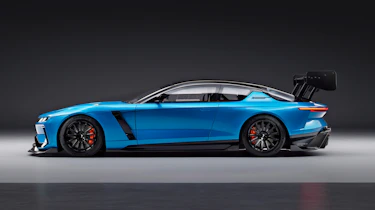
The new Interceptor is a clean-sheet design and does not share its platform with an existing car. It’s a large machine, envisaged from the start as a four-seater, as per the original Interceptor. Technical director Jack Glennon says its dimensions are around 5.5m long and 2m wide, akin to a large coupe such as the BMW M8. ‘We didn’t want to go down the path of yet another hypersonic two-seater,’ Duerden explains.
Its bodywork is in aluminium rather than composite. Although Jensen Group and its personnel have a background in carbonfibre, they decided on aluminium to fit the Interceptors grand tourer character and for practical reasons: if you need to make any changes to carbonfibre you need to effectively start again, whereas aluminium is a more versatile production process and can be tweaked more easily.
The chassis likewise is aluminium. The new Interceptor is built around a bonded, riveted monocoque structure with two longitudinal elements. Aluminium was also chosen partly because of potential benefits for ride quality, says Duerden: ‘we don’t want [it to be like] a skateboard.’ Suspension is by aluminium double wishbones all round, with dampers supplied by Nitron. Also part of the desired spec from the start was a large V8 engine, to fit the character of the original Interceptor, which used Chrysler V8s from 5.9 to 7.2 litres in capacity.
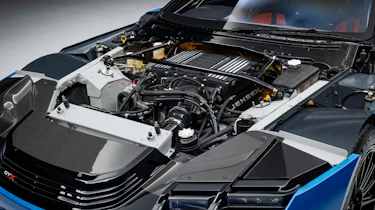
The GTX is powered by a GM-sourced 6.8-litre, 7000rpm dry-sump V8 built by specialists LME in Texas. While the block is standard, more or less everything else is modified with many forged components. A 2.65-litre supercharger takes power to a ‘modest’ 960bhp, Duerden says. ‘We can do more if customers want.’ Power goes to the rear wheels, via a carbon propshaft and transaxle arrangement.

The V8 is mounted well behind the front axle line and space has purposefully been left for an electric motor ahead of the engine, should hybrid power be required in the future. Final production engine provider has not yet been decided but is likely at this stage to be General Motors, not least because JIA uses GM engines in its Interceptor restomods.
The GTX will feature both traction control and ABS, as would the road car. The brakes are steel rather than composite, as the intention is for this to be a user-friendly and practical car to run. The GTX uses a six-speed motorsport-spec sequential gearbox. The road car is planned to feature either a H-pattern manual gearbox or eight-speed auto, depending on customer demand.
The GTX runs on treaded Michelin Pilot Sport tyres rather than slicks, as they are more approachable at the limit for novice drivers and also because data from development will be more relevant to the road car. It weighs 1660kg with fluids, with a front:rear weight distribution of 49:51. The fuel tank is a race-spec safety cell (with 481 litres to get decent running between fills in testing). The production road car will have a conventional tank. That test phase begins immediately following the car’s reveal. As you read this, the GTX will be pounding around test tracks and runways covering miles and gathering data.
Jensen Interceptor GTX design
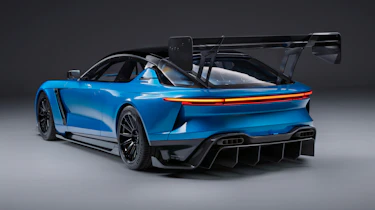
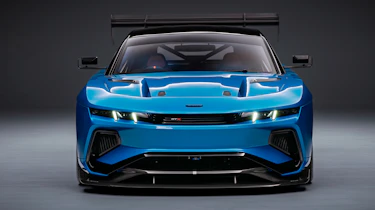
The design theme naturally echoes that of the original Interceptor. Particularly in the treatment of the C-pillar, wraparound tail and bonnet line, including elements of its surfacing and contours, however it has purposefully avoided being retro or a pastiche. Everything painted blue on the GTX is handformed aluminium, coupled with 3D-printed details such as the aluminium vents in the bonnet. There are modern and intricate-looking LED tail-light units (which incorporate the ‘J’ logo motif), titanium badges and titanium exhaust tips.
The bodywork is close to production-level. The surfacing is mature and fit and finish at a far higher level than one would normally see in a track car or a one-of-one working prototype test car – hence its description as an ‘enhanced prototype.’ ‘We've gone further with this car than you [typically] would with a first-stage prototype,’ Duerden says. ‘All the panel tooling is already produced for hand production.’
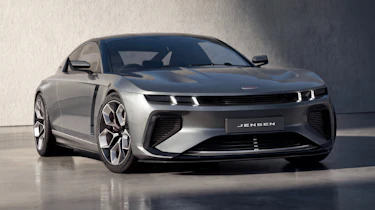
While the GTX will always be a two-door car, the production GT may feature slim backward-hinged rear doors, similar to those of the Mazda RX-8. Take a closer look at the silver GT in the renders and you can see the additional shutlines for its rear doors versus the GTR and GTX.
The majority of the black elements on the GTX are carbonfibre aero aids, including the GT3 racecar-style rear wing, which is claimed to develop 350kg of downforce on its own. The floor is flat, with a large, functional, two-level diffuser. CFD aero analysis has been carried out by technical partners.
The windows are made from polycarbonate rather than glass, partly for lightweight track suitability but also as another pragmatic touch, since it gives the chance to refine the surfaces before setting the final curvature for production. Wheels, supplied by Vossen, are 20-inch one-piece forged items with a bespoke design.
Jensen Interceptor interior
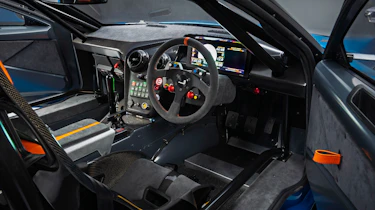
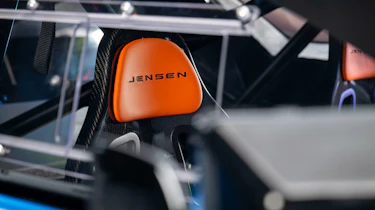
The GTX’s interior is sparse but smartly finished, with Alcantara upholstery and a higher level of fit and finish than many track-focused prototypes. Although the GT is designed to be a four-seater, as a track-only car the GTX naturally just has two seats. With all the space of the intended production four-seat Interceptor but only two carbon Tillet seats and a race-car style centre console, the GTX is very roomy inside, even with a rollcage. There’s plenty of elbow room for two large occupants.
There are three pedals in the footwell since you use the clutch pedal to get underway with the race-spec sequential transmission, and thereafter can shift without touching the pedal, either using paddles behind the steering wheel or the push-pull sequential gear lever.
The console includes controls for the HVAC system, wipers and so on, all systems which will be refined and redesigned for the production car. Instrument panel is a motorsport-spec display by MoTeC with data logging and configurable displays. Engine management and traction control is also by MoTeC.
Who is behind the car?
Jensen International is a new division of the Jensen International Group, which includes Jensen International Automotive, the restomod business re-engineering original Interceptors.
One of the people involved in the new Interceptor is Jeff Qvale, an experienced figure in the US automotive industry. His father Kjell Qvale was a major shareholder in the original Jensen Motors company in the ’70s.
Jensen International is based in Banbury and has established a supplier network for the GTX. The new Interceptor’s design has been carried out by independent studio Avant Design and its bodywork created by Coventry Metalcraft, with the carbonfibre aero components by Artiglio Automotive.
How much will the new Interceptor cost?
Jensen International is in a position to build the GTX right away, should customers come forward. It would support buyers at high-end trackdays through race team partners to assist with running the car. Tooling is established and ‘10 to 15’ GTXs could be built before it would need to be refreshed. If a customer would like to buy a GTX here and now, how much would they be expected to pay? For a car in this exact spec, the answer is ‘£850,000-plus.’ Which is quite a considerable sum.
The GTR would follow next and the GT at an unspecified later date, as Jensen International establishes partners and investors to take the project forward. It has invested around £1.2m to get the project to this point, a sizeable portion of that spend being on tooling.

While the GTX and GTR will be built in very small numbers for individual vehicle approval, the GT is intended to have a larger production run while remaining a low-volume car. It’s too early to predict a potential price window for the GT road car at this stage. Its low-volume nature will naturally mean it too will be a large sum, though naturally far less than the GTX. JIA’s Interceptor restomods cost six figures, with its flagship Interceptor R Supercharged priced at £420,000 and its S conversion at around £150,000 plus donor car.
The new Interceptor has been designed to be built in right- or left-hand drive, however Jensen International is concentrating on the UK market initially. Jensen International is going about the creation of the new Interceptor in a pragmatic, realistic way. These are difficult times to launch a brand new car into but the Interceptor recipe certainly holds appeal. The next stage, from the track to the road, depends on partners to take the project forward.