The new Slate Truck looks brilliant, but isn't as simple as it seems
The Slate Truck is more about clever marketing than genuine simplicity, reckons Richard Porter
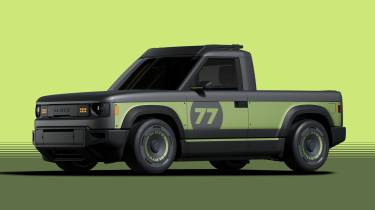
You might know about Slate, the American start-up company founded in 2022 to create a simple, affordable, all-electric pickup. It was an idea so interesting it drew the attention of Amazon founder Jeff Bezos, who handed the company a load of money, or left it behind their bins if they weren’t in at the time. Three years later, in April 2025, Slate showed off its homework and it was, as promised, a square-cut little truck with simplicity at its core. Even the name, Slate Truck, is simple.
Deliveries will start sometime towards the end of 2026 and, when they do, every truck built in the firm’s Indiana factory will start in the same base spec, with grey, unpainted polypropylene panels and a minimalist cloth interior. You can leave it like this if you like, or you can go to town with official customising options including body decals, full wraps, lift kits, different wheels and a range of interior trimmings. There’s even the option to fit extra bodywork over the rear bed and install rear seats, turning your pickup into an SUV.

When the Slate was announced it seemed to fill the car people of the internet with joy at the beguiling simplicity of the base vehicle, a simplicity symbolised by its side windows, which open and close with an old-fashioned hand crank. Actually, I think the windows say a lot about the sleight of hand at the heart of the Slate. In modern cars, wind-up windows are not simpler or lighter than the powered equivalent. They’re more complicated because they require a greater number of mechanical parts and, as Lotus was happy to point out when it made ’leccy windows standard on the Elise, they’re heavier too. You might argue that a hand crank will be more reliable for longer, and it’s true that after 30 years an electric window motor can become slow and noisy, but it’s equally true that an ageing manual window can become loose or slip out of alignment. Either way, you’re going to need to pop off a door card.
You can fit a Slate Truck with powered windows from the accessories list, but it’s more telling what comes as standard. The list includes air conditioning, keyless entry, auto-high-beam headlights, and the legally required stability control, six airbags, rear-view camera and, because it becomes mandatory in the US in 2029, forward collision warning with automatic emergency braking.
On the surface this little truck seems refreshingly uncluttered, and that’s a very appealing thing, but I don’t buy the idea that it’s a work of bare-bones simplicity that you could drive to the end of the earth in 40 years’ time and keep going with your bare hands. Fascinating and refreshing though it is in many ways, what the Slate Truck sells is the illusion of simplicity.
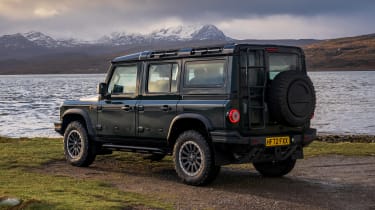
I feel the same about the Ineos Grenadier, which, with its ladder chassis and beam axles, projects a self-consciously old-school vibe that says, ‘You could keep me going for six decades, making do and mending as you would with a pair of good boots.’ But the Grenadier comes with a choice of two BMW straight-sixes, the B57 diesel or B58 petrol, connected to ZF’s 8HP automatic gearbox. These are not simple bits of hardware, and if anything went on the wonk as you attempted to wrestle your Ineos across the Darién Gap you’d be trying to fashion an OBD reader from mud and twigs. Again, the Grenadier sells an illusion of simplicity because simplicity is appealing in big 4x4s, just as it is in small pickup trucks.
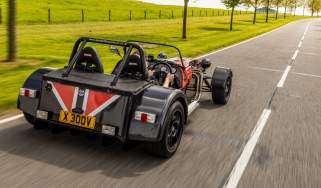
It’s equally appealing in something closer to evo home: sports cars. The difference is, if you truly crave simplicity in a brand new sports car you can have it in a Caterham Seven. But if you want something to use year-round that doesn’t look like you found the roof at a festival, where are you going? My first thought is the Alpine A110, which is a wonderful and pretty simple car. Except, it’s not. It has air con and CarPlay and keyless entry. But if you removed all of those things, maybe lobbed the carpet and soundproofing in a skip for good measure, would it make the car better, or would it make it harder to live with and more annoying? When it comes to sports cars, I don’t think it’s simplicity we want in and of itself so much as lightness and efficiency, which the A110 offers in spades while still being quite well equipped.
Sadly the Alpine has just gone out of production and, fabulous thing though it is, I don’t think it was enough of a sales success to make Renault’s accountants smile. Maybe they should have tried to give it a boost by stripping out all the convenience features and screwing in some needless manual windows. After all, never underestimate the appeal that comes from the illusion of simplicity.