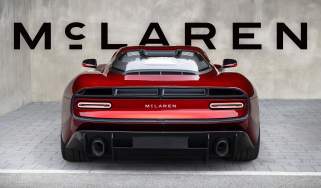
McLaren McL 6GT is a new manual supercar and a complete reset
Unbelievably, the design of this new McLaren is more surprising than the reintroduction of a manual transmission…


McLaren has revealed its McL 6GT, a concept for a new supercar set for production in 2028 and a major departure from what the company has done up to this point. It has a retro-futuristic aesthetic entirely unrelated to the existing lineup and, almost unbelievably, a manual transmission.
The McL 6GT retains much of what we know about McLaren: a carbon structure at its core and a V8 engine (of unspecified aspiration or output) in the middle. But then things change dramatically. This is McLaren’s first manual-transmissioned car since the legendary F1. Strictly speaking, it’s McLaren Automotive’s first ever manual car, if you consider McLaren as it is today, a company that was first founded in the late-2000s and started life with the MP4-12C supercar.
There are no specifics on exactly how it works – whether it’s a simulated manual like the 12 Cilindri Manuale and Koenigsegg CC850 – or whether its stick and third pedal are tied to the drivetrain with old-fashioned linkages and cables like the Pagani Utopia and GMA T.50. McLaren describes it as an ‘authentic’ manual transmission, which sort of suggests the latter…

Now for the design, which if anything is even more shocking than the reintroduction of the manual. This is a car unlike anything McLaren has produced before, including really, the M6 GT prototype from the 1970s that inspired it. It’s retro, yes, but it’s also original and save for the McLaren badges, could be totally unrelated to a 750S, or anything else in the modern McLaren family. We’re used to McLarens that are shaped by the wind tunnel, almost hollowed out by airflow requirements.

The McL 6GT is a total departure from that, with confident shapes and clean surfacing for its carbonfibre coachwork. There is acquiescence to airflow of course, with intakes at the front, an almost S-duct-like exit on the front clam and Maserati MCPura-esque lower areas on the sides devoted to cooling and airflow. But it’s clearly defined within the design, not defining it. The rear again is very sturdy in its shape by comparison to the flowing, almost liquid forms we see on normal McLarens. The shape being a nod to '60s prototypes does mean there's a hint of other new cars that call back to that period in their designs; I see a bit of Capricorn Zagato and even Ferrari 296 in its silhouette, plus Caterham Project V in its tail.
The McL 6GT is also all about tactility, so inside there’s plenty of knurled machined aluminium controls and a considered gear stick designed for weighting and feel (and a 3D Kiwi within the actual shift knob). That McLaren is still fully devoted to hydraulic steering systems will help the end of tactility too. McLaren’s desire for this to be a departure from its existing cars and for it to call upon its history is obvious inside too. Just look at the use of a reinterpreted version of the old McLaren logo on the new steering wheel…

Other details are relatively scarce, as strictly speaking this is a concept previewing a production model set to debut in two years time. What we do know is it will be its own thread in the McLaren family tree – a more exclusive one closer in positioning to its Ultimate Series, than the 750S and Artura production supercars.
McLaren up to this point has been a company focused on the bleeding edge of technology and performance, very forward-looking. The McL 6GT represents a new school of thought at Woking; one with an eye on the rearview mirror too. It's a welcome change of pace and a confident punt at reigniting the market’s interest in the brand.