Porsche 911 Carrera GTS (992.1) Fast Fleet test – living with the 194mph coupe
There’s lots to like inside the GTS, but also room for improvement
The first thing any passenger in the evo Fast Fleet 911 comments on is how nice the interior is: it’s a clean, modern design, with that sense of hewn-from-solid quality journos like us often bang on about. It is – one might say, frequently – a nice place to be.
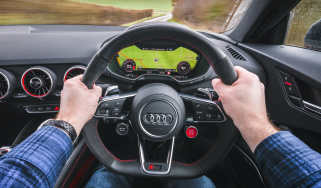
Not a perfect place, though. The steering wheel is big, and although its artificial suede ‘RaceTex’ trim feels great, its bulky spokes get in the way of my hands slightly at quarter-to-three, and it has big lumps at ten-to-two that block the outermost displays on the instrument cluster. That cluster has a nice, albeit slightly plasticky, analogue tacho in its centre, classic 911 style, flanked by what looks a little like two miniature tablets, wedged at diagonals to the rev counter. Their configurability means you can see the bits the steering wheel blocks – namely the fuel level, coolant temp and the time – in other display areas, but it’s odd to have a section of the instrument panel you can’t actually see while driving, unless you crane your neck to look around the wheel.
> Porsche 911 Carrera GTS review – hybrid done the right way
There’s a rather inelegant cup-holder right next to the gearlever (in a neat push-click moulding you can easily switch out for a little loose-change-style tray, if you prefer), which puts your cup/bottle/flask right in the way of your gearchange arm. Fine in a PDK car, as many 911s are, but less ideal in a manual (especially when the gearbox is this much fun to use). You can fit slim drinks bottles in the doors, and there’s a passenger cup holder which pops out of the dash, but if you’re taking a big water bottle or a coffee it’s not ideal. I know drinking coffee while driving is a filthy habit anyway, and this car might finally help me kick it. Literally filthy in this case, since the GTS’s firm suspension tends to shake coffee out of the gap in the lid and sloshes it over the surrounding bits of the console, including the electric handbrake switch.
I’ve tried to mentally design-sketch a better cup-holder solution in my head while at the wheel – maybe a more robust version of the spindly pop-out armatures in the previous-gen 911 – but I haven’t come up with one yet. Maybe I should stick to the day job, because passengers’ initial reaction is absolutely right: the GTS’s cabin is a pretty stunning interior overall.
More reviews
In-depth reviews
- Porsche 911 Carrera GTS T-Hybrid review – the first hybrid 911 is one of the best
- Used Porsche 911 (991, 2011 - 2018) review – should you buy the unloved 911?
Reviews
- New Porsche 911 Turbo S review – McLaren Artura performance with four seats
- RML GT Hypercar review – the Porsche 911 taken to the ultimate extreme
- Used Porsche 911 (997, 2004 - 2012) – the ultimate sweet spot 911
- Porsche 911 Turbo S (992.1, 2020 - 2024) review – Stuttgart’s supercar slayer
- Porsche 911 3.2 Carrera (1984 - 1989) review – flawed but furiously charming
I’ve grown to love the optional bucket seats, too, which are surprisingly comfy on a long journey. Fitting bulky items behind them is a bit of a challenge since they can’t fold, though. If you plan to carry stuff in your 911, they’re not the way to go. But – like the rest of the cabin – they look and feel great. – evo issue 321
Living with it – evo issue 320
Every Porsche customer is offered a free driver training session. We take ‘our’ 911 along to try it at first hand
'You’re right-handed, aren’t you?’ asks Mark Robins from the passenger seat of evo’s Carrera GTS. I’m guessing it’s not the fact I’m wearing a watch on my left wrist that’s tipped Porsche’s instructor off. ‘Ye‑es?’ I reply, tipping the 911’s nose into one of the Porsche Experience Centre’s arcing, technical corners. ‘Have you ever noticed you sometimes relax your grip with your left hand when you turn the wheel, but you don’t with your right?’ he asks.
This is the first of several Sherlock Holmes-like observations I’ll learn from today, about my driving style, and also about how our 911 handles at, below, and beyond its limits. And how to apply those lessons on the drive home and, hopefully, for years to come.
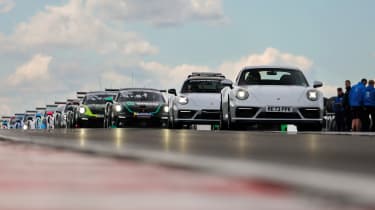
Every new Porsche customer is offered a free-of-charge session like this one with a ‘Porsche Driving Consultant’ such as Robins. We’re at the Silverstone PEC to get an idea of what that training can involve. Customers decide what they’d like to get from the session: some haven’t yet locked down the spec of the car they’re buying and would like to try-before-they-buy different options from behind the wheel; some are regular trackday drivers; some have never been near a circuit. All the sessions have an emphasis on how to handle the car safely; Porsche feels it has a duty of care when it sells powerful road cars to people who may have limited driving experience or have never done any advanced driver training before. Plus, it’s fun.
Today Porsche has multiple PECs on multiple continents but the UK is where it started, initially at the MIRA and Millbrook proving grounds before this purpose-built centre was constructed at Silverstone in 2008.
It’s built on what was originally Silverstone’s figure-of-eight rally complex: I remember coming here as a child to see the ‘Silverstone RallySprint TV Challenge.’ (Worth typing that into YouTube to relive the PEC’s past life.) The centre’s main handling circuit retraces some of the original layout, albeit without the water-splash and yump (though the crossover bridge remains on the infield). It’s all tarmac now, and designed to look like a public road: dotted white line down the middle, reflective corner markers of the kind you’d see on a B‑road. The training majors on skills drivers can apply on the road – reading it fluently and interpreting its messages through vision and the car itself.
The 911 GTS is a clear communicator. It feels very much at home here, the limited-slip diff hooking up keenly out of the last corner and the front axle generating more grip than I’ve asked of it on the road. It’s remarkable how much speed you can roll into corners, even without trailing the brakes.
And it turns out I’m asking more of the front wheels with my right hand than my left. ‘If you imagine sawing a piece of wood, you’d brace it with your less dominant hand and do the fine motor control – the sawing – with your dominant hand,’ Mark says. ‘It’s the same here: your right hand is doing more of the fine-motor control than your left.’
There’s another eye-opener for me in the brake testing zone. In addition to the main handling track, Porsche has built a secondary, more undulating circuit with two long straights within its infield, for extreme acceleration and braking. Porsche’s policy, Mark explains, is that a model’s 62-0mph braking time must be at least half that of its 0-62mph acceleration time. Given that our long-termer’s quoted 0-62 is 4.1 seconds, it needs to stop pretty smartly.
So, let’s find out. Robins gets me to perform an emergency stop from motorway speeds, wagering beforehand: ‘I’ll have a bet with you – you’ll stop just beyond that line in the distance.’ And I do. ‘How are you feeling the limit of the braking?’ he asks. I answer that I’m feeling the ABS juddering through the pedal, and using more or less pressure depending on how much vibration I’m feeling. ‘That’s good,’ he nods, ‘but there’s a better way.’ He tells me to relax my arms as I brake, explaining that enables you to feel the car’s deceleration rate by how far the G-force pulls your shoulders forwards from the seat. Again, I’m doing something with my hands without realising it: bracing my arms on the wheel when braking at full force. ‘It’s survival instinct,’ Mark points out. It’s an emergency stop, after all.
We try the exercise again, with newly slackened arms, and I stop well before the line, with less ABS intervention. Even accounting for my reaction being a bit sharper after a practice run, it’s a stark difference.
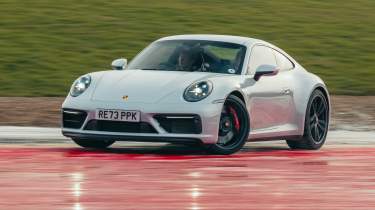
Among the most entertaining zones are those for skid control: a steering pad to balance the car in a continuous powerslide; the Ice Hill, a steep, low-grip slope soaked by sprinklers; and a straight-line skidpan, home to the ‘kick plate’ – a hydraulic platform pre-programmed to pull the rug from the rear wheels as they drive over it. Whether it nudges the car’s tail left or right is randomised.
Robins points out how crucial vision is – ‘lead with your eyes,’ as he puts it – looking at where you want the car to straighten out to, not anywhere else. Once your focus is on where you need to be, you can hold the 911 in a slide for the length of the strip, before straightening out neatly at the end.
I’ve really enjoyed the session, and Robins tells me I’m ‘a good pedaller,’ which is gratifying. But I’ve definitely learned a lot. Not least that the GTS is just as much fun on the circuit as on the road. – evo issue 320
| Total mileage | 3869 |
|---|---|
| Mileage this month | 454 |
| mpg this month | 25.2 |
| Costs this month | £0 |