Porsche Macan Electric review – Germany's answer to Hyundai's Ioniq 5 N
Porsche’s switched its golden goose SUV to electric power. Has the gamble paid off and can it match Hyundai's Ioniq 5 N?
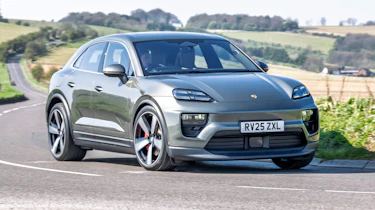
Don't be fooled by the familiar name; the second-generation Porsche Macan represents something entirely new. Not only has it gone fully-electric, it’s the first Porsche to ride on the brand new Premium Platform Electric (PPE) architecture – co-developed with Audi – that now also underpins the new Cayenne Electric. In the current climate for both brands, an all-electric future looks very wobbly at the moment.
The original Macan was an emphatic success both in terms of execution and popularity, and this new version also has the tools to be a class-leading premium SUV. For those not ready to ditch their petrol engined Macans just yet, the current car is still available to buy with petrol engines until production ends in summer 2026, with an all new internal combustion engine model expected in 2028.
Despite the introduction of an electric powertrain, the Macan’s fundamental philosophy hasn’t changed. It sits below the Cayenne in Porsche’s SUV line-up and aims to bring some life to the driving experience, with hints of sports car DNA in its make-up. It’s a different route to the one Audi has taken with its new PPE-based Q6 e-tron, which is a loping, relaxing EV with little in the way of sporting pretence. But as we’ll discuss, the end result is an electric SUV with a distinctly Porsche feel, and impressively high levels of ability that retain some of the original’s hot-hatch feel.
Motors and performance
- Range from 387bhp base car to the 630bhp Turbo
- Turbo gets to 62mph in just 3.3sec
- Only the base Macan is rear-wheel drive
More reviews
In-depth reviews
Reviews
- Porsche Macan GTS Electric 2026 review – the sweet spot in the range, but it’ll cost you
- Porsche Macan T 2023 review
- Porsche Macan GTS 2022 review – does the GTS still have its sporty SUV rivals trounced?
- Porsche Macan GTS 2020 review
- 2020 Porsche Macan Turbo review - still the class leader?
- New Porsche Macan S review - Alfa Stelvio and Mercedes GLC rival updated
The Macan is built on Porsche’s PPE architecture, which has been developed alongside Audi to deliver significant gains in range, performance and dynamics. And considerable cost savings, too. All models are fitted with a 95kWh (usable) lithium-ion battery pack positioned within the underbody, and like the Taycan, the Macan’s platform runs on an 800-volt system to benefit charging speeds (270kW, with a 10 to 80 per cent top up taking 21 minutes) and temperature management.
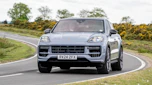
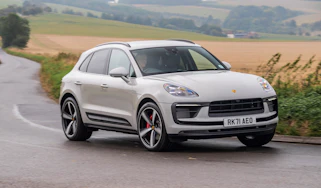
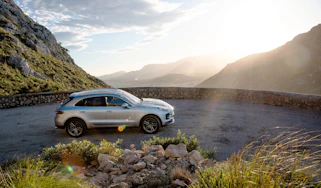
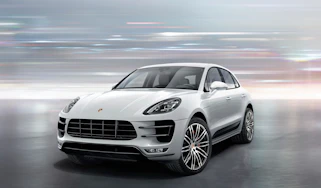
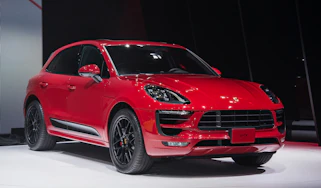
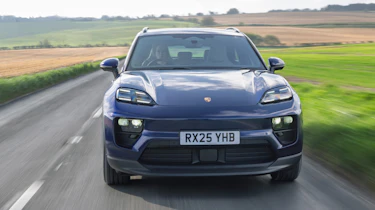
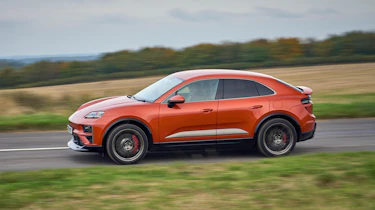
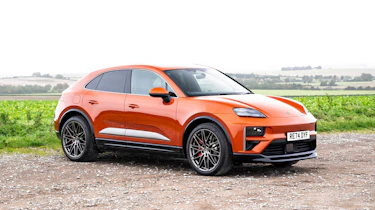
The Macan’s pebble-smooth surfacing is typical Porsche, and there’s detailing that you’ll recognise from elsewhere in the range – including the shallow-angle bonnet, Taycan-style narrow headlights and full-width rear light bar. The trouble is, these combine in a slightly dumpy, awkward looking whole. In profile, it’s something between a conventional SUV and a fastback coupe-style model, and for some, it won’t quite have the instant desirability of the petrol Macan.
With that said, there are reasons for the new body shape. The sloping roofline works with an active rear spoiler, active front cooling flaps and flexible underbody covers to cut through the air more cleanly, resulting in an impressive 0.25 drag coefficient. The EV platform also enables short overhangs, with an 8.6cm longer wheelbase than the petrol car.
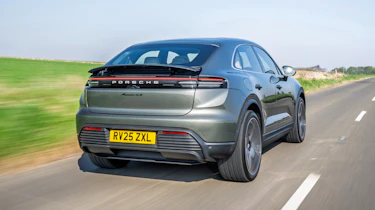
In its lightest single-motor form it comes in at a chunky 2220kg, and the dual-motor Turbo crunches the scales at 2405kg. For a new EV running on a new-generation platform, that’s pretty poor.
The Macan does at least have the power to shift all that mass, generating up to 630bhp in Turbo form thanks to a pair of e-motors. And with precise control of torque output to the wheels, Porsche’s ePTM traction control system can respond faster and more accurately, responding to wheelspin in under 10 milliseconds. Power is transmitted via a single-speed gearbox, rather than the Taycan’s two-speed solution, and during normal everyday driving, up to 98 per cent of total braking energy can be recovered via regen.
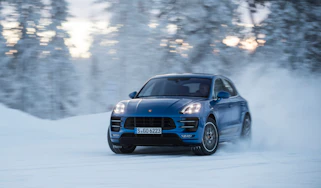
If the road is slippery, disable the ESC at your peril. It’s only when you do so that you realise how effective the electronics are at subtly metering out the power without overwhelming the tyres. The PTV-equipped Turbo will light up its rears instantaneously if you get on the power too hard, and gathering up slides can feel scrappy as the weight jostles from side to side. It’s more exploitable in ESC Sport, which allows enough slip to overdrive the rear tyres but softens your inputs with a light hand.
Step all the way down to a Macan 4 and while the performance drops due to its lower output powertrain generating 382bhp the driving experience still feels a step above most competitors. The sweet spots in terms of performance are probably the 442bhp Macan 4S and 509bhp Macan GTS, good for 0-62mph in 4.1sec and 3.8sec respectively.
Porsche Macan Electric v rivals
| Alpine A390 GTS | Porsche Macan 4 Electric | Hyundai Ioniq 5 N | |
|---|---|---|---|
| Motors | Twin rear, single front | Single rear, single front | Single front, single rear |
| Power | 464bhp | 402bhp (launch control) | 641bhp (with overboost) |
| Torque | 608lb ft | 479lb ft (launch control) | 546lb ft |
| Weight | 2121kg (222bhp/ton) | 2330kg (175bhp/ton) | 2235kg (291bhp/ton) |
| 0-62mph | 3.9sec | 5.2sec | 3.4sec |
| Top speed | 137mph | 137mph | 161mph |
| Basic price | £69,390 | £71,900 | £65,800 |
Ride and handling
- Turbo gets standard locking diff, rear steering is optional, as are air springs and adaptive dampers on Macan and 4 models
- Full range of chassis tech needed for the best Macan experience
- Low-speed ride is a bit lumpy
The Macan’s chassis systems are a bit of an acronym fest: it’s offered with ePTM (Porsche Traction Management), dual-valve PASM (Porsche Active Suspension Management) dampers and the Turbo gets PTV Plus (Porsche Torque Vectoring Plus). The latter adds an electronically-controlled locking differential on the rear axle and helps bring the chassis alive.
Rear-wheel steering is offered as an option, too, while air springs and adaptive dampers are standard on the 4S, GTS and Turbo. To improve weight distribution, the latter’s rear motor is directly mounted to the body and positioned behind the back axle – 911 style.
Before you get excited by the Macan’s rear-mounted drive unit, it doesn’t drive like a 911. But that’s not to say it doesn’t feel like a Porsche. It starts with the steering; the responses are calm, clean and precise, and as you wind on lock, the speed of the rack gradually quickens to pivot the car into corners. There isn’t much feel, but the Macan has a sense of accuracy far beyond that of its Q6 e-tron relative. The brakes, meanwhile, are firm and easy to modulate, and have a more positive initial response than even Porsche’s own Taycan. There’s real finesse to every touch point.
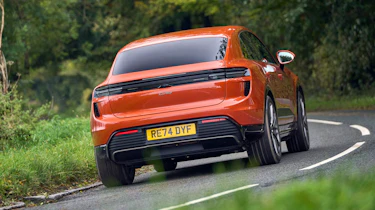
Somehow, despite its faintly ridiculous kerb weight, in Turbo trim the Macan carries through that sense of athleticism when you up the pace on smooth roads. You’re aware of the huge forces involved, but it changes direction like a lighter car, quickly settling on its springs and leaning into the available grip from the tyres. You can cover ground extremely quickly, and the limiting factor tends to be how long your stomach can cope as 630bhp squeezes your insides between corners (we lasted about 15 minutes).
If you don’t bleed off enough speed into corners the Macan’s front-end doesn’t stay completely locked on line, but take a slow-in-fast-out approach and it gives you more options. With its locking rear diff, the Turbo allows you to get on the power really early out of tight corners, taking a neutral attitude where you’d normally expect the front end to push.
Work through this and the balance neatly transitions to oversteer, the rear tyres continuing to dig in and find drive but requiring a flick of corrective lock. Not very crossover-like, and quite entertaining.
The trade-off for controlling all this mass, however, is a low speed ride that can be lumpy, particularly with the dampers set to Sport or Sport Plus. There’s a sense of tension to the car as the suspension resists body movements, and while Normal mode for the dampers does let the Macan flow and relax more, it also gives up some control and amplifies the sense of weight. Sport is better suited when you start leaning on the chassis.
There remains a high level of refinement and the Macan has a quality flow to it, its body control always tight leaving your passengers and you calm and collected. What it lacks in terms of the frantic pace offered by the Turbo, the 4 is still responsive and keen to demonstrate its Porsche DNA.
While someone buying a Macan most likely isn’t looking for the last word in steering feel, chassis poise and adjustability but they will appreciate how Porsche doesn’t sacrifice any of the brand’s expertise in these areas simply because it’s the entry point to the line-up rather than the poster child.
On the motorway, the Macan settles into a calm cruise and is painless to cover miles in. The occasionally choppy low speed ride across the range becomes more settled at speed, and noise isolation is best in class. The BMW iX is more impressive in its ability to cushion its occupants from the road, but then it doesn’t have the same ability to drop sports cars on a tight back road.
Interior and tech
- Cabin design a mix of Taycan and Cayenne
- Quality is good even if it’s a bit bland
- Android-based UI is intuitive
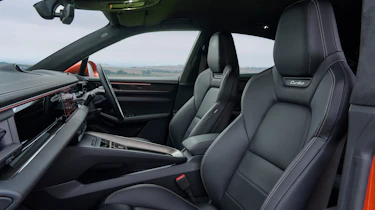
When you’re not exploiting the Macan’s dynamic DNA it’s a very comfortable car to travel in. The near silence of its electric running (tyre noise will never be 100 per cent suppressed) and the ergonomics of the interior make it an intuitive area to be in, with place a plenty, a seating position that feels more GT car than SUV and, if specced thoughtfully can be made to feel Range Rover-esque in terms of fit and finish.
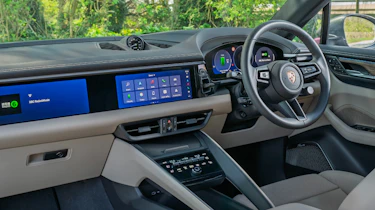
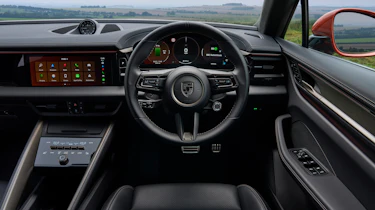
You’ll recognise most of the Macan’s interior from the latest Cayenne, with a dash-mounted gear selector alongside a crisp central touchscreen running Android OS-based software. A bank of tactile physical climate controls sit on the centre console, and if you fork out extra, the passenger gets their own 10.9-inch display for media streaming and general infotainment functions. A curved 12.9-inch dial pack comes as standard, and while an iX offers more glitz and intricate detailing, some will appreciate the Porsche’s more understated feel.
Option the secondary passenger infotainment display and the Macan’s interior is a bit of a pixel-fest, with a curved digital dial pack behind the wheel and a pair of screens set within a gloss black panel across the dashboard. Thankfully, not everything is controlled through the displays, with a bank of tactile knurled switches for the climate controls mounted on the centre console.
The latest Macan runs Porsche’s latest infotainment software, underpinned by Android Automotive OS. The layout of the menus is similar to what’s gone before, but there’s a more modern sheen to the graphics, and you get access to Porsche’s App Centre to download new functions to the car.
An augmented reality head-up display is offered with the Macan Electric, too, which can project navigation directions ahead of you. In our experience it can be disorientating to use, but perhaps could be something to get used to with time.
Range, efficiency and running costs
- Claimed range up to 398 miles
- Peak charging speeds of up to 270kW
- Real world range is around 300 miles in temperate conditions
Class-leading range claims is one of the fruits of the Macan’s PPE architecture. Energy-saving elements have been designed into the platform, including the use of silicon carbide in the rear pulse inverter to improve efficiency, and a powertrain management system that uses the rear motor to drive the car under normal conditions, only bringing the front motor in when more power (or traction) is needed.
The result is a claimed 398 miles of range for the base rear drive Macan, dropping to 380 miles in the 4. Despite its healthy power uplift, the 4S only drops by a further three miles, with the Turbo achieving 367 miles. All Macans use the same 95kWh (usable) battery pack, so will cost the same to charge up. Topping up from 10 to 80 per cent takes 21 minutes, thanks to a peak speed of 270kW. However, a week with a Macan proved less impressive. Charging overnight on a 7kW charger we only managed a full charge indicating a sub-300-mile range.
Given that the Macan relies heavily on regenerative braking during normal driving, the physical discs and pads should last well. With so much performance and weight being put through them, the tyres might be a different story, and replacements for the largest, optional 22-inch items (255-width at front and 295 at the rear) won’t come cheap.
Price and rivals
For the £68,600 Porsche charges for the base Macan Electric, you can get your hands on a number of premium electric SUVs from the likes of BMW, Tesla, Alpine, and Audi, but few offer the same blend of quality, range and dynamic ability. BMW’s 460bhp iX3 50 xDrive is the newest one contender, costing from £58,755 and delivering exceptional levels of comfort and luxury, range and strong links to BMW's dynamic DNA.
With its 3.4sec 0-62mph time and £61,990 price tag, the Tesla Model Y Performance gets you a lot of performance for the money, but the Porsche is immeasurably more polished, more premium and more satisfying to drive.
Audi’s Q6 e-tron starts from £61,315, and comes with the same PPE underpinnings as the Macan – albeit with a different chassis calibration which gives it a very different character from behind the wheel. It’s less incisive and much less sporting, but some might appreciate its more laid back character and cruising ability. You could also consider the Polestar 3, from £76,540 or the less practical, less sophisticated but more affordable Polestar 4, from just £50,750, though the 536bhp long-range dual motor for £62,750 is more comparable.
The only rival to the Macan that can match it as a driving experience is the Alpine A390, priced from £61390 for the 395bhp GT and £69390 for the 472bhp GTS – both undercut the Macan and Macan 4 in price but pip them for power and are accurate, sharp steers. Last-gen battery tech and poor range count against them. Hyundai's 641bhp (on overboost) Ioniq 5 N, though not a 'proper SUV' (and more the better for it in our view) is huge fun, really fast and good value comparatively at £65,800. Likewise Kia's EV6 GT, which is less still at £60,035, though it's not as focussed or fun as the Hyundai.
That's a chunk less than the £89,000 Macan GTS and £97,500 Turbo, meanwhile, which previously only had the move into the Lotus Eletre and BMW’s iX xDrive60 to worry about. They outpace both rivals but the iX offers better GT qualities and a more luxurious cabin, and the Lotus a more dramatic, space-age design and cabin.