De Tomaso Pantera (1971-1992) review – the forgotten 1980s supercar
The Pantera is an oft-forgotten, much-misunderstood supercar. Driving the rare GT5-S version shows it deserves its place among the greats
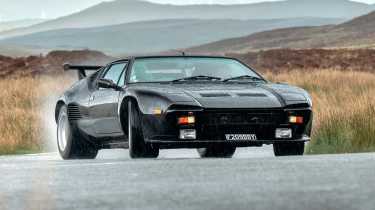
‘ELVIS SHOT HIS.’ This quote from Car magazine’s legendary The Good, The Bad and the Ugly listings section and the apocryphal tale of The King opening fire on his Pantera when it refused to start has a lot to answer for. So too does the ‘poor man’s Countach’ label the Pantera has been given over the years, frequently by people who haven’t driven one. Unfairly? We’re about to find out.
If you’re a student of supercar culture then you’ll know the Pantera is very much its own car; one of the most charismatic and enigmatic of the genre’s golden era. Alejandro De Tomaso’s Ford V8-powered supercar may have lacked the breeding of its Modenese contemporaries from Ferrari, Lamborghini and Maserati but it never wanted for visual or aural drama.
De Tomaso Pantera in detail
The Pantera (Panther) was conceived as an image-boosting exercise for Ford in the early 1970s, filling the glamour vacuum left by the Le Mans-winning GT40. For expediency, its development was outsourced to De Tomaso in Italy. Ford engines were a given, of course, the 5.8-litre V8 supplying 330bhp and plenty of low-down torque through a ZF five-speeder.
A prototype (called simply the 351) was shown at the 1970 New York Show. Styled by Ghia’s Tom Tjaarda, with chassis development carried out by ex-Lamborghini engineer Giampaolo Dallara, the design was well received and showed great promise. With the longitudinally-installed V8 sitting ahead of the rear axle, it presented the intriguing prospect of being a major-league exotic – with all the style, performance and drama of its Italian contemporaries – but without the highly-strung temperament.
The Pantera went on sale in 1971. Unhappily, early cars developed a reputation for being poorly made and unreliable. To cut a long and rip-roaring story criminally short, after a blockbusting start under majority Ford ownership, the Pantera sold like hot cakes – some 6000 between 1971 and 1974, but terrible quality issues, including rust and engine overheating, meant Ford was continually paying to have them fixed under warranty.
The ’70s oil crisis together with strict new US crash and emissions regulations added to Ford’s pain, so much so that, having tried to solve the problems by buying Alejandro de Tomaso out of his remaining 20 per cent stake, Ford threw in the towel completely and sold the whole business back to de Tomaso for a nominal fee.
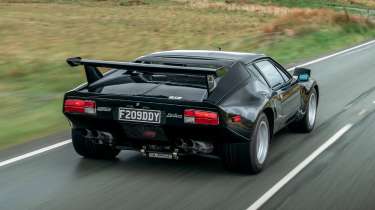
Having moved to smaller premises in Modena, undeterred, Signor de Tomaso pressed ahead with the widebody Pantera GT5, which was introduced at the start of 1980. With its bolt-on fibreglass flares and huge delta-wing spoiler it was a big change from the petite, slim-hipped original, but there’s no arguing it suited the times.
The GT5‑S tested below followed in late 1984 and featured smooth, blended all-steel fender flares. Both iterations were built in tiny numbers – estimates suggest fewer than 200 of each, with as few as 25 right-hand-drive GT5‑Ss leaving the factory. The last of the Panteras was sold in 1992.
Driving the Pantera GT5-S today, by Richard Meaden
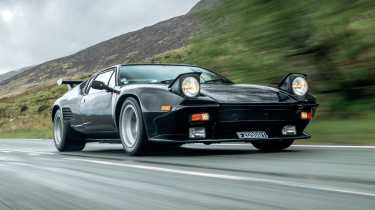
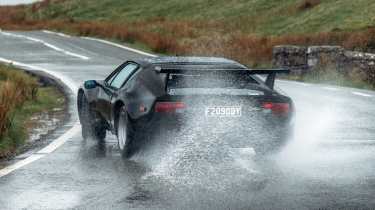
For sheer presence, the wide-arch GT5 is hard to beat. It is a sensational-looking machine, made all the more gobsmacking by the vast, deep-dish 15x10in front and 15x13in rear Campagnolo alloys wrapped with 285/40 VR15 and 345/35 VR15 tyres, the rears being the same size as those fitted to the Lamborghini Countach QV. If anything, the Pantera looks even more extreme, thanks to the sheer amount of tread visible when following the car.

With its ruched leather and glossy panels of wood veneer, the cockpit is unexpectedly reminiscent of a Maserati Biturbo’s, though this makes more sense when you realise Alejandro de Tomaso also owned Maserati at the time. The driving position is cramped, thanks to significant intrusion from the left-hand wheelarch, heavily offset pedals and an equally oddball steering wheel position. As a result, you have to sit slightly skewed in the seat with your left leg drawn back so your foot is almost out of the footwell, or stretched out and stuffed beneath the clutch pedal. Neither is ideal and I would imagine it’s nigh impossible to do either if you’re 6ft or more.
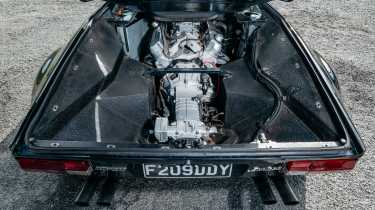
The engine is the heart of any supercar, but in this Pantera it is an all-pervading source of decibels and wonderment. Strange to tell, considering the Pantera’s early bond with Ford, these later cars didn’t benefit from US-supplied V8s because the legendary 351 (5.8-litre) Cleveland engines were no longer made in the US. For a while De Tomaso sourced them through Australia, where they were still made, but when they too dried up, the GT5‑S switched to the 351 Windsor V8.
The car tested here, a GT5-S from 1984, is running a Windsor. Good for 320bhp according to a recent dyno run, it sounds like a phalanx of Japanese war drums at idle. People get sniffy about the Pantera’s reliance on what was effectively a crate engine, but I’d defy anyone to stand behind it and not break into a Jack Nicholson grin. It’s nothing short of an homage to internal combustion.
The engine is mated to a ZF five-speed gearbox. A supercar staple in the early days, it has a sweeter shift than a stationary practice run up and down the gears suggests. Once on the move, if you’re positive it slices through the chromed gate nicely, feeling better than a contemporary Lamborghini Countach’s or Lotus Esprit’s shifts but not as precise as a Ferrari’s.
The steering is lighter than you’d expect given the size of the front tyres, though all things are relative. It feels slightly slow off-centre but you get a good sense of building lateral load and the balance feels progressive and consistent. It can get a bit distracted on bumpy roads, the steering tugging in your hands in a manner not dissimilar to an F40’s, but as with the manic Ferrari wheel it calms considerably on smooth surfaces.
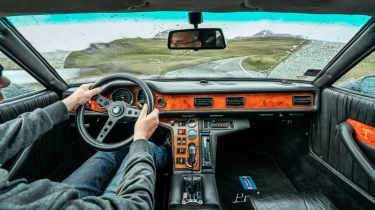
Damping-wise it has crisp control that contains itself in a short stroke of the damper. It gets its work done decisively, reacting and settling cleanly. While it can’t quite achieve the same levels of comfort as a Ferrari Testarossa it possesses better body control through high-speed compressions. You can drive it surprisingly hard. Not as you would a modern supercar, but with a more attacking style than you would the aforementioned Ferrari, Lotus and Lambo too.
Considering there’s a colossal four-barrel Holley carburettor pushed right up against the bulkhead window, the Pantera can be uncannily hushed at cruising speeds. Yes, there’s road and wind noise, but the big V8 somehow melts into the background on small throttle openings. Of course, when you nail it there’s the most fabulous sound to enjoy: a rich, rising bellow punctuated by a filthy, phlegmy crackle as you snap the throttle shut during upshifts. The soundtrack wouldn’t be out of place in a Le Mans GT40 and from an ownership point of view, there must be something reassuring about knowing you’re not facing crippling bills if the engine needs major work.
Values and buying guide
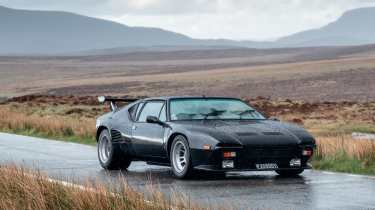
If this makes it the poor man’s Lambo, then so be it. The driving experience is more than rich enough and certainly for the price, which even at highs of £250,000, is less than you'll pay for any Countach now. Panteras in need of serious work are still around for under £100,000 but make no mistake, this car's place in the vintage supercar pantheon is elevating prices accordingly.
You'll want one that's in fine fettle, though. Being a steel unibody construction, Panteras were known to be susceptible to rust, both in terms of their exterior bodywork and the chassis. Check the rockers and sills, inside the wheel wells and the structure. Check every bodywork edge too, from the engine lid, to the panels around the glasshouse. With values going the way they are though, finding a Pantera in less than ideal condition is a rarer and rarer thing.
With thanks to Steve Gilbey Classics and David Smith
Specifications
| Engine | V8, 5763cc and 5752cc |
|---|---|
| Power | 320-350bhp @ 5400rpm (GT5) |
| Torque | 333-380lb ft @ 3400rpm |
| Weight | 1450kg (GT5-S) (224bhp/ton) |
| 0-60mph | 5.1-5.4sec |
| Top speed | 165mph-174mph |
| Price new | £45,000 new (1985) (£143,500 in today's money) |
| Value now |